OTHER SPORTS
OTHER SPORTS

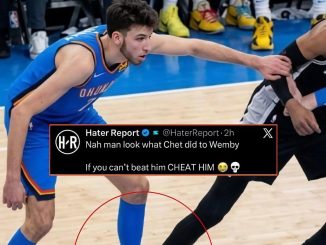
Chet Holmgren STOPS Victor Wembanyama IN THEIR TRACKS AFTER FOOT-ON-FOOT DEFENSE ON OFFENSIVE REBOUND ATTEMPT 😭🛑 What unfolded in a packed NBA showdown felt less like a routine regular-season sequence and more like a collision point between two of the most unique defensive and offensive forces the league has seen in years. When Chet Holmgren met Victor Wembanyama under the rim during a critical offensive rebound attempt, the moment instantly froze the arena. Not because of a foul call or a highlight dunk, but because of the sheer physical improbability of what just happened—two seven-foot-plus unicorns entangled in a battle of balance, timing, and defensive precision that ended with Holmgren standing his ground and stopping Wembanyama in his tracks. The play came late in a tightly contested matchup, with both teams trading defensive stops and transition bursts that had already shifted momentum multiple times. The ball went up off a contested jumper, bouncing high off the front rim and drifting toward the left side of the basket. Wembanyama, using his famously long strides and uncanny timing, rotated into position like he had the rebound pre-calculated. It looked like a routine second-chance opportunity for a player who has turned contested boards into personal property all season long. But Holmgren read it differently. What made the moment remarkable wasn’t just the outcome, but the anticipation. Holmgren didn’t react late—he arrived early. Sliding into the lane from the weak side, he positioned his frame between Wembanyama and the rim with a level of timing that suggested film-room preparation had met elite instincts. As the ball dropped, both players elevated almost simultaneously, but Holmgren’s vertical discipline and hand placement told the real story before the collision even fully developed. Instead of chasing the ball blindly, Holmgren focused on Wembanyama’s body positioning. He anticipated the French star’s extension angle, stepping into the rebound lane just enough to disrupt Wembanyama’s landing space without overcommitting into a foul. The result was a rare, almost surreal moment: Wembanyama’s momentum met a perfectly timed defensive wall. The contact was not violent, but it was definitive. Foot met foot in a split-second entanglement as both players landed awkwardly while fighting for vertical control. The ball ricocheted loose, deflected off fingertips and fell harmlessly toward the perimeter, where guards scrambled to recover it. The whistle stayed silent, but the message was loud—this was not going to be an easy night for either frontcourt star. On the broadcast, the reaction was immediate. Analysts paused mid-sentence. Replay angles showed Holmgren’s subtle foot placement, the micro-adjustment that made all the difference between a highlight putback and a disrupted possession. In slow motion, it became clear that this was not a lucky stop—it was structured defensive execution at its highest level. For Holmgren, nights like this are becoming a pattern rather than a surprise. The Thunder big man has quietly built a reputation as one of the league’s most disciplined rim protectors, combining elite timing with a wingspan that allows him to contest shots without overextending. Against Wembanyama, however, the challenge is different. Most bigs he faces are either outmatched in length or speed. Wembanyama is neither. He is, in many ways, the rare player who can match Holmgren’s defensive language sentence for sentence. That’s what made this particular sequence so compelling. It wasn’t a highlight block from behind or a chase-down recovery. It was a front-row, chest-to-chest, vertical chess match that ended in a stalemate—but one that Holmgren slightly tilted in his favor. Wembanyama, for his part, didn’t look rattled. Instead, he immediately reset, jogging back on defense with the kind of calm demeanor that has become his trademark. But even for a player known for emotional control, there was a brief moment where the surprise was visible. He had anticipated contact, but not that level of precision in timing. It was the kind of defensive possession that forces even elite scorers to recalibrate. The Spurs’ coaching staff later emphasized that the possession itself was not the issue. It was the principle behind it—how quickly Oklahoma City rotated, how efficiently Holmgren closed space, and how little margin was left for Wembanyama to operate. In modern NBA analytics, possessions like this don’t always show up as block shots or steals, but they are often graded as “denied opportunities,” a category that quietly swings playoff-level games. What makes Holmgren versus Wembanyama such a fascinating matchup is not just size versus size, but philosophy versus philosophy. Holmgren plays like a guard trapped in a center’s body—lean, reactive, and spatially aware. Wembanyama plays like a forward who was engineered in a lab to stretch every defensive concept to its breaking point. When they collide, it is not brute force that decides outcomes, but geometry. On this possession, geometry favored Holmgren. He narrowed the angle of approach just enough to force Wembanyama into a narrower landing corridor, reducing the French star’s ability to fully extend toward the rebound. That split-second constraint changed everything. Instead of a clean putback attempt, Wembanyama was forced into a contested reach, and from there the possession unraveled. Coaches often talk about “eliminating air space” as a defensive principle. Holmgren executed it without fouling, without overcommitting, and without losing balance—three factors that are notoriously difficult to combine against a player with Wembanyama’s wingspan. The aftermath of the play saw both teams pushing the tempo in opposite directions, but the psychological residue lingered. Oklahoma City’s bench reacted with visible energy, recognizing the significance of a stop that didn’t just end a possession but challenged a superstar’s rhythm. On the Spurs’ side, there was a recalibration, a reminder that even high-percentage interior looks must be earned every inch of the way. The broader context of the matchup added even more weight. These two players are not just rising stars; they are structural pillars of their respective franchises. Every meeting between them feels like a preview of postseason basketball, where one possession can dictate momentum swings that define entire series. And while the league is full of talented big men, few matchups carry the same “mirror image” quality as Holmgren versus Wembanyama. Both are tall, both are mobile, both protect the rim at elite levels, and both can initiate offense in transition. Yet their defensive instincts differ in subtle but important ways. Holmgren thrives on anticipation and body positioning. Wembanyama relies on reach and reactive recovery. When those approaches intersect, the margins become razor thin. This particular play highlighted that difference. Holmgren did not out-jump Wembanyama in a traditional sense. He out-positioned him. He didn’t overpower him. He pre-empted him. And in modern basketball, where spacing and timing often matter more than raw strength, that distinction is everything. As the game progressed, both players continued to impact the contest in different ways. Wembanyama responded with stretches of offensive dominance, using perimeter shooting and face-up drives to stretch the Thunder defense. Holmgren countered with rim protection, switching onto perimeter players and deterring drives without needing to record traditional stats. But the highlight sequence remained the defining moment. It is rare for a single rebound attempt to become the talking point in a game filled with elite talent, yet that is exactly what happened. Coaches dissected it. Analysts replayed it. Fans circulated it endlessly on social media, debating whether it represented defensive brilliance or a rare offensive miscalculation. The truth, as always in matchups of this caliber, sits somewhere in between. Wembanyama did not make a mistake so much as he encountered a defensive countermeasure perfectly designed for his skill set. Holmgren did not dominate the possession so much as he executed a near-flawless defensive read at exactly the right moment. It was less about failure and more about collision—two elite players arriving at the same point in space with incompatible intentions. As the NBA continues to evolve into a league defined by positionless basketball and unprecedented length, moments like this will likely become more common. But that does not make them less significant. If anything, they become more valuable as indicators of how the next era of competition will be defined—not by who is bigger, but by who processes faster in the smallest windows of time. For Holmgren and Wembanyama, this was just one possession in a long career arc that will likely include many more meetings, many more adjustments, and many more battles that feel like chess matches played above the rim. But for one brief moment, in one tightly contested rebound attempt, the game stopped being about projections and potential and became about execution under pressure. And in that moment, Holmgren stood his ground.

  What unfolded in a packed NBA showdown felt less like a routine regular-season sequence and more like a collision point between two of the most unique defensive and offensive forces the league has seen […]