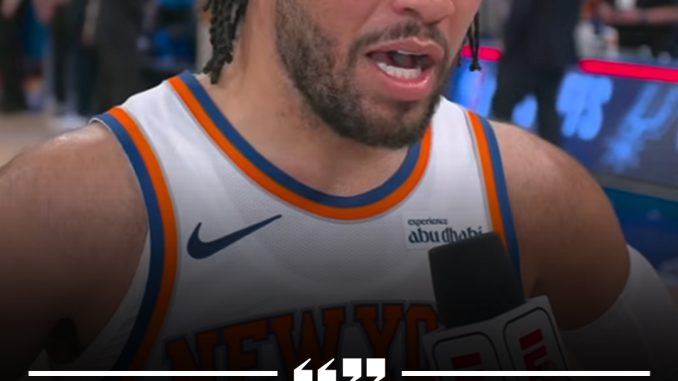
The debate over greatness in New York basketball has never been a quiet one. From the bruising Patrick Ewing era that defined an entire generation of Knicks basketball to the modern resurgence led by Jalen Brunson, every era in Madison Square Garden carries its own mythology, its own expectations, and its own weight of scrutiny. But few takes in recent memory have ignited conversation quite like Jeff Teague’s blunt assessment of the Knicks’ current floor general, a statement that placed Jalen Brunson not just among the best guards in franchise history, but above the legendary standard set by Patrick Ewing in terms of overall franchise impact and offensive control.
Teague, a former NBA All-Star and veteran point guard who spent years battling elite backcourt talent, didn’t hesitate when asked where Brunson stands in the Knicks’ historical hierarchy. His answer cut through nostalgia and sentimentality. In his view, Brunson has already reached a level of influence and consistency that New York has “never seen before,” a bold declaration considering the weight of Ewing’s legacy as the cornerstone of Knicks basketball throughout the 1980s and 1990s.
For a franchise defined by iconic big men, physical defense, and grinding playoff battles, the idea that a 6-foot-2 guard has reshaped the standard of excellence is both revolutionary and controversial. Yet it is precisely Brunson’s style—compact, calculated, relentlessly efficient, and mentally unshakable—that has forced analysts like Teague to rethink what franchise dominance looks like in the modern NBA.
Brunson’s rise in New York has been nothing short of transformative. When he arrived, the Knicks were still searching for identity, stability, and a reliable closer who could withstand the pressure of the Garden lights. Since then, he has evolved into one of the most dependable offensive engines in the league, capable of controlling tempo, manipulating defenses in isolation, and delivering in late-game situations with a calm that has become his trademark.
What makes Teague’s comparison so striking is not simply the statistical output Brunson has produced, but the emotional and cultural shift he has triggered within New York Knicks basketball. Ewing’s legacy was built on physical dominance, defensive intimidation, and carrying teams deep into the playoffs during an era defined by bruising half-court basketball. Brunson’s impact, however, has been more surgical than physical, more cerebral than brute force. He has turned the Knicks into a perimeter-driven, execution-heavy offense that thrives on precision rather than power.
Teague’s argument centers on that transformation. In his eyes, Brunson has not only elevated the Knicks’ ceiling but redefined how the franchise wins games in the modern era. Where past Knicks teams often relied on defensive grit and interior scoring, Brunson has introduced a new era of guard-led control, where every possession runs through his decision-making and scoring versatility.
Statistically, Brunson’s production has backed up the praise. He has consistently ranked among the league leaders in clutch scoring, isolation efficiency, and fourth-quarter production. His ability to operate in tight spaces, draw contact, and finish through physical defenders has made him one of the most reliable late-game options in the NBA. But beyond numbers, it is his composure that has drawn comparisons—and in Teague’s case, outright elevation above Knicks legends.
Ewing’s era, while iconic, was defined by playoff heartbreaks as much as dominance. The Knicks of the 1990s were perennial contenders, yet often fell short against dynasties built around Michael Jordan’s Bulls or Reggie Miller’s Pacers. Brunson’s supporters argue that while Ewing carried the weight of expectation in a more physically demanding era, he did not achieve the same level of consistent postseason breakthrough that modern stars are now judged by.
Teague’s perspective challenges traditional narratives. Instead of measuring greatness purely by legacy, championships, or era dominance, he emphasizes impact per possession, leadership under pressure, and offensive reliability in the most difficult moments. By that metric, Brunson’s résumé in New York becomes historically significant.
What also cannot be ignored is the psychological dimension Brunson brings to the court. Teammates repeatedly describe him as unflappable, a player who does not drift emotionally regardless of scoreline or opponent momentum. That stability has become the foundation of New York’s resurgence. In high-pressure environments like Madison Square Garden, where expectations often overwhelm developing stars, Brunson has thrived instead of shrinking.
Opposing coaches have noted that defensive schemes designed specifically to slow him down often fail because of his adaptability. Trap him, and he passes out with precision. Play him straight up, and he dictates tempo at his own pace. Switch smaller defenders onto him, and he punishes them in the post. Switch bigger defenders, and he isolates them on the perimeter. This versatility has made him not just a scoring threat, but an offensive system unto himself.
The comparison to Ewing, however, remains complex and emotionally charged. Ewing’s impact on New York basketball culture extends far beyond statistics. He was the face of an era where toughness defined identity, where every game against rivals like the Chicago Bulls or Indiana Pacers felt like a war of attrition. His defensive presence anchored the Knicks’ identity, and his loyalty to the franchise made him a symbol of New York sports perseverance.
Yet Teague’s argument does not attempt to erase that legacy. Instead, it reframes how greatness is evaluated across eras. In today’s NBA, where spacing, pace, and perimeter creation define success, Brunson’s ability to dominate the most critical parts of modern basketball carries immense weight. The game has changed, and with it, so have the criteria for evaluating impact.
Inside league circles, Brunson’s rise has become a case study in player development and system fit. His success in New York is often attributed not only to his individual talent but to his synergy with coaching schemes that maximize his strengths. Unlike many franchise stars who are asked to adapt to systems, Brunson appears to have become the system itself.
Teague’s remarks also reflect a broader shift in how former players analyze the modern game. Many guards from previous eras recognize the increased responsibility placed on today’s primary ball-handlers. The offensive burden Brunson carries each night—initiating sets, closing games, and serving as the primary scoring option—would have been unthinkable in more balanced offensive structures of the past.
Still, not everyone agrees with Teague’s bold stance. Critics argue that comparing Brunson to Ewing ignores positional differences, era context, and the defensive foundation that defined Knicks basketball for decades. Ewing was not just a scorer; he was a defensive anchor who altered shots, controlled the paint, and shaped game plans simply by being on the floor.
But even those who disagree with Teague’s conclusion acknowledge the undeniable truth: Brunson has changed the trajectory of the franchise. The Knicks are no longer a team searching for identity. They are a structured, confident contender with a clear offensive leader who thrives under pressure.
What makes this moment particularly significant is that Brunson’s story is still being written. Unlike Ewing’s completed legacy, Brunson is in the prime of his career, with years ahead to further define his place in Knicks history. Each playoff run, each clutch performance, and each leadership moment adds another layer to a legacy that is rapidly expanding.
Inside the locker room, the belief is different from the outside noise. Players speak less about comparisons and more about trust. They trust Brunson with the final shot, the final possession, and the final word when games tighten. That trust, built over consistent execution, is what has elevated him into franchise-defining territory.
For Teague, that is the ultimate measure. Not nostalgia, not reputation, but reliability when everything is on the line. In that regard, he believes Brunson has already surpassed what any Knicks player has done before him.
Whether that claim holds up over time will depend on how Brunson’s career unfolds, particularly in the postseason. Championships remain the final currency of greatness in New York, a city where banners define legacy. But even without them, Brunson has already reshaped the narrative of what Knicks basketball looks like in the modern NBA.
And in the eyes of Jeff Teague, that alone places him in a category no one in franchise history has ever occupied.
Be the first to comment