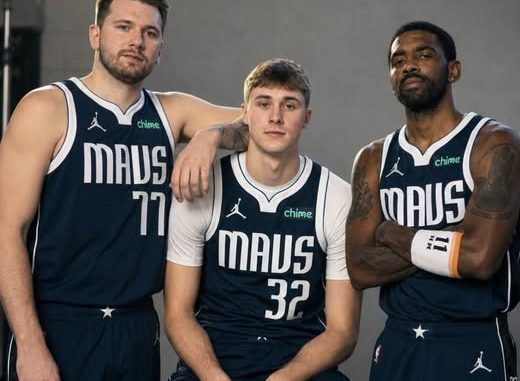
In the ever-evolving landscape of the NBA, where roster construction is as much about imagination as it is about cap sheets and collective bargaining realities, a new wave of speculation has taken over Dallas—and it’s not just about what the Mavericks are building today, but what they could become tomorrow. The idea of a “dream trio” featuring Luka Dončić, Kyrie Irving, and rising phenom Cooper Flagg has ignited conversations across league circles, front offices, and fanbases alike. And while the concept still lives in the realm of projection and possibility, its sheer offensive ceiling has already earned it one of the most electrifying theoretical tags in modern NBA discourse.
For the Dallas Mavericks, the pairing of Dončić and Irving already represents one of the most talented backcourts in the league when both are healthy and in rhythm. Dončić, a generational offensive engine capable of bending defenses with his pace, size, and elite playmaking, has consistently operated as a walking mismatch. Irving, on the other hand, remains one of the most skilled isolation scorers the league has ever seen, a guard whose footwork, handle, and creativity in tight spaces make him nearly impossible to contain one-on-one. Together, they form a partnership built on shot creation, late-game shotmaking, and a shared ability to thrive under pressure when possessions slow down and defenses tighten.
What has shifted the conversation from “dangerous duo” to “dream trio” is the hypothetical addition of Cooper Flagg, a two-way forward prospect whose rise has scouts and executives projecting him as one of the most complete young players to enter the league in years. Flagg’s blend of defensive versatility, rebounding instincts, transition scoring, and improving perimeter skill set makes him an archetype every contender covets: a high-impact wing who does not require high usage to change games. In theory, placing him alongside Dončić and Irving creates a rare balance of veteran elite creation and youthful two-way dynamism.
Offensively, the potential fit borders on overwhelming. Dončić already orchestrates one of the league’s most efficient half-court systems, manipulating defenders with methodical pacing, probing dribble sequences, and pinpoint passing reads that consistently generate high-quality looks. Irving complements that with the ability to break down set defenses in isolation, forcing rotations that collapse structure and open driving lanes or corner threes. Add Flagg into that ecosystem, and suddenly Dallas would possess a third layer of offensive pressure—one that punishes defenses not through isolation dominance, but through timely cuts, offensive rebounding, transition bursts, and secondary scoring opportunities.
The hypothetical spacing dynamic is particularly intriguing. Modern NBA offenses thrive on gravity, and Dončić and Irving already command double teams in crunch situations. Defenders are forced to choose between conceding pull-up threes, allowing downhill drives, or rotating into scramble situations that often end in breakdowns. Flagg’s presence would amplify those dilemmas. His ability to finish in transition and operate as a connective passer would punish late rotations, while his improving shooting mechanics would keep defenders honest enough to prevent them from sagging off him entirely. In a league where marginal spacing advantages often decide playoff series, that trio would theoretically stretch defensive coverages to their breaking point.
Yet the fascination with this trio is not limited to offense. It is the contrast between offensive firepower and defensive projection that makes the conversation even more compelling. Dončić and Irving, while elite offensively, have long faced scrutiny regarding defensive consistency. Flagg, however, is widely viewed as a potential defensive anchor on the wing—someone capable of guarding multiple positions, rotating in help schemes, and providing the kind of defensive energy that allows stars to conserve effort on the perimeter. In this imagined construction, Flagg would not just be an add-on scorer; he would be the stabilizer, the glue that balances the roster’s structural extremes.
From a coaching perspective, the strategic possibilities are nearly endless. Lineups featuring Dončić as a primary initiator, Irving as a secondary creator or off-ball scoring threat, and Flagg as a roaming connective forward would allow for constant variation in offensive reads. One possession could feature Dončić operating in a high pick-and-roll with Flagg as the screener and short-roll decision-maker. The next could see Irving isolating on the wing while Dončić spaces into a weak-side facilitator role, drawing attention even without the ball. Flagg’s versatility would allow him to toggle between roles seamlessly—finishing plays, initiating transition offense after rebounds, or collapsing defenses with cuts.
The psychological impact on opposing defenses might be just as significant as the tactical one. Teams game-planning for Dončić and Irving already face a taxing challenge: pick your poison between two of the most skilled perimeter scorers in basketball. Introducing a third dynamic threat reduces the margin for error to almost zero. Defensive schemes would be forced into constant rotation, communication breakdowns would become more likely, and fatigue would accumulate over the course of a series. In playoff basketball, where adjustments are incremental and possessions are magnified, that kind of pressure can be decisive.
Of course, the NBA is not built on hypothetical talent alone. The reality of constructing such a trio would involve significant roster engineering, financial constraints, and developmental timing. Dončić and Irving already occupy massive portions of offensive responsibility and salary structure. Adding a high-impact young star like Flagg would require not just opportunity but organizational alignment, draft fortune, and long-term planning. Even then, integrating three high-usage talents into a cohesive system is never guaranteed. History has shown that star accumulation does not automatically translate to championship chemistry.
Still, the Mavericks have never been a franchise shy about pursuing bold visions. From the Dirk Nowitzki era to the current Dončić-led core, Dallas has consistently operated with the ambition of building around elite offensive talent. The idea of evolving into a multi-era offensive powerhouse—blending Dončić’s generational playmaking, Irving’s surgical scoring, and Flagg’s emerging two-way versatility—fits squarely within that organizational identity. It represents not just a roster idea, but a philosophical extension of what Dallas basketball has long prioritized: skill, creativity, and offensive brilliance.
Around the league, executives would likely view such a trio with a mixture of intrigue and skepticism. On one hand, the talent concentration would be undeniable, potentially rivaling some of the most offensively gifted lineups in modern NBA history. On the other hand, questions would arise about ball dominance, defensive sustainability in high-leverage playoff moments, and whether three star-level players with overlapping offensive instincts could truly maximize each other’s strengths without diminishing individual rhythm.
For fans, however, the appeal is far more immediate and visceral. The idea of Dončić dissecting defenses with his trademark patience, Irving dazzling with acrobatic finishes and impossible shot-making, and Flagg soaring through transition lanes or locking down opposing wings creates a vision of basketball that is both explosive and unpredictable. It is the kind of trio that could turn regular-season games into highlight reels and playoff series into offensive showcases.
What makes this speculation particularly compelling is the timeline convergence. Dončić is in his prime, operating as one of the league’s most dominant forces. Irving remains a high-level scorer capable of shifting playoff outcomes when healthy and engaged. Flagg represents the future, a projection of what the next generation of NBA wings could look like. The intersection of those timelines creates a rare narrative opportunity: a franchise attempting to bridge present contention with future dominance in a single competitive window.
Whether or not this dream trio ever materializes in reality, its conceptual existence already speaks to the evolving nature of NBA roster construction. Teams are no longer simply chasing two-star models or traditional big-three formations. Instead, the modern league increasingly rewards versatility, positional interchangeability, and layered offensive creation. In that context, the idea of Dončić, Irving, and Flagg sharing the floor is less about fantasy and more about the direction basketball continues to move toward.
For now, it remains a “what if” scenario—one that lives in trade machines, draft projections, and late-night fan debates. But in a league defined by constant movement, unexpected alliances, and rapid roster evolution, even the most speculative ideas can find pathways into reality. And if there is one certainty surrounding the Mavericks, it is that they will continue to orbit the center of the NBA’s most ambitious conversations.
If this trio ever does take shape, it would not just redefine Dallas basketball—it would challenge the league’s understanding of offensive ceiling altogether.
Be the first to comment