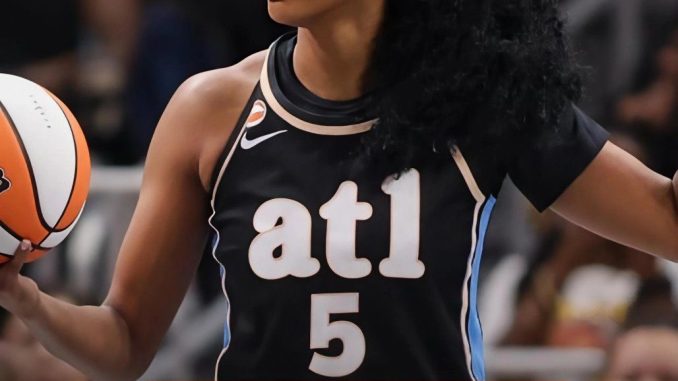
The conversation surrounding pay equity in professional basketball has once again surged to the forefront of sports discourse after a fiery exchange of public commentary involving Angel Reese and a viral response from NBA superstar Kevin Durant that amplified growing tensions over compensation in the WNBA. What began as a pointed critique from one of the league’s most recognizable young stars quickly evolved into a broader conversation about labor value, revenue distribution, and the long-standing structural differences between the WNBA and its male counterpart.
Reese’s remarks, which reignited debate around the WNBA’s pay scale, struck a chord across the basketball landscape. Her comments reflected a sentiment that has echoed throughout the league for years: that the league’s financial structure does not fully reflect the value, visibility, and cultural impact of its athletes. While the WNBA has made measurable progress in revenue growth, media exposure, and sponsorship expansion, player compensation remains a persistent flashpoint in discussions about fairness and sustainability.
At the center of the issue is a simple but powerful comparison that continues to dominate headlines. WNBA salaries, even at the top end of the scale, remain significantly lower than those in the NBA, despite increasing interest in women’s basketball and a new generation of stars driving unprecedented engagement. Reese, one of the most visible young faces in the sport, has not shied away from using her platform to highlight that disparity. Her remarks were widely interpreted as a call for continued pressure on league leadership and for a more aggressive push in upcoming collective bargaining discussions.
Reese’s rise in professional basketball has been closely watched since her transition from collegiate stardom to the WNBA spotlight. Known for her confidence, rebounding dominance, and unapologetic personality, she has quickly become one of the league’s most marketable figures. But with that visibility has also come scrutiny, particularly when she speaks on issues that extend beyond the court. In this case, however, her comments resonated with a wide segment of players and fans who view pay equity as a fundamental issue in the sport’s evolution.
Her argument centered on the idea that WNBA players are not only athletes but also cultural ambassadors who drive engagement, ticket sales, merchandise revenue, and global interest in the women’s game. The underlying question she raised was whether compensation structures adequately reflect that contribution. While she did not propose specific figures or policy changes, her tone was firm, suggesting that incremental improvements may no longer satisfy a generation of players who have grown up in a more commercially aware and socially vocal sports environment.
The situation escalated further when Durant entered the conversation through a widely circulated comment referencing union dynamics and player leverage. Known for his candid engagement on social media and willingness to weigh in on basketball discourse, Durant’s remarks were interpreted as supportive of labor empowerment and collective bargaining strength. He did not directly criticize the league, but his framing of the issue emphasized the importance of organized negotiation and solidarity among players—language that many interpreted as validation of Reese’s broader point.
Durant’s involvement added a new layer to the debate because of his stature as one of the most accomplished players in modern basketball. His perspective carries weight not only because of his on-court achievements but also because of his long-standing engagement in discussions about player autonomy, media narratives, and league economics. By introducing the concept of union leverage into a trending conversation, he effectively shifted the discussion from a single player’s complaint to a structural labor issue that spans both men’s and women’s professional basketball.
The reaction across social media was immediate and polarized. Supporters of Reese praised her for speaking openly about a topic that has historically been considered sensitive within professional sports circles. Many fans and analysts pointed out that visibility without equitable compensation remains a core tension in women’s professional sports. Others, however, pushed back, arguing that league revenue differences between the NBA and WNBA naturally lead to different salary structures, and that comparisons between the two leagues are not always straightforward.
Still, the conversation quickly expanded beyond basketball economics into broader questions of gender equity in sports. Advocates highlighted the rapid growth of women’s basketball viewership in recent years, particularly during college tournaments and high-profile WNBA matchups. They argue that the league is at a pivotal moment where increased media rights deals and sponsorship opportunities could eventually reshape salary expectations, especially if growth trends continue.
The role of the WNBA Players Association also came under renewed focus. As the official labor body representing players, the union is expected to play a central role in upcoming negotiations over salary structures, revenue sharing, and player benefits. Historically, WNBA collective bargaining agreements have produced incremental gains, including improved travel conditions, increased salaries, and enhanced maternity benefits. However, players like Reese represent a newer generation that may be pushing for more aggressive reform rather than gradual adjustment.
Economically, the WNBA operates within a significantly different revenue ecosystem compared to the NBA. While the league has experienced notable growth in attendance, sponsorships, and broadcast deals, it still operates at a smaller financial scale. This gap is frequently cited by league officials when explaining salary structures. However, critics argue that investment disparities, marketing differences, and historical underfunding have also contributed to the current gap, making it more complex than simple revenue comparison.
One of the key points emerging from the renewed debate is the importance of understanding how revenue sharing models function in professional sports. In most major leagues, player salaries are tied to a percentage of basketball-related income. As the WNBA continues to expand its media footprint, the central question becomes whether that growth will translate proportionally into player compensation. Reese’s comments suggest that many players are increasingly attentive to that equation.
Durant’s union-focused response also highlighted a recurring theme in professional sports: collective bargaining power as a driver of economic change. His reference to union dynamics underscored the reality that most major salary shifts in sports history have come not from individual advocacy alone, but from organized negotiations that leverage collective player influence. That perspective aligns closely with how the NBA itself evolved over decades, gradually increasing player revenue share through successive labor agreements.
Beyond the economics, the cultural dimension of this debate cannot be overlooked. Reese represents a new era of athletes who are not only comfortable engaging in off-court conversations but are also expected to do so by their fan base. Social media has amplified athlete voices, allowing players to directly influence public discourse in ways that were not possible in previous generations. As a result, statements about pay equity now travel instantly and generate immediate national attention.
Endorsement opportunities also complicate the narrative. Many WNBA stars, including Reese, supplement their league salaries with significant off-court income through sponsorships and brand partnerships. Critics of pay disparity arguments often point to this as evidence that total compensation for elite women’s players can rival or exceed expectations. However, supporters counter that endorsement income is not guaranteed, varies widely by marketability, and should not be used as a substitute for fair league wages.
From a league perspective, maintaining balance between financial sustainability and competitive compensation remains a delicate task. The WNBA has invested heavily in expansion strategies, youth development, and international branding efforts. Yet every public debate over pay structure brings renewed pressure to accelerate those efforts. The league has consistently maintained that it is committed to improving player conditions, but it must do so within the constraints of its revenue model.
What makes this latest exchange particularly significant is the convergence of influence. Reese represents the emerging voice of the next generation of WNBA stars, while Durant symbolizes the established elite of the NBA weighing in on structural labor issues. Together, their comments have created a cross-league dialogue that extends beyond women’s basketball and into the broader economics of professional sports.
As the league approaches future labor negotiations, the intensity of public discourse is likely to increase. Players are more vocal, fans are more engaged, and media coverage is more expansive than at any previous point in WNBA history. That combination ensures that pay equity will remain a central storyline both on and off the court.
For now, the debate sparked by Reese and amplified by Durant shows no sign of slowing. Instead, it has evolved into a broader reflection of where women’s professional basketball stands today—and where its players believe it should go. Whether that momentum translates into structural change will depend on negotiations, revenue growth, and continued collective pressure from players determined to reshape the economic future of the sport.
Be the first to comment