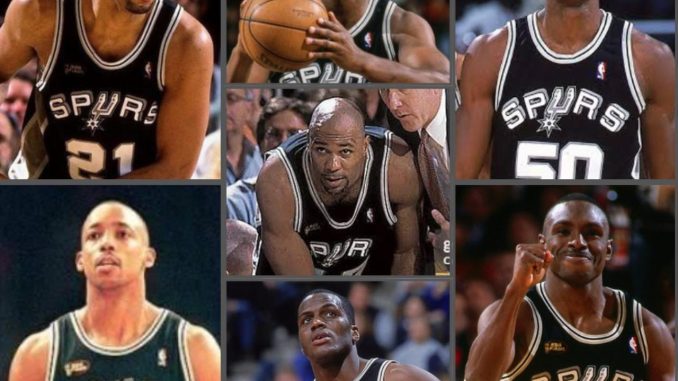
The 1998-99 NBA season was unlike anything the league had ever experienced. A bitter labor dispute between owners and players forced a lockout that wiped out nearly half the schedule, delayed opening night until February, and cast uncertainty over the future of professional basketball. Fans were frustrated, arenas were quiet, and the league was desperate for a new story after the retirement of Michael Jordan and the breakup of the dynasty Chicago Bulls that had defined the decade. Into that void stepped a franchise built not on glamour or chaos, but on discipline, defense, and two towering superstars who overwhelmed the league from the paint outward.
The San Antonio Spurs entered the shortened 50-game season with unfinished business. Two years earlier, the organization had endured a disastrous campaign after injuries sidelined franchise cornerstone David Robinson for most of the year. That difficult season, however, positioned San Antonio to select Tim Duncan with the No. 1 overall pick in the 1997 NBA Draft, a move that would alter the course of league history forever.
By Duncan’s rookie season, the Spurs were already dangerous. They won 56 games in 1997-98 and immediately became a championship contender. Yet their postseason run ended in disappointment against the eventual Western Conference champion Utah Jazz. Questions remained about whether Duncan and Robinson could coexist at the highest level, whether the Spurs had enough offensive firepower in crunch time, and whether head coach Gregg Popovich could guide a championship team after taking over midseason just a year earlier.
Those doubts vanished during the lockout season.
From the opening tip of the 1998-99 campaign, San Antonio looked like a team on a mission. The Spurs finished with a league-best 37-13 record, dominating opponents with suffocating defense and remarkable consistency during a compressed schedule that exhausted teams physically and mentally. While other contenders struggled to establish rhythm after the long layoff, the Spurs thrived in structure and execution. Their identity was clear every night: control the paint, rebound relentlessly, defend every possession, and trust their Twin Towers to carry them through pressure moments.
Duncan was the centerpiece of everything. In just his second NBA season, he elevated himself from promising young star to full-fledged superstar. Night after night, Duncan punished defenders with textbook footwork, soft touch around the rim, and a calm demeanor that never changed regardless of circumstance. He averaged 21.7 points, 11.4 rebounds, and 2.5 blocks per game during the regular season while anchoring the league’s top defense alongside Robinson.
Robinson, meanwhile, embraced a role that perfectly complemented the younger star. Already an MVP and Defensive Player of the Year earlier in his career, Robinson no longer needed to dominate the offense every possession. Instead, he became the ultimate defensive weapon and veteran leader. His mobility, rim protection, and willingness to sacrifice individual numbers for team success transformed San Antonio into a nightmare matchup for every opponent.
Together, they formed one of the greatest frontcourts in basketball history.
The “Twin Towers” nickname became more than a catchy label. It represented a system opponents simply could not solve. Duncan controlled the low block with surgical precision, while Robinson erased mistakes defensively and sprinted the floor like a forward despite standing seven feet tall. Teams could not attack the rim because one elite shot blocker always waited nearby. Double-teaming either star opened opportunities for San Antonio’s shooters and role players, while trying to defend them one-on-one usually ended in foul trouble or easy baskets.
What made the Spurs especially dangerous was how perfectly the roster fit around its stars. Veteran point guard Avery Johnson directed the offense with poise and leadership. Sean Elliott provided perimeter scoring and toughness, while sharpshooter Steve Kerr stretched defenses from beyond the arc. Role players such as Mario Elie, Jerome Kersey, and Malik Rose supplied grit, defense, and championship experience.
Everything revolved around Popovich’s philosophy. Long before “Spurs culture” became synonymous with sustained excellence, the foundation was being laid during that lockout season. Popovich demanded accountability, ball movement, and defensive intensity on every possession. He preached sacrifice and team-first basketball in an era increasingly driven by isolation scorers and superstar marketing. The Spurs rarely beat themselves. They executed fundamentals at an elite level, avoided distractions, and consistently imposed their style on opponents.
In many ways, San Antonio’s rise symbolized a shift in the NBA landscape. The flashy, celebrity-driven dominance of the Bulls gave way to a quieter but equally effective dynasty built on professionalism and precision. Duncan was the antithesis of the larger-than-life superstar image that dominated the 1990s. He avoided controversy, shunned attention, and simply overwhelmed teams with efficiency and consistency. Robinson’s humility and leadership reinforced that identity.
By the postseason, the Spurs were fully locked in.
San Antonio opened the playoffs against the Minnesota Timberwolves and quickly established control. Duncan and Robinson dominated the interior, exposing Minnesota’s lack of size and playoff experience. The Spurs advanced in four games, signaling that they were operating at a different level from most of the conference.
The next challenge came against the Los Angeles Lakers, a star-studded team featuring young superstars Shaquille O’Neal and Kobe Bryant. Many expected the series to become a defining battle between generations of dominant big men. Instead, the Spurs dismantled Los Angeles with shocking authority.
San Antonio swept the Lakers 4-0 in the Western Conference Semifinals, stunning basketball observers around the league. Duncan outplayed everyone on the floor, Robinson neutralized O’Neal defensively as effectively as anyone could at the time, and the Spurs’ disciplined execution exposed the Lakers’ inconsistency. The sweep sent a powerful message: this was no ordinary contender. San Antonio was built for a championship.
The Western Conference Finals against the Portland Trail Blazers provided a tougher test. Portland possessed depth, athleticism, and defensive versatility, pushing the Spurs into physical, grinding battles. Yet San Antonio’s composure never cracked. Duncan delivered dominant performances throughout the series, while Elliott famously hit one of the most iconic shots in franchise history in Game 2 — a dramatic corner three while falling out of bounds that became forever known as the “Memorial Day Miracle.”
That shot changed the entire trajectory of the series.
The Spurs eventually defeated Portland in four games, completing an undefeated run through the Western Conference playoffs and moving one step closer to the franchise’s first NBA championship. The Finals matchup against the New York Knicks carried major intrigue. New York had become the first No. 8 seed in NBA history to reach the Finals, fueled by the toughness of Latrell Sprewell, Allan Houston, and Marcus Camby.
But the Knicks entered the series battered and undermanned after losing star center Patrick Ewing to injury during the Eastern Conference Finals. Without Ewing’s presence in the middle, New York simply had no answer for Duncan and Robinson inside.
The Spurs controlled the Finals from the outset.
Duncan was magnificent throughout the series, averaging 27.4 points and 14 rebounds while consistently punishing the Knicks in the paint. Whether it was turnaround jumpers, offensive rebounds, or defensive stops, Duncan dictated the series on both ends of the floor. Robinson provided elite defense and veteran composure, while the supporting cast delivered timely contributions in crucial moments.
Still, the Knicks fought relentlessly. Sprewell’s explosiveness and Houston’s shot-making extended the series to five games and prevented a sweep. Madison Square Garden crackled with energy as New York attempted to pull off one more miracle run. Yet every time momentum seemed to shift, San Antonio responded with poise and execution.
Game 5 at Madison Square Garden became the defining moment in Spurs history.
With the championship within reach, San Antonio leaned on its identity. Duncan controlled the interior, Robinson anchored the defense, and Johnson — the undersized veteran point guard whose career had nearly ended years earlier — delivered the biggest shot of his life. In the final minute, Johnson knocked down a floating jumper over New York’s defense to seal a 78-77 victory and secure the franchise’s first NBA championship.
As the clock expired, years of frustration disappeared instantly for the Spurs organization. Robinson, who had endured devastating playoff losses throughout the 1990s despite individual greatness, finally captured the elusive title that completed his Hall of Fame résumé. Duncan won Finals MVP in only his second NBA season, cementing himself as the league’s next dominant superstar. Popovich secured the first championship of what would become one of the greatest coaching careers in sports history.
The significance of that title extended far beyond one season.
San Antonio’s championship validated an organizational philosophy that prioritized patience, culture, and teamwork over glamour. The Spurs proved that defense and discipline could still dominate in a rapidly evolving NBA. They also established the blueprint for a dynasty that would remain relevant for nearly two decades.
The 1999 title was merely the beginning.
Over the next several years, Duncan and Popovich transformed the Spurs into the gold standard of consistency. Additional championships followed in 2003, 2005, 2007, and 2014, while San Antonio became synonymous with professionalism and sustained excellence. Yet none of those later triumphs happen without the breakthrough of 1999, when the Twin Towers first conquered the league together.
Critics sometimes attempted to diminish the championship because it occurred during a shortened season. Opponents argued the 50-game schedule made the title less meaningful. But inside NBA circles, players and coaches understood the truth. The lockout season was arguably more difficult in many respects. The compressed schedule created constant fatigue, back-to-back games piled up relentlessly, and teams had little practice time to build chemistry. Surviving that environment required mental toughness, adaptability, and extraordinary discipline — all qualities the Spurs possessed in abundance.
San Antonio finished the playoffs with a dominant 15-2 record, one of the greatest postseason runs in league history at the time. They overwhelmed elite opponents, controlled games defensively, and consistently executed under pressure. There was nothing fluky about their championship.
The image of Duncan and Robinson standing side by side with the Larry O’Brien Trophy remains one of basketball’s defining moments from the late 1990s. One was a young superstar ascending toward greatness; the other was a respected veteran finally receiving the championship validation he deserved. Together, they formed the foundation of a dynasty and changed the trajectory of an entire franchise.
In the aftermath of Jordan’s retirement, the NBA needed a new identity. While many searched for the next flashy superstar or entertainment phenomenon, the Spurs quietly built a powerhouse rooted in fundamentals and trust. Their dominance during the lockout season reminded the basketball world that championships are not always won by the loudest team or the most marketable stars. Sometimes they are won by the smartest, toughest, and most disciplined group in the league.
That was the story of the 1998-99 Spurs.
The Twin Towers took over the NBA, silenced every doubt, and delivered San Antonio its first championship banner — the beginning of one of basketball’s greatest dynasties.
Be the first to comment