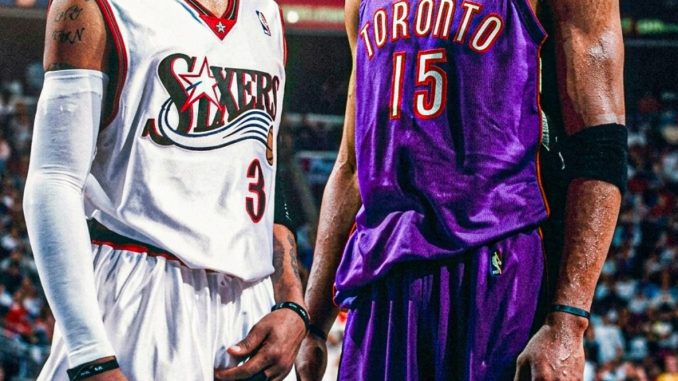
Twenty-five years later, the echoes of that unforgettable spring night in Philadelphia still reverberate through NBA history. Before social media clips dominated timelines, before every playoff performance was instantly immortalized online, two transcendent superstars delivered a basketball masterpiece so electrifying that it still stands as the gold standard for individual playoff duels. The 2001 Eastern Conference Semifinals between Allen Iverson and Vince Carter was more than a series. It became mythology.
Game 7 on May 20, 2001, inside the deafening walls of the First Union Center, was the climax of an era when the NBA was desperately searching for its next defining rivalry in the aftermath of Michael Jordan’s second retirement. What emerged instead was a collision between two cultural icons at the peak of their powers, two players who represented different styles, different cities, and different visions of basketball greatness.
Iverson was chaos wrapped in courage — the undersized warrior who attacked giants without fear. Carter was elegance and elevation — the aerial genius whose athletic brilliance made every possession feel cinematic. Together, they authored a seven-game battle that remains unmatched in intensity, artistry, and star power.
The 2001 postseason arrived with enormous pressure surrounding both franchises. The Philadelphia 76ers were the East’s No. 1 seed behind Iverson’s MVP campaign, a season in which he led the league in scoring while carrying a bruising, defense-first roster. Head coach Larry Brown built the Sixers around toughness, grit, and relentless defensive pressure, but everyone understood the truth: Philadelphia’s championship hopes lived and died with Iverson.
Meanwhile, the Toronto Raptors were ascending behind Carter, whose popularity had exploded after his legendary performance in the 2000 Slam Dunk Contest and his unforgettable Olympic dunk over French center Frederic Weis. Carter wasn’t just Toronto’s superstar; he had become Canada’s basketball ambassador. The Raptors had never advanced beyond the first round before that season, but suddenly they had a legitimate superstar capable of challenging anyone in the league.
What followed across seven games was basketball theater at its absolute peak.
The duel officially detonated in Game 1 when Iverson erupted for 54 points in a scorching performance that instantly elevated the series into must-watch territory. Carter answered with brilliance of his own, refusing to back down from the relentless scoring barrage. Every possession felt personal. Every basket became a statement.
By Game 2, Carter fired back with 50 points of his own, silencing Philadelphia’s crowd while announcing that this would not be a one-man showcase. The exchange of haymakers transformed the matchup into something larger than basketball. Fans weren’t merely watching playoff games anymore; they were witnessing two supernovas colliding in real time.
Iverson played with a level of aggression that bordered on reckless abandon. He attacked the paint despite being barely six feet tall and weighing around 165 pounds. Toronto’s bigger defenders hit him repeatedly, yet he continued charging into traffic possession after possession. Blood, bruises, and exhaustion became part of his nightly routine.
Carter responded with breathtaking efficiency and calm. Where Iverson was fury, Carter was fluidity. His pull-up jumpers looked effortless. His dunks carried violence disguised as grace. He floated above defenders while making impossible shots seem routine. Every game became a referendum on style as much as substance.
The series also carried emotional complexity beyond basketball. Carter was balancing playoff pressure while attending his college graduation ceremony at the University of North Carolina before Game 7, a decision that became one of the most debated storylines in NBA history. Critics questioned whether the trip would distract him. Supporters applauded his commitment to education and personal fulfillment.
What nobody questioned was the magnitude of the moment awaiting him upon his return to Philadelphia.
Game 7 arrived carrying historic tension. The series was tied 3-3. The winner would advance to the Eastern Conference Finals. The loser would spend the summer haunted by what might have been.
Inside the arena, the atmosphere felt combustible long before tipoff. Philadelphia fans roared with desperation, sensing that their MVP needed one more superhuman performance. Toronto entered with confidence, believing Carter had already proven capable of conquering any stage.
And for 48 unforgettable minutes, the stars delivered exactly what the basketball world demanded.
Iverson attacked from the opening possession, weaving through defenders with impossible speed and body control. Every crossover ignited the crowd. Every jumper sent waves of noise crashing through the building. Toronto threw multiple defenders at him, trapping him relentlessly, but nothing slowed him down for long.
Carter answered possession after possession. He buried contested jumpers, attacked the rim, and carried Toronto offensively whenever the Raptors seemed in danger of losing control. Neither superstar blinked.
The game itself became a study in endurance and willpower. Players collapsed onto benches during stoppages, physically drained by the pace and emotional intensity. Every possession felt weighted with consequence. Defenses tightened. Bodies hit the floor. Momentum swung wildly from quarter to quarter.
Iverson ultimately finished with 21 points and 16 assists, a stat line that revealed the evolution of his greatness. Rather than forcing impossible shots all night, he trusted teammates like Dikembe Mutombo, Aaron McKie, and Tyrone Hill to deliver crucial baskets. It was leadership through sacrifice, proof that his brilliance extended beyond scoring titles and highlight reels.
Carter scored 20 points and nearly authored the defining moment of the entire series in the closing seconds.
With Philadelphia clinging to an 88-87 lead, Toronto had one final possession. Carter rose from the right wing for a jumper that seemed suspended in time. Millions watched breathlessly as the ball arced toward the basket.
The shot missed.
Philadelphia erupted.
Iverson sprinted across the court in celebration while Carter stood frozen in disbelief. One shot separated immortality from heartbreak. The Sixers advanced. The Raptors’ miracle run ended inches short of basketball eternity.
Yet over time, the legacy of that series transcended winners and losers.
The 2001 duel became a defining chapter in NBA culture because it represented authenticity at its purest form. There was no manufactured rivalry. No social-media narratives. No superteam politics. Just two transcendent competitors dragging their franchises into battle night after night.
Iverson embodied rebellion and fearlessness. His cornrows, tattoos, sleeve, and unapologetic individuality challenged the NBA’s traditional image while resonating deeply with a new generation of fans. On the court, he represented relentless determination. He was proof that heart could outweigh size.
Carter symbolized basketball artistry. He brought flair, creativity, and athletic innovation that helped globalize the league’s appeal. His impact in Canada cannot be overstated. Before Carter, basketball in Toronto existed on the margins compared to hockey. After Carter, an entire generation of Canadian stars began dreaming bigger.
Today’s NBA landscape is filled with Canadian talent, from Shai Gilgeous-Alexander to Jamal Murray and RJ Barrett, and many have credited Carter’s Raptors era as the spark that transformed basketball culture across the country.
Iverson’s influence remains equally profound. Modern guards who dominate with creativity, handles, and fearless scoring owe part of their basketball DNA to him. His cultural impact stretched far beyond statistics. He changed how athletes expressed themselves, how fans connected with stars, and how individuality was viewed within professional sports.
What makes the 2001 series even more remarkable in retrospect is the level of sustained excellence both stars maintained under suffocating playoff pressure. Over seven games, Iverson averaged 33.7 points per game while Carter averaged 30.4. They combined for four 50-point performances during the series, a staggering display considering the slower pace and physical defensive environment of early-2000s basketball.
This was not today’s spacing-heavy era filled with freedom of movement and offensive-friendly rules. Defenders hand-checked relentlessly. Paint attacks came with punishment. Every basket required survival.
And still, Iverson and Carter produced art.
The images from that series remain permanently etched into NBA history: Iverson stepping over defenders after impossible finishes, Carter hanging in the air seemingly longer than physics should allow, exhausted teammates watching two superstars trade impossible shots like heavyweight fighters refusing to fall.
The duel also represented a bridge between generations. The NBA was transitioning from the Jordan era into an uncertain future. Kobe Bryant and Shaquille O’Neal were dominating the Western Conference with the Los Angeles Lakers, but the Eastern Conference lacked a signature rivalry capable of capturing imaginations.
Iverson and Carter provided exactly that.
For younger fans discovering the series today through archival footage and documentaries, the games almost feel unreal compared to the modern NBA. The physicality is startling. The isolation-heavy offenses seem brutally difficult. Yet the emotional intensity remains timeless.
There was also vulnerability within the rivalry that modern audiences rarely see. Both stars carried immense burdens. Iverson had to shoulder nearly all of Philadelphia’s offensive creation while absorbing constant punishment. Carter faced the weight of an entire nation’s expectations while trying to establish legitimacy for a young franchise.
Neither hid from the pressure.
That willingness to embrace responsibility elevated the series beyond ordinary playoff basketball. It became deeply human. Every made shot felt emotional. Every miss carried visible pain.
The Sixers eventually advanced to the NBA Finals, where Iverson famously dropped 48 points in Game 1 against the heavily favored Lakers and delivered the iconic step-over moment against Tyronn Lue. Although Philadelphia lost the series in five games, Iverson’s playoff run became legendary.
But many still believe his true masterpiece came earlier against Carter.
Even now, analysts, former players, and longtime fans continue debating whether any playoff duel since has truly matched the brilliance of 2001. Great battles have emerged over the years — LeBron James versus Paul Pierce, Stephen Curry versus LeBron James, and numerous other iconic clashes — but the Iverson-Carter showdown remains uniquely revered because it felt so raw and personal.
There were no shortcuts to greatness in that series. Every point had to be earned through exhaustion, contact, and willpower.
Twenty-five years later, the statistics still impress, but numbers alone cannot fully explain why the series continues to resonate. The real magic existed in the emotional electricity surrounding every game. Fans genuinely believed they were watching history unfold possession by possession.
And they were.
The 2001 Eastern Conference Semifinals did more than decide who advanced to the next round. It crystallized a generation of basketball culture. It showcased two future Hall of Famers pushing themselves to artistic and physical extremes. It reminded the sports world that greatness often emerges when contrasting styles collide under immense pressure.
Allen Iverson and Vince Carter gave basketball something eternal that spring.
A rivalry.
A masterpiece.
And perhaps the greatest playoff duel the NBA has ever seen.
Be the first to comment