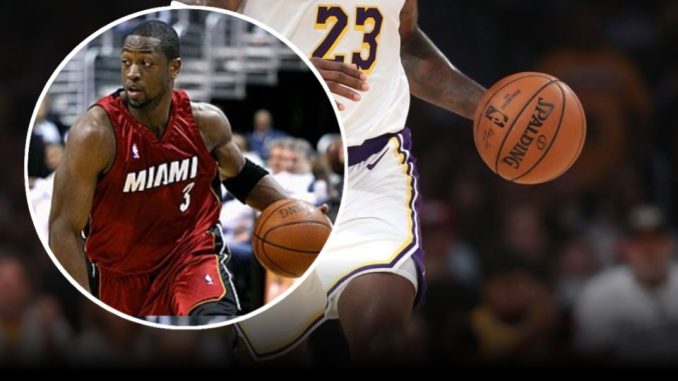
Dwyane Wade has never been one to shy away from speaking candidly about the realities of life at the highest level of basketball, and his latest reflection on the looming retirement conversation surrounding his longtime teammate and friend LeBron James struck a deeply human chord across the basketball world.
As the NBA landscape continues to buzz with speculation about whether the 41-year-old superstar will return for a 24th season in the league, Wade acknowledged what many around the game quietly feel but rarely articulate so bluntly: watching a generational icon approach the end of his career is emotionally complicated, even painful.
According to Wade, the constant retirement discourse surrounding LeBron “has to suck a little bit,” not only for fans who have grown up watching him dominate multiple eras, but also for those who have shared the floor, the locker room, and the journey with him. For Wade, this moment carries an even deeper weight. Their shared history stretches from championship highs in Miami to later reunions in Cleveland and Los Angeles, forming one of the most iconic partnerships of the modern NBA era.
Wade’s sentiment reflects more than nostalgia. It captures the tension between admiration for LeBron’s unprecedented longevity and the inevitability of time catching up with even the most physically gifted athlete in basketball history. As LeBron weighs whether to extend his career into a 24th season—an almost unthinkable milestone when he entered the league straight out of high school in 2003—the emotional stakes continue to rise across the league.
For Wade, who retired in 2019 after a celebrated 16-year career, the transition away from the game offered him a clearer perspective on what players endure in their final chapters. The routine scrutiny, the constant questions about “one last season,” and the pressure of deciding when to walk away all become part of the final stretch of greatness. In LeBron’s case, that scrutiny is amplified to a global scale.
The bond between Wade and LeBron has always been more than just basketball. Their time together with the Miami Heat produced four consecutive NBA Finals appearances and two championships, forming one of the most dominant duos of the 2010s. Wade, already a champion before LeBron’s arrival, welcomed the younger superstar into Miami’s championship ecosystem in 2010, setting aside ego for the sake of building something historic. That partnership reshaped the league’s power structure and ushered in a new era of player empowerment.
Years later, fate brought them together again, first briefly in Cleveland and then later in Los Angeles with the Los Angeles Lakers. While their time as teammates in those later stages did not mirror the championship dominance of Miami, it reinforced a friendship built on mutual respect and shared understanding of greatness. That history is why Wade’s comments about LeBron’s retirement conversations carry such emotional weight.
LeBron, now in his early forties, remains one of the most productive players in the league, defying nearly every conventional expectation about aging in professional sports. His ability to maintain elite performance across scoring, playmaking, and leadership has made him a living outlier in the modern NBA. Most players at this stage of their careers have long transitioned into reduced roles or retired altogether. LeBron, however, continues to operate as the centerpiece of a franchise still chasing championship relevance.
The retirement question, though, has become unavoidable. Each offseason brings renewed speculation about whether this could be the final chapter. LeBron himself has remained measured in his public comments, often emphasizing his love for the game and his ongoing physical capability while avoiding definitive statements about a timeline. That ambiguity fuels both excitement and anxiety among fans and analysts alike.
Wade’s perspective highlights a truth that often gets lost in the noise: even for legends, the end of a career is not a singular moment but a prolonged emotional process. It begins long before the final game is played, creeping into interviews, offseason workouts, and casual conversations with former teammates. In LeBron’s case, that process is unfolding under the brightest spotlight in sports.
Around the league, players and coaches have expressed similar sentiments, acknowledging that LeBron’s eventual retirement will mark the end of an era that spans multiple generations of basketball fans. For younger players, he has been the only constant presence in the NBA throughout their lives. For veterans, he has been a rival, a teammate, and in some cases, a standard of excellence that redefined what longevity could look like.
The idea of LeBron entering a 24th season raises both admiration and disbelief. The physical demands of the NBA are unforgiving, with 82-game regular seasons, travel schedules, and playoff intensity placing immense strain on the body. Yet LeBron has continued to evolve his game, shifting from explosive scorer to calculated floor general without losing his ability to dominate games when needed.
Wade’s remarks also underscore a broader emotional truth about sports: greatness is often easier to appreciate in hindsight than in real time when it is actively fading from view. Fans who grew up watching LeBron’s early dominance in Cleveland, his championship runs in Miami, his historic 2016 comeback, and his late-career leadership in Los Angeles are now confronting the reality that those moments will soon become part of history rather than present-day experience.
For the Lakers organization, the uncertainty surrounding LeBron’s future adds another layer of complexity to an already high-stakes period. Every roster decision, every draft pick, and every free agency move is made with an awareness of both short-term championship aspirations and long-term planning. As long as LeBron remains on the roster, the franchise exists in a dual timeline—competing now while preparing for a future without him.
Inside the locker room, LeBron’s presence continues to shape the culture. His work ethic, preparation, and expectations for excellence have become institutional pillars for younger teammates. Even as retirement speculation grows louder, his influence remains steady, reinforcing the idea that his impact extends far beyond box scores and highlight reels.
Wade’s reflection—particularly his phrasing that the situation “has to suck a little bit”—speaks to the emotional contradiction at the heart of this moment. On one hand, there is celebration for a career that has exceeded nearly every measurable standard of greatness. On the other, there is the difficulty of watching something so historically significant approach its conclusion.
For many in the basketball world, LeBron’s eventual retirement will not simply be the end of a player’s career; it will be the closing of a chapter that began in the early 2000s and shaped the entire modern NBA. His influence stretches across playing style, athlete empowerment, media narratives, and global fandom. Few athletes in any sport have carried that level of sustained cultural relevance for so long.
Wade’s comments also reflect a deeper understanding shared among retired athletes: stepping away from the game does not erase the identity built over decades. If anything, it intensifies the appreciation for what was sacrificed, endured, and achieved along the way. For someone like LeBron, whose career has been defined by both longevity and excellence, that transition will be even more complex.
As speculation continues about whether the 2026–27 season will indeed mark the final chapter of LeBron James’ career, one thing remains certain: every decision he makes from this point forward will be viewed through the lens of legacy. Whether he returns or not, his place in basketball history is already secured, but the emotional reality of watching that story reach its conclusion is something even his closest friends, like Dwyane Wade, are openly acknowledging as difficult.
For now, the basketball world waits. LeBron remains undecided, the Lakers remain competitive, and the conversation continues to grow louder with each passing day. And somewhere in that space between certainty and speculation lies the emotional truth Wade pointed to—a truth that even legends, friends, and fans cannot escape: endings, no matter how historic the journey, are never easy to watch unfold.
Be the first to comment