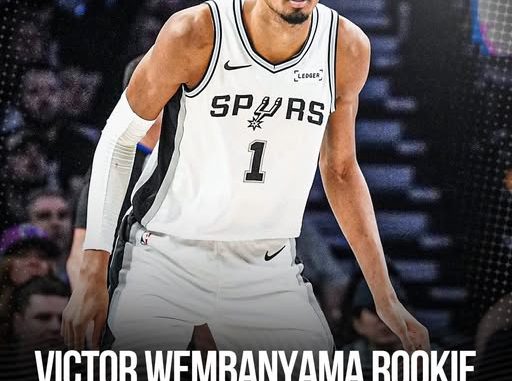
The sports collectibles world has been shaken to its core after a true one-of-one rookie card of Victor Wembanyama sold for an astonishing $5.11 million, setting a new all-time record for the most expensive non-autographed NBA card ever purchased. The sale does not just represent another milestone in the booming trading card industry; it signals a seismic shift in how modern basketball greatness is being valued, speculated on, and immortalized in physical form.
For a market already accustomed to record-breaking sales tied to legends of the game, this latest figure has forced collectors, investors, and even skeptics to recalibrate their understanding of scarcity and hype in the modern era. Wembanyama, still early in his NBA journey with the San Antonio Spurs, has now achieved a level of off-court valuation that rivals and in some cases surpasses established icons whose legacies are already cemented in basketball history.
The card in question is not merely rare; it is singular in the most literal sense. A true one-of-one rookie card represents the pinnacle of modern card production, where every design decision, foil variation, and embedded feature is engineered for exclusivity. In this case, the absence of an autograph only amplifies the intrigue, as the valuation rests entirely on the image, scarcity, and symbolic weight of Wembanyama’s rookie season projection rather than any personal inscription from the player himself.
The $5.11 million transaction has instantly become a benchmark moment for the hobby, eclipsing previous non-autographed NBA card records and pushing the boundaries of what collectors are willing to pay for potential rather than proven legacy. In many ways, the sale reflects a broader cultural reality: the sports memorabilia market has evolved from nostalgia-driven collecting into a sophisticated, high-stakes asset class where rarity, narrative, and future expectations converge.
Wembanyama’s rise has been unlike any prospect in recent memory. Standing at a rare combination of height, skill, and defensive versatility, he entered the NBA with generational expectations attached to his name. That hype has translated beyond the court, where every jersey, highlight, and now collectible associated with him becomes part of a rapidly expanding global brand. The record-breaking card sale is simply the latest proof that his influence is no longer confined to basketball arenas.
Industry analysts have long predicted that the modern sports card market would eventually produce a transaction that challenges the psychological ceiling of the hobby. That moment has now arrived, and it centers on a player who is still defining his career. For many collectors, the appeal lies not only in Wembanyama’s present talent but in the speculative arc of what he could become over the next decade. The card, in this sense, is not just a collectible; it is a bet on history yet to be written.
The $5.11 million price tag also highlights the increasing role of ultra-high-net-worth collectors in shaping the upper limits of the market. While traditional collectors once dominated the hobby, today’s landscape is heavily influenced by investors treating rare cards as alternative assets, similar to fine art or vintage automobiles. The result is a marketplace where emotional attachment and financial speculation often intersect in unpredictable ways.
Comparisons to past icons are inevitable. Cards tied to Michael Jordan, Kobe Bryant, and LeBron James have long set the standard for basketball memorabilia value. Yet even among those legendary names, most record-breaking sales have involved autographed cards or iconic game-worn memorabilia. The fact that a non-autographed rookie card of a current player has now reached such a figure signals a dramatic shift in valuation dynamics.
What makes this moment even more striking is the timing. Wembanyama is still early in his NBA career, still adjusting to the demands of professional basketball in the United States, and still building his statistical résumé. Yet the collectibles market has already assigned him a level of historical significance typically reserved for retired legends. This disconnect between career stage and market valuation is precisely what makes the sale both controversial and fascinating.
Within hobby circles, reactions have been split between awe and skepticism. Enthusiasts view the sale as validation of Wembanyama’s once-in-a-generation potential, arguing that his physical tools and skill set justify unprecedented attention. Critics, however, see it as another example of speculative excess, where hype cycles in modern sports inflate values beyond sustainable logic. Regardless of perspective, the transaction has undeniably reset expectations for what rookie cards in the modern NBA era can command.
Auction dynamics also played a crucial role in driving the final price. Competitive bidding among elite collectors often escalates quickly when a true one-of-one item enters the market. In such scenarios, emotional urgency can override traditional valuation models, especially when buyers fear missing out on a piece of sports history that can never be replicated. The uniqueness of the card ensured that once bidding began in earnest, there was no comparable fallback option available.
The broader implications for the trading card industry are significant. Manufacturers and licensing partners may now face increased pressure to continue innovating ultra-limited parallels, while also navigating concerns about market saturation at lower tiers. If a non-autographed rookie card can reach more than $5 million, questions inevitably arise about how much further the ceiling can be pushed for future superstars entering the league.
For the NBA itself, the development underscores the global reach of its newest international icon. Wembanyama’s appeal extends far beyond France or the United States, resonating across markets where basketball fandom is rapidly growing. The fact that a collectible tied to him can command such a figure speaks to his emerging status as a global sports figure whose influence transcends traditional league boundaries.
Inside the San Antonio Spurs organization, the focus remains on development, consistency, and long-term success. Yet moments like this inevitably add another layer of external pressure and attention. Every performance by Wembanyama now carries dual significance: one on the court in pursuit of wins, and another in the broader ecosystem of branding, collectibles, and global sports economics.
Historically, the collectibles market has often mirrored on-court success, but not always in real time. In some cases, speculation leads performance, while in others, established greatness drives value long after careers conclude. Wembanyama’s case is unusual because his market valuation has already reached historic levels before he has completed even a small fraction of his NBA journey. That reality places him in a category of athletes whose cultural and financial impact begins almost immediately upon entry into the league.
The $5.11 million sale also reflects the growing sophistication of grading, authentication, and rarity certification processes that underpin modern collectibles. Buyers at this level are not simply purchasing cardboard; they are acquiring verified assets with documented provenance, condition integrity, and verified one-of-one status. These factors collectively reduce risk and increase confidence in long-term value retention, particularly for ultra-rare items tied to global stars.
As the dust settles, one thing is clear: this is not just a record-breaking sale, but a defining moment for the intersection of sports, business, and culture. Wembanyama’s rookie card has become more than a collectible; it is now a symbol of how modern athletic potential is monetized in real time, long before legacies are fully written.
Whether the $5.11 million figure ultimately proves to be a peak, a stepping stone, or a new baseline will depend on how both Wembanyama’s career and the broader collectibles market evolve. But for now, the message from the auction world is unmistakable. A new era has arrived, and at its center stands a towering young star whose value extends far beyond the basketball court.
Be the first to comment