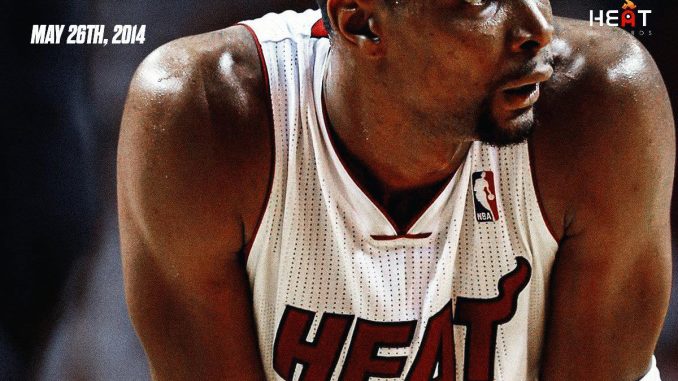
Bosh’s 25-Point Surge Powers Chris Bosh, Miami Heat to 3–1 Grip Over Indiana Pacers as LeBron Shines in Game 4 Win
Twelve years ago on this day, the Miami Heat delivered another defining postseason statement in their quest to cement a modern-day dynasty, grinding down a physical Indiana Pacers team 102–90 in Game 4 to seize a commanding 3–1 series lead. It was a night that perfectly encapsulated the Heat’s championship identity during their “Big Three” era—star power when it mattered most, timely execution on both ends, and a renewed sense of urgency from Chris Bosh, whose 25-point performance helped tilt the Eastern Conference battle decisively in Miami’s favor.
At the center of it all was LeBron James, once again asserting his dominance on the biggest stage. James powered his way to 32 points and 10 rebounds, relentlessly attacking Indiana’s defense, controlling tempo, and delivering the kind of all-around force that left the Pacers searching for answers as the fourth quarter slipped away. But just as crucial to Miami’s victory was the resurgence of Chris Bosh, who responded to recent scrutiny with one of his most important performances of the postseason, finishing with 25 points on 7-of-12 shooting and 6 rebounds, providing the balance and spacing that allowed Miami’s offense to fully function.
The win did more than just push Miami to a 3–1 series advantage—it sent a message. The Heat were not just relying on LeBron James to carry them, nor were they willing to allow Indiana’s bruising frontcourt or defensive physicality to dictate the terms of engagement. Instead, this was a collective reminder that Miami’s championship blueprint required contributions across the board, especially from Bosh, whose role often fluctuated but whose importance remained constant.
From the opening tip, the Pacers made it clear they intended to impose their will physically. Roy Hibbert anchored the paint with rim protection and rebounding presence, while David West brought veteran toughness in the mid-post, challenging Miami’s interior defense with forceful positioning and smart footwork. Indiana’s game plan was predictable but difficult to counter: slow the pace, attack the glass, and force Miami’s perimeter stars into contested mid-range looks.
Yet Miami, hardened by years of playoff battles under head coach Erik Spoelstra, was prepared for the grind. The Heat’s defensive rotations were sharp early, with James setting the tone as a help defender and transition engine. Whenever Indiana threatened to build momentum, Miami responded with disciplined stops that turned into quick-hit offense, preventing the Pacers from ever fully dictating tempo.
Still, the early stretches of the game were tight. Indiana’s crowd energy spilled onto the court, and for moments, the Pacers looked poised to even the series at two games apiece. George Hill’s steady ball-handling and perimeter shooting kept Indiana within striking distance, while Danny Granger’s scoring bursts provided necessary support on the wing. But Miami’s advantage lay in its ability to escalate its offensive ceiling when needed, and that’s where Bosh’s performance became essential.
Throughout the series, Bosh had often been asked to sacrifice touches, spacing the floor for LeBron James and Dwyane Wade while taking on the more thankless defensive assignments against Indiana’s physical front line. But Game 4 became a turning point. Spoelstra and the Miami coaching staff made a clear emphasis to get Bosh involved early and often, a strategic adjustment that paid immediate dividends.
Bosh attacked with confidence from the mid-range, stepped into open jumpers without hesitation, and even battled effectively inside against Indiana’s size. His ability to stretch the floor pulled Hibbert away from the rim, subtly altering Indiana’s defensive structure and opening driving lanes for James. Every time the Pacers attempted to collapse the paint, Bosh punished them with timely shooting and intelligent movement off the ball.
After the game, Spoelstra highlighted exactly how intentional the Heat were in making sure Bosh remained engaged offensively. The message from Miami’s sideline was clear: Bosh was not an accessory to the system—he was a vital pressure point that had to be activated for the offense to reach its peak.
“We were really aggressive to try to get him going,” Spoelstra said, a reflection of both strategy and trust. That trust was repaid in full, as Bosh delivered one of his most composed and impactful performances of the postseason.
While Bosh’s resurgence was critical, the gravitational force of LeBron James remained unavoidable. Every possession seemed to bend toward his influence. Whether isolating from the wing, posting smaller defenders, or pushing the pace in transition, James controlled the game with surgical precision. His 32 points were not simply the product of volume scoring—they were the result of calculated aggression, reading Indiana’s defensive shifts and attacking the smallest seams in coverage.
James also added 10 rebounds, reinforcing his presence on the glass and ensuring that Miami rarely allowed Indiana second-chance opportunities to build momentum. His defensive intensity was equally impactful, as he rotated across multiple positions, contesting shots at the rim and switching onto guards when necessary. In many ways, it was a complete LeBron performance—one that reflected both leadership and inevitability.
Dwyane Wade, though less statistically dominant in this particular contest, contributed in quieter but meaningful ways, particularly as a secondary playmaker and defensive disruptor. His ability to collapse Indiana’s perimeter defense created additional space for both James and Bosh, even if the box score did not fully reflect his influence.
As the game progressed into the second half, Miami began to fully assert control. The Pacers, known for their resilience, attempted to respond with physical defense and half-court execution, but Miami’s spacing and shot-making gradually wore them down. Bosh’s mid-range accuracy forced Indiana into uncomfortable rotations, while James repeatedly punished mismatches that emerged from those rotations.
The defining stretch came late in the third quarter and early in the fourth, when Miami strung together a series of defensive stops that translated into fast-break points. Indiana, already struggling to generate efficient offense against Miami’s switching schemes, began to press. Turnovers crept in. Shot selection deteriorated. And Miami capitalized ruthlessly.
Every playoff series has a moment where control subtly shifts from one team to another. Game 4 was that moment. With Miami extending its lead and Indiana’s offense stagnating, the emotional weight of the series began to tilt heavily toward the defending champions. The Pacers fought, but the margin for error had already narrowed beyond comfort.
What made Miami’s performance particularly dangerous for the rest of the league was the balance on display. When James dominates individually, the Heat are formidable. When Wade finds rhythm, they become explosive. But when Bosh delivers at a high level—stretching defenses, scoring efficiently, and anchoring offensive spacing—the Heat become nearly impossible to defend for a full 48 minutes.
That balance was fully on display in Game 4. Indiana could not overload on James without paying the price elsewhere. They could not fully collapse on Wade without leaving shooters and mid-range specialists open. And when they attempted to contain Bosh’s touches, Miami’s offensive structure simply adapted and punished the rotations.
Defensively, Miami also showed championship-level discipline. Indiana’s attempts to generate inside-out offense were frequently disrupted by timely help defense and strong closeouts. Hibbert was contested at the rim, West was forced into difficult mid-range attempts, and perimeter shooters rarely found clean rhythm for sustained stretches.
By the time the final buzzer sounded, the 102–90 scoreline reflected more than just a Game 4 victory—it reflected Miami’s growing command of the series. The Heat had absorbed Indiana’s physical challenge, adjusted strategically, and elevated their execution at the exact moment required.
For Chris Bosh, the night served as both validation and reminder. Validation that his role in Miami’s championship structure was indispensable. And reminder that even within a team built around superstar brilliance, his ability to shift defensive geometry and provide consistent scoring remained a key variable in Miami’s pursuit of another title.
For LeBron James, it was another entry in a growing postseason legacy of dominance, where every series seemed to feature at least one game that reinforced his status as the league’s most unstoppable force. His 32-point, 10-rebound performance was not just efficient—it was authoritative.
For the Pacers, the loss was a harsh lesson in the margins of playoff basketball. Competing physically was not enough. Sustaining execution over four quarters against a team with Miami’s experience, talent, and adaptability required near-perfect stretches that Indiana could not consistently produce.
As the series shifted back to Miami with a 3–1 advantage, the narrative had become clear. The Heat were not merely surviving Indiana’s challenge—they were systematically breaking it down. And with Bosh reasserting himself alongside LeBron’s brilliance, Miami looked every bit like a team closing in on another step toward championship glory.
Be the first to comment