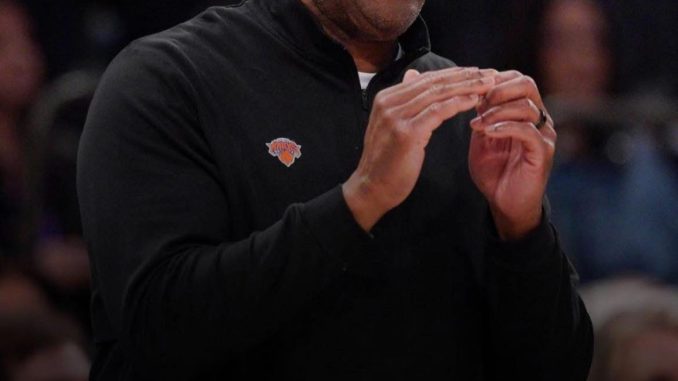
In a season already defined by seismic shifts in the NBA landscape, the New York Knicks have authored a storyline that feels almost cinematic in its weight and timing. According to reports, head coach Mike Brown is set to earn a $2 million bonus after guiding the franchise to its first NBA Finals appearance since 1999, a milestone that instantly repositions both the team and the city within the modern basketball hierarchy. For a franchise long associated with droughts, near-misses, and restless expectation, the breakthrough carries the emotional force of history finally bending in its favor.
For the New York Knicks, the journey to this moment has been anything but linear. Decades have passed since the franchise last stood on the game’s grandest stage, and in that time Madison Square Garden has become a theater of rebuilding cycles, star experiments, and fleeting optimism. The 1999 Finals run, led by a gritty, defense-first identity, now feels like a distant echo. What makes this current achievement even more striking is not just that the Knicks have returned to the NBA Finals, but the manner in which they have done so—through a blend of structural discipline, roster clarity, and a coaching identity that has steadily reshaped the franchise’s competitive DNA.
At the center of that transformation stands Mike Brown, a veteran coach whose reputation has long been defined by defensive organization, accountability, and adaptability. The reported $2 million incentive tied to the Knicks’ Finals appearance is more than a contractual footnote; it is a reflection of organizational belief in a system that has finally delivered at the highest level. Brown’s coaching journey has included stops across multiple franchises and eras, but this particular chapter in New York may ultimately define his legacy in ways previous assignments could not.
The significance of the bonus itself extends beyond financial reward. In modern professional sports, incentive structures are often designed to align leadership performance with organizational ambition. In this case, the Knicks’ front office clearly tied Brown’s compensation to postseason success that had eluded the franchise for over two decades. That alignment now looks prescient. The $2 million figure, while substantial, pales in comparison to the broader economic and cultural windfall associated with a Finals berth in New York—ticket demand surging, global media attention intensifying, and the franchise brand reasserting itself as a centerpiece of the NBA’s biggest market.
What has distinguished Brown’s tenure most is not any single tactical innovation, but rather the consolidation of identity. The Knicks have become one of the league’s most disciplined defensive teams, capable of sustaining intensity across full possessions and multiple game environments. Their playoff run has been characterized by physicality, rotational cohesion, and an ability to close games without panic. In an era where offensive firepower often dominates headlines, New York’s resurgence has been rooted in control, structure, and resistance.
Players have repeatedly pointed to the clarity of Brown’s system as a defining factor in their postseason success. Roles are defined, expectations are consistent, and adjustments are made with precision rather than reactionary volatility. That stability has allowed the Knicks to withstand swings in momentum that would have previously derailed them in past playoff campaigns. It is not simply that they are winning—it is how they are winning that signals a deeper organizational shift.
The path to the Finals has not been without adversity. Every postseason run carries moments where identity is tested, and New York’s journey included stretches where offensive execution stalled or opponents attempted to exploit mismatches in transition defense. Yet each time, the Knicks responded with recalibrated focus rather than fragmentation. That response pattern is often the clearest indicator of coaching influence, and in this case it underscores Brown’s impact as both strategist and culture builder.
For the city of New York, the emotional resonance of this moment cannot be overstated. Basketball in New York is not merely entertainment; it is civic identity, generational memory, and daily conversation layered across boroughs. The Knicks’ return to the Finals stage reactivates a collective experience that has been dormant since the late 1990s. Fans who grew up hearing stories of the 1999 run are now witnessing a new version unfold in real time, one that carries its own narrative weight and statistical legitimacy.
Economically, the implications are equally significant. A Finals appearance in New York triggers a ripple effect across media rights, merchandise demand, hospitality revenue, and global brand exposure. Madison Square Garden becomes not just a home arena, but a focal point of international sports attention. In that context, Brown’s $2 million bonus is almost symbolic—a contractual acknowledgment of value that is exponentially multiplied by the broader financial ecosystem activated by postseason success.
Within the locker room, the tone has reportedly shifted from surprise to conviction as the Knicks advanced through each round. Early skepticism about whether the roster had sufficient depth to survive a grueling Eastern Conference path has been replaced by a growing belief that this team is built for sustained contention. That psychological transformation is often the most difficult step in championship progression. Talent opens the door, but belief keeps it open under pressure.
Brown’s experience has also played a critical role in managing that psychological arc. Having navigated playoff environments across different organizations, he understands the emotional volatility of postseason basketball. His approach has emphasized composure, repetition, and accountability, particularly in late-game scenarios where execution margins shrink dramatically. Those margins have often defined the Knicks’ success in close playoff contests.
The historical framing of this achievement inevitably circles back to 1999, when the Knicks last reached the Finals and fell short of capturing the franchise’s first championship since 1973. That era, defined by physical defense and veteran leadership, has long been romanticized in New York basketball lore. Yet this current iteration is not a direct replica. Instead, it reflects a modern adaptation—more versatile offensively, more fluid in rotation management, and more analytically aligned in decision-making.
What remains consistent across eras is the pressure. Coaching the Knicks has always meant operating under one of the most intense media environments in sports. Every decision is magnified, every losing streak scrutinized, every playoff run dissected in real time. Brown’s ability to navigate that pressure while maintaining competitive stability has been central to the team’s breakthrough.
As the Knicks prepare for the final stage of their season, attention now shifts from achievement to completion. Reaching the Finals is a milestone, but it is not the endpoint. The challenge ahead is significantly greater, requiring sustained excellence against an opponent that will test every structural and tactical strength the team has developed. The margin for error will shrink further, and the demands on execution will intensify.
Still, regardless of what unfolds next, this season has already altered the trajectory of the franchise. The Knicks are no longer defined by absence or waiting. They are defined by arrival. And in that arrival, Mike Brown’s role is both central and undeniable. His reported $2 million bonus is a financial marker of success, but the true measure of his impact lies in something far more enduring: the restoration of belief in a franchise that had spent a generation searching for its return to basketball’s biggest stage.
In a league where coaching tenures are often judged in narrow windows of results, Brown’s work in New York stands as a reminder that structure, patience, and identity can still reshape outcomes at the highest level. The Knicks are back in the Finals, the city is re-energized, and a franchise once defined by longing now stands one series away from rewriting its history entirely.
Be the first to comment