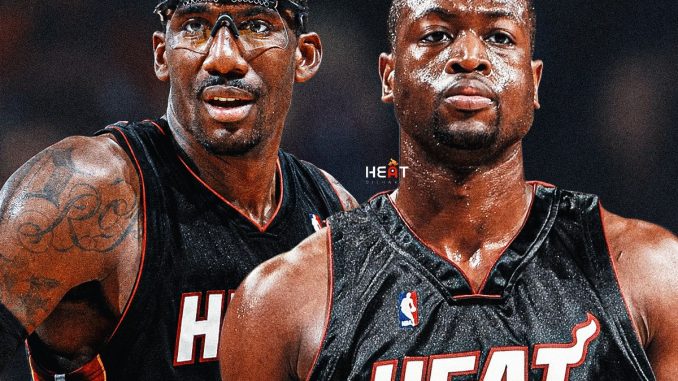
Dwyane Wade has never been shy about reflecting on the moments that shaped the course of NBA history, and one of his latest revelations has opened the door to an intriguing “what if” scenario that could have completely changed the destiny of the Miami Heat and the league itself. Long before the formation of the iconic Big 3 featuring LeBron James, Chris Bosh, and Wade, the Heat legend admitted he was pushing heavily for Miami to pursue Amar’e Stoudemire, believing the explosive All-Star forward could become the perfect running mate in South Beach.
The revelation sheds light on a fascinating period in NBA history when the Heat were desperately searching for another superstar to pair with Wade after their 2006 championship triumph began to fade into frustration and inconsistency. At the time, Wade was carrying an enormous burden. Injuries had slowed him at various points, Miami’s roster was aging, and the franchise’s future appeared uncertain following the decline of the Shaquille O’Neal era. Wade was still one of the most electrifying players in basketball, but the Heat lacked the elite co-star necessary to return to championship contention.
According to Wade, Amar’e Stoudemire was the player he wanted most.
It is easy to understand why. During the late 2000s, Stoudemire was one of the NBA’s most dominant offensive forces. Explosive around the rim, impossible to stop in transition, and devastating in the pick-and-roll, the former Phoenix Suns superstar had built a reputation as one of the league’s most feared big men. His athleticism was revolutionary for his size, and his chemistry with Steve Nash in Phoenix had turned the Suns into one of basketball’s most entertaining teams.
For Wade, who thrived attacking the basket and collapsing defenses, Stoudemire represented an ideal partner. The thought of the two stars sharing the floor together in Miami was enough to excite fans even years after the fact. Wade recently admitted he strongly believed Stoudemire could help elevate the Heat back into title contention, and he pushed internally for the organization to make a serious move.
At the time, the Heat were trying to navigate one of the most important crossroads in franchise history. Wade had already established himself as the face of the organization and one of the greatest players of his generation. Yet Miami understood that keeping Wade happy and competitive would require another elite talent. The Eastern Conference was evolving rapidly, and franchises like the Boston Celtics had assembled powerhouse rosters capable of dominating the league.
The Celtics’ formation of their own Big 3 with Kevin Garnett, Paul Pierce, and Ray Allen in 2007 dramatically shifted the balance of power in the NBA. Suddenly, teams recognized that star pairings and superteams were becoming essential to winning championships. Miami could not afford to remain stagnant.
That urgency intensified the organization’s search for another superstar, and Stoudemire quickly emerged as one of the most attractive possibilities available. Rumors surrounding his future in Phoenix had been circulating for years. The Suns were consistently competitive but struggled to break through to the NBA Finals despite their revolutionary offense. Questions about roster construction, luxury tax concerns, and playoff disappointments created speculation that Phoenix might eventually consider major changes.
Wade saw an opportunity.
The idea of pairing Wade with Stoudemire was not merely based on talent alone. Stylistically, the combination appeared almost perfect. Wade’s relentless slashing ability demanded defensive attention, while Stoudemire’s explosive finishing around the basket would have created matchup nightmares for opposing frontcourts. Defenses would have been forced into impossible choices.
If opponents collapsed on Wade, Stoudemire could dominate inside. If teams focused on limiting Stoudemire in the paint, Wade could attack one-on-one with devastating effectiveness. Both players thrived in transition, both played with emotional intensity, and both possessed the kind of star power capable of energizing an entire franchise.
At that stage of his career, Wade was determined to maximize every championship opportunity available to him. Although he had already secured a title in 2006 and delivered one of the greatest Finals performances in NBA history against the Dallas Mavericks, he understood how difficult sustained contention could be. The years following Miami’s championship run had been frustrating. Injuries, roster limitations, and inconsistent depth left the Heat struggling to remain among the league’s elite.
Wade’s push for Stoudemire reflected both his ambition and his understanding of the changing NBA landscape. Superstars increasingly recognized the importance of teaming up with other elite players rather than attempting to carry entire franchises alone. Wade was among the first stars of his generation to fully embrace that reality.
Ironically, while Wade was lobbying for Stoudemire, the basketball world had no idea something even bigger was quietly forming behind the scenes.
The possibility of LeBron James joining Miami was not yet viewed as an inevitable outcome. James was still the centerpiece of the Cleveland Cavaliers and remained publicly committed to bringing a championship to his home-state franchise. Chris Bosh was starring in Toronto and had established himself as one of the league’s premier power forwards. While whispers about the famous 2003 draft class eventually teaming up existed in NBA circles, few believed it would actually happen.
That uncertainty made Miami’s interest in Stoudemire feel entirely realistic.
There were several moments when the idea appeared plausible. Trade rumors linked Stoudemire to multiple franchises, and Miami frequently surfaced as a possible destination. The Heat were aggressively exploring ways to add another star around Wade before the summer of 2010 arrived. Pat Riley and the front office understood the importance of remaining flexible while simultaneously searching for immediate upgrades.
Had Miami succeeded in landing Stoudemire before the legendary Big 3 era materialized, NBA history might look completely different today.
One of the most fascinating aspects of Wade’s revelation is considering the ripple effects it could have created across the league. If Stoudemire had arrived in Miami, would LeBron James still have chosen South Beach in free agency? Would Chris Bosh have joined as well? Or would Miami’s roster construction have prevented the franchise from creating the superstar trio that ultimately dominated the NBA for four straight Finals appearances and two championships?
The answers remain impossible to know, but the implications are enormous.
The formation of Miami’s Big 3 in 2010 became one of the defining moments in modern sports history. James’ televised “Decision” altered player empowerment forever and accelerated the era of superstar collaboration. Wade played a crucial role in convincing both James and Bosh to join him in Miami, sacrificing individual spotlight in pursuit of championships.
But if Stoudemire had already been in place, the dynamic could have shifted dramatically.
Financial flexibility was central to Miami’s ability to sign both James and Bosh. The Heat meticulously planned their salary cap situation for years, preserving room to chase multiple superstars in free agency. Acquiring Stoudemire beforehand may have complicated that strategy significantly.
There is also the basketball fit to consider. While Stoudemire was undeniably elite offensively, the eventual Big 3 succeeded because of its balance, versatility, and willingness to sacrifice. Bosh adapted his game in countless ways to make the partnership work. He became a defensive anchor, expanded his shooting range, and often accepted reduced offensive opportunities for the greater good.
Whether Stoudemire could have embraced a similar role remains one of the great hypothetical debates.
At his peak, Stoudemire was a dominant scorer who excelled with the offense flowing through him. His partnership with Nash in Phoenix maximized his offensive gifts, but his defensive limitations often became a point of criticism. Miami’s championship teams under Erik Spoelstra ultimately relied on defensive versatility and relentless effort. Bosh became vital precisely because he transformed himself into a switchable defender capable of anchoring smaller lineups.
Still, there is no denying how terrifying a Wade-Stoudemire partnership would have been offensively.
During the late 2000s, Wade was arguably the most explosive slashing guard in basketball outside of Kobe Bryant and LeBron James. His ability to finish through contact, attack the rim, and create offense under pressure made him nearly impossible to contain. Pairing that with Stoudemire’s vertical athleticism and finishing ability could have created one of the most unstoppable pick-and-roll combinations in the league.
Fans often forget just how dominant Stoudemire was before injuries began to take a greater toll. He was a perennial All-Star, a multiple-time All-NBA selection, and one of the few big men capable of completely changing a game offensively. In his prime, Stoudemire combined power, speed, and explosiveness in ways few forwards ever had.
For Miami, adding a player of that caliber would have signaled a major commitment to maximizing Wade’s championship window.
Wade’s comments also provide another reminder of how much influence superstar players increasingly held over organizational decisions during that era. Franchises still maintained significant control, but elite players were becoming more vocal about roster construction and championship aspirations. Wade understood the importance of collaboration between stars and management.
His desire to recruit Stoudemire demonstrated his willingness to actively shape Miami’s future rather than simply wait for the front office to make decisions independently. That leadership later became crucial when the Heat pursued James and Bosh.
Wade’s recruiting efforts in 2010 have become legendary over time. Many around the league believed he sacrificed the most personally to make the Big 3 work. He willingly handed portions of the offensive spotlight to James, adjusted his game, and prioritized winning over individual accolades. Those sacrifices helped establish Miami as one of the defining teams of the decade.
Yet before all of that happened, Wade’s vision for the Heat centered on Stoudemire.
The revelation highlights just how unpredictable NBA history can be.
One trade, one free-agency decision, or one salary-cap adjustment can alter the trajectory of entire franchises. Had Stoudemire joined Miami earlier, perhaps the Heat never become the league’s most polarizing superteam. Perhaps LeBron remains in Cleveland longer. Perhaps Bosh chooses a different destination. Perhaps the balance of power throughout the NBA shifts entirely.
Instead, Miami stayed patient.
That patience ultimately allowed the franchise to execute one of the boldest and most successful free-agency coups in league history. James and Bosh arrived in the summer of 2010, instantly transforming the Heat into the center of the basketball universe. The partnership generated enormous scrutiny, criticism, and pressure, but it also produced unforgettable moments and championship success.
The Big 3 era reshaped the Heat organization forever.
James won two MVP awards in Miami and delivered the finest basketball of his career. Bosh reinvented himself as a modern big man ahead of his time. Wade cemented his legacy not only as a champion but as the cultural foundation of one of basketball’s greatest dynasties.
Still, Wade’s recent comments about Stoudemire serve as a compelling reminder that dynasties are often built on fragile circumstances and unpredictable timing.
There was a point when Miami’s future looked far less certain.
Before championship parades, before “The Decision,” and before the Heat became the NBA’s ultimate villain, Wade was simply searching for another superstar capable of helping him carry the franchise back to prominence. In his eyes, Amar’e Stoudemire represented that opportunity.
It is a testament to Stoudemire’s talent that Wade viewed him as a potential franchise-changing addition. During his peak years with Phoenix, Stoudemire was widely considered one of basketball’s most devastating offensive weapons. His combination of athleticism and scoring made him nearly impossible to defend in space.
Even after eventually joining the New York Knicks in 2010, Stoudemire initially looked rejuvenated. He delivered an MVP-caliber stretch during his first season in New York and briefly restored the Knicks to national relevance before injuries once again disrupted his momentum.
That brief resurgence only reinforces how dangerous the Wade-Stoudemire partnership might have been had it materialized earlier in Miami.
For Heat fans, the revelation adds another fascinating chapter to the franchise’s rich history. Miami has long been known as one of the NBA’s most aggressive organizations when it comes to star acquisition. Riley built a culture centered on championship ambition and bold moves. Wade’s desire to recruit Stoudemire fit perfectly within that organizational identity.
Ultimately, though, fate had different plans.
Instead of Wade and Stoudemire forming Miami’s next great duo, the Heat assembled something even more historic. The Big 3 era became one of the most influential stretches in modern NBA history, inspiring future superstar collaborations across the league and permanently changing how players approached free agency and team-building.
Yet the fact that it nearly happened differently makes the story even more compelling.
NBA history is filled with alternate realities and near-misses that could have transformed the sport forever. Wade’s admission about wanting Stoudemire in Miami belongs firmly in that category. It is the kind of revelation that forces fans to imagine entirely different championship races, rivalries, and legacies.
Would Wade and Stoudemire have won titles together? Could they have challenged the Celtics, Lakers, and Spurs without LeBron James and Chris Bosh? Would Wade’s legacy look different if he never formed the legendary Big 3?
Those questions will forever remain unanswered.
What is clear, however, is that Wade recognized the urgency of surrounding himself with elite talent long before Miami’s dynasty officially began. His pursuit of Stoudemire showed both his competitive mindset and his willingness to aggressively chase championship opportunities.
In the end, the Heat may not have landed the superstar Wade originally envisioned, but the franchise ultimately found a path that changed basketball history forever. And now, years later, Wade’s revelation about Amar’e Stoudemire offers fans a captivating glimpse into the alternate version of NBA history that almost became reality.
Be the first to comment