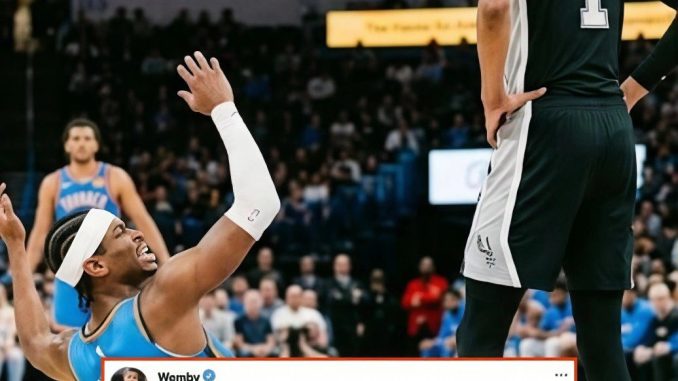
Oklahoma City’s 122–113 Game 2 victory over the San Antonio Spurs was supposed to be remembered as another statement win in a rapidly intensifying Western Conference Finals. Instead, it has ignited a far more volatile storyline—one centered on rising frustration from Victor Wembanyama, a bruising physical identity from the Oklahoma City Thunder, and a composed, unshaken response from Shai Gilgeous-Alexander that has only deepened the emotional divide in a series now tied 1–1.
From the opening tip, Game 2 carried a different temperature. Oklahoma City leaned heavily into a defensive approach that bordered on suffocating, using length, rotations, and consistent body contact to disrupt San Antonio’s half-court rhythm. Wembanyama, who entered the night as the Spurs’ primary offensive and defensive anchor, immediately found himself surrounded by converging defenders every time he touched the ball. What began as physical resistance quickly escalated into a broader test of composure, and by the third quarter, that tension spilled visibly into frustration.
Wembanyama, who had been dominant in stretches during Game 1, struggled to find clean air in Game 2. Every post touch came with a second body. Every pick-and-roll action saw a Thunder defender sliding underneath his space before he could fully gather. Even on the perimeter, Oklahoma City’s wings crowded his release points, daring him to make quick decisions under pressure. The result was a night where rhythm never fully arrived, and San Antonio’s offensive flow repeatedly stalled in isolation attempts that ended in contested looks.
By mid-second quarter, frustration began to surface. After a particularly physical sequence in the paint, Wembanyama was seen exchanging words with officials as he gestured toward his arms, signaling what he believed to be excessive contact. Moments later, after another Thunder double-team forced a turnover, he slammed the ball lightly toward the floor in visible irritation. While not crossing into ejection territory, the emotional strain was unmistakable. For a player known for his calm demeanor and almost detached poise, the shift was notable.
Oklahoma City’s defensive game plan was not subtle, nor was it accidental. The Thunder have built their identity this postseason on controlled aggression, using their depth and versatility to dictate tempo without relying on overtly reckless fouling. In Game 2, that identity sharpened into something more confrontational. They switched aggressively across screens, crowded post entries early, and sent help defenders from unconventional angles, forcing San Antonio into rushed decisions. The physicality was legal in stretches, debated in others, but unquestionably effective in disrupting Wembanyama’s preferred rhythm.
San Antonio’s coaching staff voiced subtle displeasure throughout the game, often turning toward officials after sequences in the paint. But the Spurs never received the whistle consistency they appeared to be searching for. Instead, Oklahoma City controlled the emotional tone, refusing to be drawn into prolonged stoppages or confrontational exchanges that could slow their momentum. Every time the Spurs attempted to respond physically, the Thunder matched intensity without hesitation.
The scoreboard reflected the broader narrative. Oklahoma City’s offense, led by Gilgeous-Alexander’s steady mid-range assault and late-clock execution, maintained control for most of the night. But the deeper story unfolded on the defensive end, where the Thunder’s approach forced San Antonio into one of its least efficient shooting performances of the series.
Gilgeous-Alexander’s impact was especially significant because of what he didn’t do as much as what he did. He did not engage in the growing war of words between benches. He did not escalate contact beyond basketball’s natural physical limits. Instead, he operated with a calm precision that contrasted sharply with the emotional spikes happening around him. When asked postgame about the physical tone of the series, he delivered a characteristically controlled response.
“We know what type of game this becomes,” Gilgeous-Alexander said. “It’s the conference finals. It’s going to be physical. You can’t let emotions dictate possessions. You just have to play through it.”
That restraint stood in direct contrast to the visible frustration from San Antonio’s side, where Wembanyama’s reactions became a focal point of both courtside cameras and social media discussion. For a Spurs team that has leaned heavily on his composure throughout the postseason, the emotional volatility in Game 2 raised questions about how they will adjust moving forward.
Still, despite the tension, Wembanyama’s impact was not entirely erased. Even in a difficult offensive environment, he altered shots at the rim, forced Oklahoma City into midrange-heavy possessions, and served as the Spurs’ primary defensive deterrent. His presence alone shifted spacing, even when the box score failed to fully reflect it. But in a series this tight, perception and momentum often matter as much as raw production, and Game 2 clearly belonged to the Thunder in both categories.
Oklahoma City’s bench also played a critical role in sustaining the physical tone. Their second unit brought sustained energy, particularly in transition defense, where they repeatedly cut off San Antonio’s early outlet opportunities. That prevented the Spurs from generating easy points and forced them into half-court sets that played directly into the Thunder’s hands.
As the game progressed into the fourth quarter, the emotional temperature only climbed. A sequence midway through the period saw Wembanyama drive into traffic and finish through contact, followed by a prolonged stare toward the baseline official. On the next possession, Oklahoma City answered with a downhill attack of their own, drawing a foul and converting at the line, a moment that seemed to symbolize the difference between the two sides: one reacting, the other dictating.
By the final buzzer, the Thunder had secured a convincing 122–113 win, evening the series at 1–1 and reclaiming home-court momentum. But the postgame conversation did not center on the final score alone. Instead, it revolved around the growing perception that this series has shifted into a physical battle of wills, with both teams testing the boundaries of playoff officiating and emotional control.
Inside the Spurs locker room, the tone was measured but clearly unsettled. Players acknowledged the physicality but avoided direct criticism of officiating. The emphasis was instead placed on adjustments—moving Wembanyama into more varied positions, increasing off-ball actions to free him from constant double teams, and finding quicker outlets before Oklahoma City’s defense can fully load up.
For the Thunder, the message remained consistent: nothing has changed. Their approach is deliberate, repeatable, and built for postseason endurance. They believe that forcing opponents into discomfort is not only acceptable but necessary at this stage of competition. And through two games, the results have supported that belief.
Still, the series is far from settled. With Game 3 shifting back to San Antonio, the Spurs now face a defining question: can they reestablish offensive control for Wembanyama without allowing Oklahoma City’s physical defense to dictate the emotional terms of the matchup? Or has the Thunder’s Game 2 blueprint already revealed a sustainable formula for controlling the series?
What is certain is that the tension has escalated beyond simple basketball execution. This is now a psychological contest as much as a tactical one. Wembanyama’s frustration, while contained in measurable limits, signals the pressure Oklahoma City has successfully applied. Gilgeous-Alexander’s calm response, meanwhile, reflects a team increasingly comfortable operating in high-stress environments without deviation from identity.
As the Western Conference Finals moves forward, Game 2 will be remembered less for its final margin and more for the emotional undercurrents it exposed. The Thunder did not just win a game—they shifted the tone of a series. And in doing so, they have forced both Wembanyama and the Spurs into an unfamiliar position: reacting rather than dictating.
Whether that imbalance holds will define everything that follows.
Be the first to comment