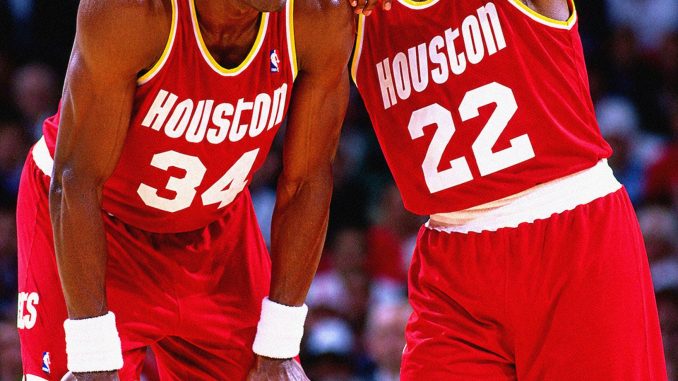
In the long and unpredictable history of the NBA, championship stories are often reserved for dynasties, superteams, and heavily favored contenders built to dominate from opening night through June. Yet every so often, basketball delivers a miracle run that transcends statistics and expectations, a journey so improbable that it becomes immortal. Thirty-one years later, the 1995 championship run by the Houston Rockets remains one of the greatest underdog triumphs the league has ever witnessed, a postseason odyssey fueled by resilience, redemption, and the unshakable brilliance of Hakeem Olajuwon.
It is impossible to revisit that legendary playoff run without hearing the unforgettable words delivered by head coach Rudy Tomjanovich after the Rockets captured their second straight NBA title: “Don’t ever underestimate the heart of a champion.” The quote has since become one of the defining statements in basketball history because it perfectly captured the spirit of a team that refused to surrender to doubt, seeding, fatigue, or the overwhelming odds stacked against them.
The 1994-95 Rockets were not supposed to win the title. They entered the postseason as the sixth seed in the Western Conference with a 47-35 record, far from dominant by championship standards. Their regular season had been turbulent and inconsistent, and there were legitimate questions about whether the defending champions even had enough left to make a serious playoff push. Chemistry issues surfaced at times, injuries slowed momentum, and the Western Conference appeared deeper and stronger than ever. Many observers believed the Rockets’ title window had already closed.
Then came the move that changed everything.
Midway through the season, Houston reunited Olajuwon with his former college teammate and close friend Clyde Drexler in a blockbuster trade that sent shockwaves through the league. Drexler, already one of the most electrifying players of his era, arrived from the Portland Trail Blazers carrying the reputation of a superstar still chasing the elusive championship ring that had slipped away during Portland’s Finals losses earlier in the decade.
The reunion between Olajuwon and Drexler carried emotional significance far beyond basketball. The two had famously played together at the University of Houston during the celebrated “Phi Slama Jama” era in the early 1980s, helping transform college basketball with their athleticism and flair. Though they had never won an NCAA title together, their chemistry and friendship endured for years. By 1995, both men were veterans with unfinished business.
When Drexler joined the Rockets, the expectations were complicated. Some analysts questioned whether the move came too late. Others wondered whether integrating another ball-dominant star in the middle of the season would disrupt Houston’s identity. The Rockets finished the regular season with little indication they were about to author one of the most difficult championship paths in league history.
What followed was basketball immortality.
Houston’s postseason began against the young and talented Utah Jazz led by the legendary duo of Karl Malone and John Stockton. The Jazz were experienced, disciplined, and widely viewed as favorites in the matchup. Yet the Rockets survived a grueling five-game battle that immediately revealed the toughness of a defending champion unwilling to go quietly.
Olajuwon was sensational from the opening series. Night after night, he displayed the complete package that made him one of the most skilled centers basketball has ever seen. His footwork was poetry in motion. His defensive instincts erased mistakes before they fully developed. His midrange touch and post moves overwhelmed opponents regardless of double teams or physical pressure. Every possession seemed to reaffirm that Houston still possessed the best player in the world.
The Rockets then faced the 59-win Phoenix Suns, a team hungry for revenge after losing to Houston in the previous postseason. Phoenix, led by MVP legend Charles Barkley, pushed Houston to the brink. The Suns stormed ahead with a 3-1 series lead, leaving the defending champions one loss away from elimination.
That was when Houston’s championship heart fully emerged.
Game 5 in Phoenix became the turning point of the entire postseason. Facing elimination on the road, the Rockets responded with desperation, precision, and belief. Veterans stepped up at critical moments. Role players made fearless contributions. Olajuwon anchored both ends of the floor, while Drexler delivered the aggressive scoring and transition attack Houston desperately needed.
The Rockets won Game 5. Then they won Game 6 at home. Suddenly the pressure shifted entirely onto Phoenix heading into a decisive Game 7.
What happened next became one of the defining moments in NBA playoff history.
Late in Game 7, with Houston trailing and the season hanging by a thread, guard Mario Elie buried a clutch three-pointer from the corner and blew a kiss toward the stunned Phoenix crowd as he backpedaled down the court. The iconic “Kiss of Death” shot instantly entered playoff lore, symbolizing the swagger and resilience that defined the Rockets’ run.
Houston completed the comeback, becoming only the fourth team in NBA history at that time to overcome a 3-1 deficit in a best-of-seven series. It was the kind of survival that often becomes the emotional foundation for a championship run. The Rockets no longer looked like an inconsistent sixth seed. They looked inevitable.
Their next challenge was perhaps even more daunting.
Awaiting Houston in the Western Conference Finals was the top-seeded San Antonio Spurs and league MVP David Robinson. The matchup was framed as a battle between two elite centers, but many believed Robinson and the Spurs held the advantage because of San Antonio’s superior regular-season dominance.
Instead, Olajuwon delivered one of the greatest individual playoff performances ever witnessed.
Throughout the series, Olajuwon systematically dismantled San Antonio’s defense with a breathtaking display of offensive mastery. Fadeaways, dream shakes, spins, up-and-unders — every move seemed unstoppable. Robinson, despite his brilliance, had no answer for the relentless creativity and precision of Olajuwon’s attack.
Game after game, Olajuwon elevated his play to mythical levels. He averaged staggering numbers during the series while controlling the emotional tempo of every contest. The Rockets defeated the Spurs in six games, stunning the Western Conference and cementing Olajuwon’s status as the unquestioned king of the NBA postseason.
For Drexler, the series carried deep meaning as well. His veteran leadership, athletic versatility, and willingness to sacrifice for the team gave Houston another dimension offensively. He did not need to dominate every possession to make a profound impact. His presence alone relieved pressure from Olajuwon and created balance throughout the roster.
By the time Houston reached the NBA Finals, the narrative surrounding the team had completely transformed. They were no longer simply defending champions trying to survive. They were battle-tested warriors carrying enormous momentum.
Standing in their way were the young and explosive Orlando Magic led by rising superstar Shaquille O’Neal and elite guard Penny Hardaway. Orlando had captured the Eastern Conference with speed, athleticism, and confidence, including a playoff victory over Michael Jordan and the Chicago Bulls during Jordan’s first season back from retirement.
Many expected the Finals to signal a changing of the guard. Instead, it became a masterclass in championship composure.
The defining moment of the series arrived in Game 1 when Orlando guard Nick Anderson missed four consecutive free throws in the closing seconds, opening the door for Houston to force overtime. The Rockets seized the opportunity immediately, with guard Kenny Smith drilling a game-tying three-pointer moments earlier in one of the most clutch shots in Finals history.
Houston stole Game 1 and never looked back.
Olajuwon thoroughly outplayed the young O’Neal throughout the series, using experience, patience, and technical brilliance to expose every defensive mistake. Drexler contributed critical scoring and rebounding, while Houston’s supporting cast repeatedly delivered timely plays under pressure.
The Rockets completed a stunning four-game sweep to secure back-to-back championships, becoming the lowest-seeded team ever to win an NBA title. Even more remarkably, they accomplished the feat by defeating four teams with 50 or more regular-season wins, a playoff gauntlet unlike almost anything seen before or since.
The achievement continues to resonate because it represented more than basketball talent. Countless championship teams have possessed elite rosters. The 1995 Rockets possessed something harder to quantify: collective belief. They never panicked when trailing in a series. They never folded under hostile environments. They embraced adversity as fuel.
Tomjanovich understood that quality better than anyone, which is why his iconic championship quote still echoes decades later. “Don’t ever underestimate the heart of a champion” was not simply postgame emotion. It was a summary of everything the Rockets had endured and overcome.
For Olajuwon, the 1995 title run elevated his legacy into the highest tier of NBA greatness. Already respected as an all-time great center, his postseason dominance that year became one of the strongest arguments for his place among basketball’s immortals. He defeated a gauntlet of Hall of Fame opponents and consistently produced at an elite level in the biggest moments imaginable.
Many fans today remember Olajuwon primarily through highlights and historical rankings, but those who witnessed the 1995 playoffs firsthand understand the full magnitude of his brilliance. He was unstoppable offensively, devastating defensively, and mentally unbreakable. Few players in league history have controlled a postseason the way Olajuwon controlled that spring.
Drexler’s championship journey also gained a poetic ending through Houston’s triumph. After years of playoff heartbreak in Portland, he finally captured the title alongside his longtime friend and former college teammate. Their reunion became one of the most meaningful partnerships in NBA history because it symbolized trust, loyalty, and unfinished dreams finally fulfilled.
The Rockets’ supporting cast deserves equal recognition for their role in the miracle run. Veterans like Smith, Elie, Robert Horry, Sam Cassell, and Otis Thorpe consistently delivered under pressure. Houston’s roster was filled with players who embraced difficult moments rather than fearing them.
Their ability to thrive in chaos became the defining characteristic of the postseason. No deficit felt insurmountable. No environment felt intimidating. Every challenge only seemed to sharpen the team’s confidence.
Three decades later, the 1995 Rockets continue to occupy a special place in basketball culture because their championship validated one of sports’ most enduring truths: greatness is not always determined by rankings, predictions, or regular-season records. Sometimes greatness belongs to the team willing to suffer longer, fight harder, and believe deeper than everyone else.
In an era increasingly dominated by carefully constructed superteams and championship expectations shaped months before the playoffs even begin, Houston’s improbable run feels even more extraordinary in retrospect. They did not cruise through the postseason with overwhelming superiority. They survived. They adapted. They clawed through adversity one possession at a time.
That is why the story still matters.
The Rockets were never supposed to win from the sixth seed. They were not favored against Phoenix. They were doubted against San Antonio. They faced a younger, faster Finals opponent in Orlando. Yet every obstacle only strengthened their resolve.
Thirty-one years later, the 1995 Houston Rockets remain one of the NBA’s ultimate reminders that championship DNA cannot always be measured in standings or statistics. Sometimes the most dangerous team in basketball is the one carrying experience, pride, and the unwavering heart of a champion.
Be the first to comment