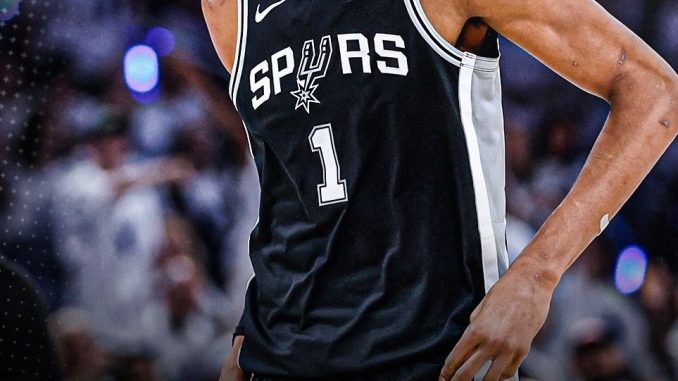
The NBA has reportedly issued a formal warning to Victor Wembanyama following what league sources described as a “postgame media disengagement incident” after the San Antonio Spurs’ Game 5 defeat to the Oklahoma City Thunder in the Western Conference Finals, adding an unexpected off-court storyline to an already heated playoff series that has swung dramatically between dominance, momentum shifts, and emotional tension on both sidelines.
According to multiple league and team-level sources familiar with the situation, the warning stems from Wembanyama’s abrupt exit from the interview area after Game 5, a 127–114 loss that gave Oklahoma City a 3–2 series lead and placed the Spurs on the brink of elimination. The incident itself did not involve any disciplinary action on the floor or during play, but rather what the league described internally as “failure to meet postgame media availability expectations,” a standard requirement for players participating in the conference finals.
While the NBA has not publicly confirmed the warning in detail, sources say the league office followed up with the Spurs shortly after reviewing postgame media footage and internal reporting from the arena. The league’s stance, according to those same sources, is that even high-profile young stars in emotionally charged playoff environments are expected to uphold media obligations unless officially excused by team communications staff or medical personnel.
What made the situation particularly notable was the manner in which it unfolded. After the final buzzer in Game 5, Wembanyama, visibly frustrated following a physically demanding night against Oklahoma City’s frontcourt pressure, initially began the standard postgame routine. However, instead of completing the full media scrum, he briefly acknowledged reporters before exiting the interview zone earlier than expected, skipping what would have been his scheduled podium availability.
Inside the Spurs’ locker room, the mood was described as “heavy but controlled,” reflecting both the disappointment of falling behind in the series and the awareness that the team had let slip a crucial opportunity on their home floor. San Antonio had entered Game 5 with momentum after leveling the series at 2–2 in Game 4, but struggled to contain Oklahoma City’s perimeter attack and transition scoring, two areas that have defined the Thunder’s postseason surge.
The league’s reported warning does not carry financial penalties or suspensions, but it serves as an official notification that further incidents could lead to fines under the NBA’s collective bargaining agreement media conduct provisions. For a player of Wembanyama’s stature—widely viewed as the face of the Spurs’ future and one of the league’s most marketable young stars—the situation has drawn outsized attention not only from fans but also from media partners and league executives invested in maintaining postseason visibility.
League sources emphasized that the NBA’s concern is less about the emotional reaction itself and more about consistency in media participation standards during marquee playoff moments. The conference finals represent one of the league’s most globally visible stages, and the NBA has historically placed strong emphasis on ensuring that its emerging stars remain accessible to media obligations that help shape the league’s narrative ecosystem.
Still, those familiar with Wembanyama’s mindset suggest the moment should be viewed through the lens of competitive frustration rather than intentional disregard. The 20-year-old center, who has carried significant expectations since entering the league, has often displayed a composed but intensely competitive demeanor. Game 5, however, tested that composure in a way few playoff games have during his young career.
Facing a Thunder team that has increasingly leaned into pace, spacing, and physical switching schemes, Wembanyama was forced into extended defensive rotations while also shouldering offensive responsibilities against constant double teams. By the fourth quarter, fatigue and frustration were evident as Oklahoma City closed the game with a decisive run that widened the gap beyond reach.
Those close to the Spurs organization maintain that there is no internal concern about Wembanyama’s professionalism or leadership trajectory. Instead, the belief is that the moment reflects the growing pains of a franchise cornerstone navigating the emotional extremes of postseason basketball at the highest level. Internally, the Spurs are said to be treating the matter as a “learning moment” rather than a disciplinary issue.
The Thunder, meanwhile, continue to lean on their balanced attack and defensive discipline to push the series to the brink of the NBA Finals. Oklahoma City’s Game 5 victory was characterized by a strong second-half surge, with their guards controlling tempo and their wings exploiting mismatches in transition. The win marked their third in the series and restored their grip on home-court advantage heading into Game 6.
For San Antonio, the challenge now extends beyond tactical adjustments. The Spurs must regroup emotionally and physically as they prepare for what could be a season-defining Game 6 on the road. Coaches have emphasized defensive rebounding, half-court execution, and improved late-game shot selection as key focal points, but equally important will be the team’s mental reset after a deflating Game 5 finish.
Wembanyama remains central to those plans. Despite the postgame attention, his on-court production throughout the series has reinforced why he is considered one of the league’s most transformative talents. His rim protection, spacing gravity, and evolving offensive repertoire have kept San Antonio competitive even against one of the Western Conference’s most cohesive teams.
However, Oklahoma City’s ability to disrupt rhythm and force constant defensive engagement has tested the Spurs’ supporting cast, placing added pressure on Wembanyama to produce not only statistically but also as an emotional stabilizer. That dual expectation has intensified as the series has progressed, especially with every possession carrying heightened significance in a tightly contested Western Conference Finals.
The NBA’s reported warning, while minor in official terms, adds another layer to a narrative already rich with intrigue: the emergence of a generational talent under the microscope of playoff scrutiny. For the league, maintaining structure and professionalism around its biggest stages is a priority. For players like Wembanyama, balancing competitive fire with public-facing responsibilities is part of the evolution into superstardom.
Around the league, reactions have been measured. Former players and analysts have largely framed the situation as a non-issue blown slightly out of proportion due to Wembanyama’s profile and the stakes of the series. Several have noted that emotional postgame moments are common in deep playoff runs, particularly for young stars experiencing their first extended postseason pressure.
Still, the NBA’s decision to formally document the incident underscores its commitment to maintaining uniform standards regardless of player status or circumstance. The message, according to league insiders, is straightforward: playoff visibility is a shared responsibility between teams and their stars, even in defeat.
As the Spurs shift their focus to Game 6, the spotlight will inevitably remain on Wembanyama—not just for his performance on the floor, but for how he responds to the added attention off it. In many ways, this moment now sits at the intersection of basketball development and public expectation, a familiar crossroads for emerging franchise players tasked with carrying both competitive and cultural weight.
San Antonio’s season, once defined by surprise contention and rapid growth, now rests on the edge of elimination. Oklahoma City holds the advantage, the momentum, and the psychological edge. But in a series that has shifted repeatedly from game to game, nothing has been entirely settled.
What remains clear is that Wembanyama’s journey—both as a player and as the face of a franchise—continues to unfold under a spotlight that extends far beyond box scores. And in the modern NBA, where performance, presence, and professionalism are increasingly intertwined, even a brief postgame exit can become part of a much larger conversation.
Be the first to comment