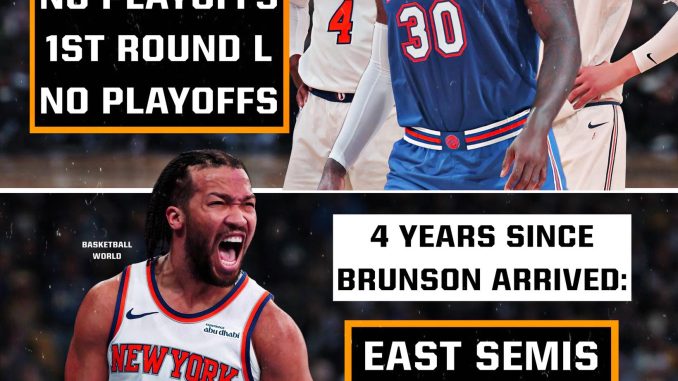
For years, the New York Knicks wandered through the NBA wilderness searching for stability, identity, and most importantly, a leader who could carry the weight of Madison Square Garden without shrinking under its spotlight. Big names came and went, experiments were tried, expectations were reset, and disappointment became a familiar rhythm in Manhattan. Then came Jalen Brunson, and with him, something the franchise had not truly possessed in a long time: certainty.
What Brunson has done in New York is not just elevate a roster; it has recalibrated an entire basketball culture. The Knicks are no longer a franchise hoping to escape irrelevance—they are now a team that expects to contend. That transformation did not happen overnight, nor did it come with flashy proclamations or marketing slogans. It came through possession-by-possession control, fourth-quarter poise, and an almost old-school understanding of how to manage the chaos of playoff basketball.
When Brunson arrived in New York, the franchise was still recovering from years of inconsistency. The Knicks had flirted with relevance in brief spurts, but they lacked a steady hand at the most important position in basketball. Too often, late-game offense devolved into isolation-heavy sequences or rushed perimeter shots. The Garden crowd, as passionate as any in sports, oscillated between hope and frustration. The missing piece was not talent alone—it was leadership that translated pressure into production.
Brunson changed that equation immediately.
His impact was not measured solely in points per game, though those numbers have consistently placed him among the league’s most reliable guards. Instead, his true value lies in structure. He slows the game when it needs to be slowed, accelerates when defenses are disoriented, and bends opposing schemes without forcing reckless decisions. In playoff environments, where possessions shrink and mistakes are magnified, that skill set becomes invaluable.
The Knicks’ rise into Eastern Conference contention has been built on that foundation. Surrounding pieces have shifted, defensive identity has strengthened, and the roster has matured, but everything still filters through Brunson’s decision-making. He has become the system rather than merely operating within one.
In the current postseason run, New York’s statement has been clear: this is no longer a team satisfied with moral victories or competitive exits. The Knicks have advanced through the Eastern Conference bracket with a level of composure that reflects their floor general. Their most recent statement came in Game 1 of the Eastern Conference Finals against the Cleveland Cavaliers, where the Knicks opened the series with a composed and physical victory, setting the tone for what they intend to be a defining chapter.
Against a Cleveland team built on length, defensive pressure, and emerging star power, the Knicks did not panic when runs came. They did not fold when momentum shifted. Instead, they leaned on Brunson’s ability to stabilize possessions and generate efficient offense when the game tightened. That is the kind of trait that does not always show up in highlight reels but defines playoff series.
What separates Brunson from many of his peers is not just skill, but temperament. The pressure of New York basketball is unlike any other market. Every possession is magnified, every slump is dissected, and every postseason run is measured against decades of unmet expectations. Yet Brunson has consistently absorbed that pressure without altering his personality or his approach. He does not chase moments; he creates them.
That consistency has reshaped the Knicks’ identity. Where once the team was reactive, it is now deliberate. Where once they were prone to emotional swings, they now operate with steadiness. And where once late-game scenarios were a source of anxiety, they are now opportunities for execution.
Much of this evolution can be traced to Brunson’s mastery of the midrange game, footwork efficiency, and body control in tight spaces. He is not the tallest guard, nor the most physically imposing, but he is among the most difficult to disrupt. Defenders are often forced into uncomfortable choices: overcommit and risk foul trouble or give him space and watch him methodically dismantle coverage.
But his influence extends beyond scoring. Brunson’s leadership is vocal, constant, and grounded in accountability. Teammates respond to his presence because it is earned rather than demanded. In film sessions, practice environments, and in-game huddles, his voice carries weight because it is backed by execution. That credibility is what transforms a good player into a franchise cornerstone.
The Knicks’ supporting cast has also benefited from the clarity he brings. Wings and bigs operate with more confidence knowing that offensive possessions will be organized. Transition decisions are cleaner. Shot selection improves. Defensive intensity is easier to maintain when the offense is not producing chaos. In many ways, Brunson has reduced noise on both ends of the floor.
This postseason has further amplified that impact. As opponents have attempted to trap, switch, and disrupt New York’s offensive rhythm, Brunson has consistently found answers. Whether it is splitting double teams, drawing contact in the paint, or manipulating pick-and-roll coverage, he has forced defenses to constantly adjust rather than dictate terms.
The Cavaliers series opener showcased that dynamic at its highest level. Cleveland entered the matchup with a strong defensive identity, anchored by size and versatility. Early stretches of the game reflected that strength, as the Knicks were forced into longer possessions and contested looks. But as the game progressed, Brunson’s control of tempo began to tilt the balance. He attacked mismatches, punished defensive hesitation, and ensured that New York never drifted into stagnation.
By the time the game entered its decisive stretch, the Knicks were operating with the confidence of a team that understood exactly where their advantages lay. Brunson’s late-game execution, particularly in isolations and pick-and-roll reads, allowed New York to close the door on Cleveland’s momentum swings. It was not domination through overwhelming athleticism, but through precision.
That precision is what has elevated the Knicks from a promising roster to a legitimate Eastern Conference powerhouse. They are no longer dependent on variance or hot shooting nights. They are anchored by structure, and that structure begins with Brunson.
What makes this transformation even more significant is the historical context. The Knicks franchise carries decades of expectation, dating back to championship eras and iconic playoff battles. For modern iterations of the team, that legacy has often felt more like pressure than inspiration. Brunson, however, has managed to reconnect the present with the franchise’s competitive identity without being overwhelmed by its weight.
In doing so, he has given New York something it has long lacked: a player who can be trusted when everything is on the line. That trust is not built through rhetoric, but through repeated demonstration. Game after game, possession after possession, Brunson has shown that he can dictate terms in the most critical moments.
Around him, the Knicks have grown into a more complete unit. Defensive rotations are sharper, rebounding effort has improved, and offensive spacing is more purposeful. Coaches have adjusted schemes to maximize Brunson’s strengths, allowing him to operate in space where he is most dangerous. That synergy between player and system is what championship-level teams are built upon.
Yet the journey is far from complete. The Eastern Conference Finals present a new level of challenge, with opponents fully aware of Brunson’s influence and determined to disrupt it. Adjustments will come, counters will be tested, and pressure will intensify. But if the opening game is any indication, the Knicks are no longer surprised by those conditions. They are prepared for them.
That preparation is the product of experience, cohesion, and leadership. And at the center of it all stands Brunson, whose steady hand continues to guide a franchise that once searched endlessly for direction.
There is a growing sense in New York that this is not a temporary surge but the beginning of a sustained era. Expectations have shifted from “can they compete?” to “how far can they go?” That change in mindset is perhaps Brunson’s most significant achievement. He has not just improved a team; he has altered its psychological ceiling.
As the series against Cleveland continues and the stakes rise even further, every possession will carry added weight. Every defensive stop, every late-game read, every adjustment will be magnified. But the Knicks enter that environment with something they have rarely had in recent decades: a sense of control.
And that control begins with Jalen Brunson, the guard who did not simply join a franchise in need of hope, but reshaped it into a contender capable of defining the Eastern Conference landscape.
The Knicks are no longer searching for relevance. They are defending their place within it.
Be the first to comment