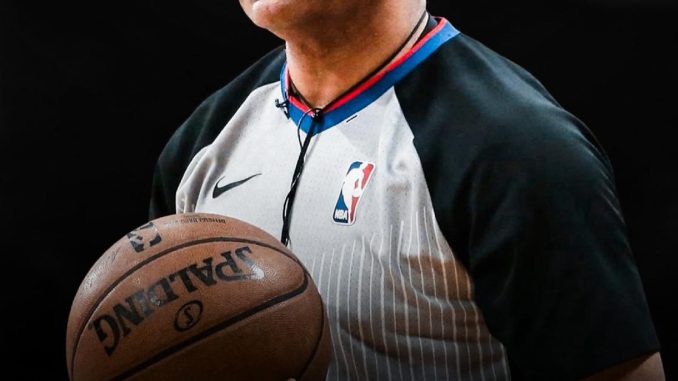
The NBA is once again confronting one of the most sensitive issues in modern professional sports—officiating integrity—as a joint investigation involving the league’s Anti-Gambling Department and the FBI has reportedly been opened into veteran referee Tony Brothers over alleged “potentially prohibited conduct” tied to postseason games, according to NBA insider Shams Charania.
The development, first reported on Thursday, has sent immediate shockwaves through the basketball world, not only because of the stature of the official involved but also due to the seriousness of the agencies now engaged. The involvement of the FBI alongside the NBA’s internal integrity mechanisms marks a rare escalation in how the league is approaching allegations that could affect competitive fairness during its most critical stretch of the season.
According to league sources cited in the initial reporting, the probe is focused on whether any actions or communications linked to Brothers may have crossed boundaries defined under the NBA’s officiating and gambling integrity rules. At this stage, there has been no public allegation of confirmed wrongdoing, and no formal charges have been announced. Still, the existence of an active federal inquiry places the matter in a category the league has historically treated with extreme caution.
The NBA has long maintained one of the strictest integrity frameworks in professional sports, particularly as legalized sports betting has expanded across the United States. The league’s Anti-Gambling Department was specifically strengthened in recent years to monitor not only player conduct but also officials, team personnel, and third-party associates who could potentially influence or be influenced by betting activity or external pressures.
While the NBA has faced officiating controversies throughout its modern history, formal investigations involving veteran referees in coordination with federal authorities remain extremely uncommon. That rarity has intensified attention on this latest development, especially given the timing—postseason basketball, where every possession is magnified and every officiating decision is scrutinized under a national spotlight.
Brothers, one of the league’s most experienced referees, has officiated numerous high-stakes playoff games over his long career. Known for his presence on the court and his authoritative style, he has been assigned to some of the most intense environments in the sport, including late-round playoff matchups where tensions between players, coaches, and officiating crews routinely reach their peak.
That experience is part of what makes the current investigation particularly notable. League veterans are typically among the most trusted officials, often selected for postseason assignments precisely because of their track record in managing pressure situations. The emergence of allegations tied to such a figure inevitably raises broader questions about oversight, accountability, and the evolving intersection between professional sports and the rapidly growing sports betting ecosystem.
Sources familiar with the league’s internal processes emphasize that the NBA’s integrity unit routinely monitors officiating patterns, communication logs, and betting market anomalies as part of its standard protocol. However, when federal authorities become involved, the scope of inquiry often expands beyond internal compliance reviews into potential violations of federal law, including fraud, corruption, or illegal gambling activity.
At this stage, neither the NBA nor federal investigators have publicly detailed the specific nature of the “potentially prohibited conduct” under review. The language used in early reports remains deliberately broad, reflecting both the early phase of the investigation and the legal sensitivity surrounding ongoing inquiries.
What is clear, however, is that the stakes are unusually high. The NBA’s reputation for competitive integrity is one of its most valuable institutional assets, particularly as it continues to deepen its commercial relationships with betting operators. Any suggestion that officiating decisions could be compromised—even at the level of perception—poses a significant reputational risk to the league.
Over the past decade, the NBA has increasingly embraced transparency initiatives aimed at reinforcing trust in officiating. This includes public referee reports, Last Two Minute Reports for close games, and expanded postgame review processes. Despite these measures, referees remain among the most scrutinized figures in the sport, often absorbing criticism from players, coaches, and fans when calls do not go their way.
The current situation adds a new layer to that scrutiny. Unlike routine postgame disputes or performance evaluations, the involvement of federal investigators signals that the questions under review may extend beyond judgment calls on the floor and into broader concerns about conduct off the court or behind the scenes.
Historically, the league has dealt with officiating controversies, but few have reached this level of formal escalation. The most notable precedent in American sports remains the Tim Donaghy scandal in the late 2000s, when a former NBA referee was convicted for betting on games he officiated and providing inside information. That case fundamentally reshaped how the league approaches gambling oversight and remains a reference point in discussions about integrity safeguards.
While there is currently no indication that the present investigation is comparable in scope or substance to past scandals, the mere association with federal scrutiny has revived long-standing concerns about vulnerability in high-pressure sports environments where betting markets are vast, dynamic, and constantly evolving.
Inside the league, there is an awareness that perception can be as damaging as confirmed misconduct. Even unproven allegations can influence public trust, particularly during the playoffs, when viewership peaks and global attention intensifies. The NBA has spent years cultivating a product that emphasizes fairness, competition, and transparency, and any disruption to that narrative is treated with urgency.
The timing of the investigation also places additional pressure on officiating crews currently working postseason assignments. While there is no indication that ongoing games are directly affected, the presence of heightened scrutiny often leads to more cautious communication channels and internal reviews of game assignments.
For players and coaches, officiating consistency has always been a central topic of discussion, particularly in playoff series where physicality increases and tactical adjustments hinge on how games are being called. The emergence of an investigation involving a high-profile referee inevitably feeds into those conversations, even if indirectly.
Within league circles, there is also an understanding that referees operate under intense conditions that require split-second decision-making in emotionally charged environments. The NBA has historically defended its officials against what it describes as disproportionate criticism, arguing that refereeing is one of the most difficult jobs in professional sports due to speed, complexity, and constant scrutiny.
At the same time, the league has not hesitated to discipline officials when necessary. Internal evaluations, performance reviews, and postseason assignments are all influenced by grading systems that assess accuracy, game management, and adherence to league protocols. The existence of a federal investigation, however, introduces a dimension that goes beyond performance and into legal territory.
As of now, there has been no public statement from Brothers regarding the investigation. In similar situations, league policy typically advises individuals involved in active inquiries to refrain from public commentary until processes are completed. It is also standard practice for the NBA to withhold detailed commentary during ongoing investigations, citing the need to preserve procedural integrity.
The FBI’s involvement underscores the seriousness with which potential gambling-related or integrity-related violations are treated in today’s sports landscape. Federal agencies have increasingly paid attention to the intersection of sports, data analytics, and betting markets, particularly as legal wagering has become more accessible and integrated into fan engagement platforms.
For the NBA, maintaining a clear separation between officiating integrity and external influences has become a cornerstone of its operational philosophy. The league has invested heavily in monitoring systems, education programs for officials, and partnerships with integrity firms designed to flag irregular activity in real time.
Despite these safeguards, the current investigation demonstrates that even robust systems are not immune to scrutiny or potential breaches. It also highlights the evolving challenges faced by major sports leagues as they navigate an era in which betting data, real-time wagering, and global media coverage converge around every major game.
Public reaction to the report has been immediate, with analysts, former players, and fans expressing a range of responses—from concern to skepticism to calls for transparency. Some have emphasized the importance of allowing the investigative process to unfold without premature judgment, while others have pointed to the broader implications for officiating credibility.
Within the broader sports ecosystem, the case is already being viewed as a test of the NBA’s commitment to transparency and accountability. How the league communicates developments, balances confidentiality with public interest, and ultimately resolves the matter will likely shape discourse around officiating integrity moving forward.
At this stage, the investigation remains ongoing, and no conclusions have been reached publicly. The NBA and federal authorities are expected to continue gathering information, reviewing relevant data, and assessing whether any violations occurred that would warrant further action.
For now, the basketball world is left in a familiar but uneasy position—waiting for clarity in a situation that sits at the intersection of competition, trust, and the increasingly complex realities of modern sports governance.
Be the first to comment