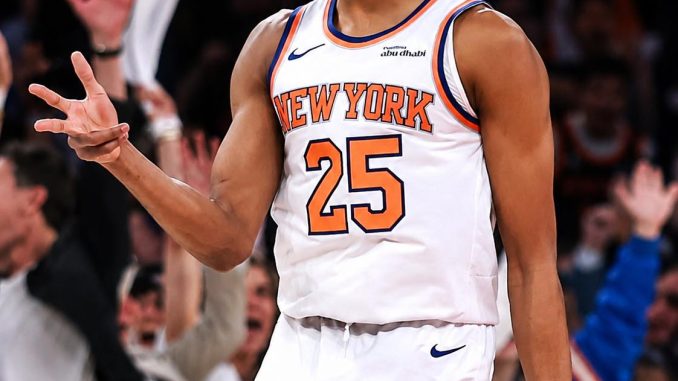
The New York Knicks have done more than just defend home court—they have seized complete control of the Eastern Conference Finals, racing to a 2–0 series lead over the Cleveland Cavaliers in a statement-making start that has Madison Square Garden echoing with memories of 1994 and visions of something even bigger still forming.
For the first time since that iconic 1994 run to the NBA Finals, the Knicks hold a 2–0 advantage in the conference finals, and this one carries a different kind of weight. It is not built on nostalgia or reputation, but on defense, discipline, and a rising belief that this group is no longer simply a feel-good playoff story—it is a legitimate championship force.
Game 2 only reinforced that message. A 109–93 dismantling of the Cavaliers turned what was supposed to be a competitive, physical series into a growing test of survival for Cleveland. The Knicks dictated pace from the opening tip, imposed their defensive identity through the middle quarters, and closed with the kind of composure that has defined elite playoff teams throughout NBA history.
What makes New York’s position even more dangerous for the rest of the league is not just that they are winning—it is how comfortably they are doing it. There has been no reliance on miracle shooting nights or last-second heroics. Instead, the Knicks have built a methodical playoff identity that has smothered Cleveland’s offense and exposed every hesitation in their half-court execution.
Game 1 set the tone with a 115–104 victory that felt closer than it ultimately was. The Cavaliers had stretches where they looked capable of stealing momentum, but New York consistently answered with defensive stops and timely scoring runs. By the fourth quarter, Cleveland was chasing angles and time, while the Knicks dictated rhythm and spacing like a veteran contender that has been here before.
Game 2, however, removed any doubt about control. From the opening possessions, New York’s intensity was unmistakable. They crowded passing lanes, forced Cleveland into rushed decisions, and turned defensive pressure into transition opportunities that steadily broke the game open. By halftime, the Cavaliers were already searching for adjustments that never fully materialized.
At the center of it all has been the Knicks’ collective defensive buy-in. Rather than relying on a single stopper or rim protector, New York has functioned as a synchronized unit—helping on drives, rotating with precision, and contesting shots without overcommitting. Cleveland’s primary scorers have been forced into uncomfortable mid-range attempts and contested drives, with very little clean airspace to operate in.
The Cavaliers entered the series believing their offensive versatility could stretch New York’s defense thin. Instead, they have found themselves trapped in a possession-by-possession grind, where every basket feels earned and every mistake is magnified. The Knicks’ ability to turn average possessions into defensive wins has flipped the pressure entirely onto Cleveland’s shoulders.
Offensively, New York has been just as disciplined. There has been no over-dribbling, no forced isolation stretches that derail rhythm. Ball movement has remained crisp, with purposeful touches that consistently generate high-quality looks. When the Cavaliers collapse inside, the Knicks have punished them from the perimeter. When Cleveland extends defensively, New York has attacked downhill with controlled aggression.
The result has been a balanced attack that does not rely on one star to carry the burden. Instead, the Knicks have leaned into shared responsibility, where different players step into key moments depending on matchup flow and defensive attention. That versatility has made them difficult to scout and even harder to contain.
Perhaps the most striking development in this series is the psychological shift that has taken hold. Cleveland, a team that entered the postseason with confidence in its defensive toughness and offensive firepower, now looks increasingly reactive. The Cavaliers are chasing answers in real time, adjusting rotations, experimenting with coverage schemes, and still struggling to slow the pace of New York’s execution.
By contrast, the Knicks appear increasingly comfortable in discomfort. Physicality has not rattled them. Momentum swings have not shaken them. Even when Cleveland has strung together brief runs, New York has responded not with panic, but with poise. That emotional steadiness is often the dividing line between good playoff teams and championship-caliber ones.
Madison Square Garden has responded accordingly. Each defensive stop has become a crescendo of noise. Each fast-break finish has added to the sense that something larger is unfolding. The crowd is no longer simply reacting to games—they are anticipating dominance.
Historically, the 2–0 lead carries significant weight. NBA teams that take a 2–0 advantage in a best-of-seven series overwhelmingly go on to win the series, and when that advantage comes with both wins at home, the pressure on the trailing team multiplies. For Cleveland, the task is now not just about winning one game, but about reclaiming belief in a series that has slipped sharply out of balance.
The Cavaliers’ offense, which was expected to be the engine of this matchup, has stalled in key stretches. Turnovers have increased under pressure, shot selection has become increasingly contested, and rhythm scorers have struggled to find consistent windows of comfort. When Cleveland has attempted to speed up the game, New York has slowed it down. When the Cavaliers have tried to impose half-court structure, the Knicks have disrupted it.
That tactical control is what makes New York’s start so significant. This is not a series being decided by hot shooting variance or late-game luck. It is being shaped by possession control, defensive execution, and the steady tightening of space on both ends of the floor.
For New York, the looming historical marker adds another layer of gravity. The last time the Knicks held a 2–0 lead in the Eastern Conference Finals was in 1994, a year that remains one of the franchise’s defining eras. That team ultimately reached the NBA Finals, falling just short of a championship, but it cemented itself in franchise lore as one of the toughest, most resilient squads in Knicks history.
Now, three decades later, comparisons are inevitable—but this team is writing its own story. While the echoes of 1994 provide context, the modern Knicks are built in a different NBA landscape, facing different styles, spacing, and pace. Yet the essence remains familiar: defense first, toughness second, and belief above all else.
Still, the series is not over, and complacency would be the only real threat to New York’s momentum. Playoff series have a way of shifting when pressure changes hands, and Cleveland will return to its home floor desperate to reset the tone. The Cavaliers know that one strong game can reframe a series, especially if they can finally impose their offensive rhythm early.
For the Knicks, the challenge now becomes sustaining control away from home, where communication becomes harder and momentum swings are more volatile. The discipline that carried them through Games 1 and 2 will be tested under a different kind of noise, where every missed shot and every defensive breakdown is amplified.
But if the first two games are any indication, New York is not simply surviving pressure—it is thriving in it. The Knicks have not only taken a 2–0 lead; they have dictated how the series is being played, forcing Cleveland into a version of basketball that feels foreign and uncomfortable.
As the series shifts, the question is no longer whether New York can compete in the Eastern Conference Finals. That answer has already been delivered emphatically. The real question now is how far this control can stretch—and whether a team that has not held this kind of advantage in over 30 years is finally ready to finish the unfinished business that history has left waiting.
Be the first to comment