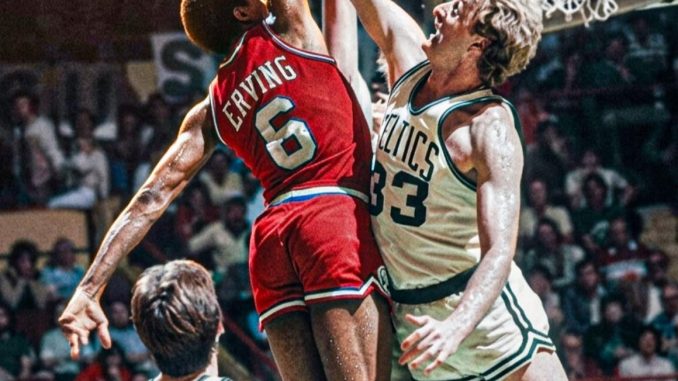
Forty-four years ago, the hardwood inside the Boston Garden bore witness to one of the most defining playoff performances in NBA postseason history, a night where poise met pressure, stars met legacy, and the visiting Philadelphia squad silenced one of basketball’s most intimidating arenas.
On that unforgettable evening, the Philadelphia 76ers stormed into enemy territory and left with a seismic 120–106 victory over the Boston Celtics in Game 7 of the Eastern Conference Finals, punching their ticket to the NBA Finals in one of the most iconic road upsets the league has ever seen.
At the center of the storm stood a ruthless scoring display from Andrew Toney, and a gravitational-defying masterpiece from Julius Erving, whose late-game brilliance turned a tense duel into a defining moment of an era.
It was not just a win. It was a statement. A collision of basketball royalty. And for Boston, a rare home collapse that still echoes through NBA lore.
The Celtics entered the night as the embodiment of dominance at the Boston Garden, a franchise built on championship expectation and fueled by a rising core that included Larry Bird, Kevin McHale, and Robert Parish. The building itself was a psychological weapon—tight, loud, unforgiving. Opposing teams often walked in already half-defeated by the noise, the banners, and the aura of inevitability.
But Philadelphia was different. This was a team hardened by postseason scars, a group that understood pressure not as a burden, but as fuel.
From the opening tip, the tone was set with physicality. Boston attacked early through half-court sets, trying to establish rhythm through Bird’s playmaking and McHale’s interior touch. The Sixers responded with discipline, refusing to let the game drift into the Celtics’ preferred style of slow suffocation.
Instead, Philadelphia leaned into its identity—defensive toughness, transition bursts, and, most importantly, shot-making from its lethal backcourt.
Andrew Toney, forever remembered as “The Boston Strangler” for his repeated postseason heroics against the Celtics, wasted no time reinforcing his reputation. He wasn’t just scoring; he was dismantling Boston’s defensive schemes with a calm, almost surgical precision.
Pull-ups from midrange. Tough finishes in traffic. Hesitation moves that froze defenders in place. Toney’s 34-point explosion was not a sudden eruption—it was a steady erosion of Boston’s resistance.
Every possession he touched seemed to bend toward inevitability.
The Celtics tried multiple coverages. Double-teams came early. Traps were set near the elbows. Physicality was ramped up in the paint. None of it mattered. Toney played as if the moment belonged to him alone, and in many ways, it did.
But while Toney provided the scoring engine, the defining visual of the night belonged to Julius Erving.
In a game already thick with tension, Dr. J delivered a sequence that shifted momentum and sentiment in equal measure. Late in the second half, with Boston attempting to claw back into striking distance, Erving took flight on a drive that defied logic and gravity alike.
Launching from the baseline, he soared into a sea of green jerseys, hung in the air long enough to make time feel irrelevant, and finished with a reverse that drew gasps even from the Boston faithful. It was more than a basket—it was a declaration that the moment belonged to Philadelphia.
The play became symbolic of everything Erving represented: elegance under pressure, creativity in chaos, and a refusal to be constrained by physical limits.
From that point forward, the Celtics were chasing not just a score, but a feeling they could not quite grasp.
Boston’s stars did what they could to respond. Larry Bird fought through contact, carving out midrange looks and pushing tempo when possible. McHale worked the paint with his signature footwork, creating scoring opportunities through sheer persistence. Dennis Johnson orchestrated stretches of offense with controlled urgency.
But Philadelphia’s defense tightened at precisely the right moments. Help rotations arrived just in time. Closeouts were disciplined. Defensive rebounds ended possessions before Boston could build momentum.
Every Celtics push was met with a counterpunch.
The Garden, usually a pressure cooker that overwhelms visitors, began to feel unfamiliar. There were moments of silence where noise typically dominated. There were possessions where Boston’s rhythm dissolved into contested shots and rushed decisions.
And each time the Celtics appeared ready to swing the game, Toney answered again.
His scoring was not limited to any one zone. He operated from the perimeter, attacked off screens, and punished defensive lapses with midrange jumpers that felt almost automatic. When Boston overcommitted, he slipped into open space. When they played off him, he punished them with rhythm shooting.
By the fourth quarter, his 34 points had become less a performance and more a steady reminder that Philadelphia always had an answer.
Still, this was Boston Garden in Game 7. No lead felt safe. No momentum felt permanent.
The Celtics made one final surge, tightening the game and forcing Philadelphia into critical possessions. The energy in the building reached its peak as Boston attempted to swing the tide with defensive stops and transition opportunities.
But that is where championship DNA reveals itself most clearly.
Philadelphia did not panic. The ball found its way into experienced hands. Decisions were deliberate, not rushed. Possessions were managed with the understanding that every second mattered more than every highlight.
Erving, in particular, controlled the tempo without forcing heroics, blending scoring, passing, and clock management into a masterclass of postseason leadership. Even when he wasn’t finishing plays, his presence altered Boston’s defensive positioning, creating space for teammates to operate.
And Toney, relentless as ever, continued to pressure the Celtics’ perimeter defense, ensuring there was no single defensive adjustment that could erase his impact.
As the final minutes ticked away, Boston’s comeback hopes faded into contested jumpers and missed opportunities. The energy that once filled the Garden with certainty gradually gave way to acceptance.
When the final buzzer sounded, Philadelphia had completed one of the most significant Game 7 road victories in franchise history, eliminating a Celtics team that would go on to define much of the decade.
The scoreboard told part of the story, but not all of it. The true narrative was written in moments: Toney’s unshakable scoring rhythm, Erving’s airborne artistry, and the collective discipline of a team that refused to be intimidated by one of basketball’s most hostile environments.
For the Celtics, the loss was a painful reminder of how narrow the margin can be at the highest level of competition. For Bird and his teammates, it was a formative moment in a rivalry that would continue to shape the Eastern Conference landscape for years to come.
For Philadelphia, it was validation.
The victory propelled the 76ers into the NBA Finals, reinforcing their place among the league’s elite and setting the stage for one of the most memorable championship runs of the era.
Looking back 44 years later, the game stands as more than just a box score entry. It is a snapshot of a transitional moment in NBA history, where established dominance met rising excellence, and where individual brilliance—both from Andrew Toney’s scoring barrage and Julius Erving’s gravity-defying artistry—carried a team through the most unforgiving stage in basketball.
In the mythology of the NBA, Game 7s are where legacies are sharpened or shattered. On that night in Boston, Philadelphia did not just survive the moment—they owned it.
And in doing so, they carved their path to the Finals with a performance that still resonates as one of the defining road upsets in postseason history.
Be the first to comment