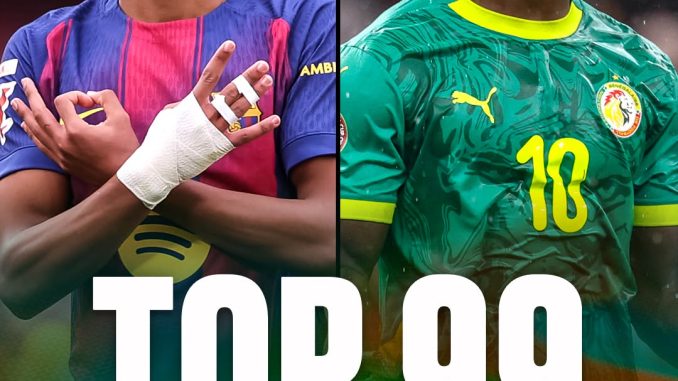
The football world has been hit with another sweeping global talking point ahead of the expanded 2026 FIFA World Cup, as reports circulate around a “Top 99 Players Ranking” that attempts to map out the elite hierarchy of talent heading into the sport’s biggest stage. In a tournament already loaded with storylines—aging legends extending their international swan songs, generational teenagers stepping into the spotlight, and established superstars fighting to cement their legacy—the idea of a definitive top-99 list has only intensified debate across fanbases, analysts, and dressing rooms alike.
While the exact order of the ranking varies depending on the publication and evaluation model, the broader consensus paints a clear picture: modern football is entering one of its most competitive eras ever. The gap between elite and world-class has never been thinner, and the World Cup arrives as the ultimate proving ground where reputations will either be confirmed or completely rewritten in real time.
At the very top of nearly every projection sits Kylian Mbappé, the French forward whose combination of speed, composure, and big-game production has already defined an era. Having delivered on the World Cup stage as a teenager and continued to evolve into a complete attacking leader, Mbappé’s presence alone shapes how opponents prepare defensively. In ranking discussions, he is often treated less as a participant and more as a measuring stick—an offensive ceiling few in world football can match when he is in full rhythm.
Close behind him in virtually every elite-tier conversation is Erling Haaland, whose goal-scoring efficiency has redefined expectations for modern strikers. Haaland’s inclusion in any top-99 breakdown is almost automatic, but his placement inside the top tier reflects more than just numbers—it speaks to his psychological impact on defenders. Even without extensive World Cup history yet, his club dominance has made him one of the most feared attacking forces in the game.
Then comes the eternal presence of Lionel Messi, whose inclusion in any ranking of this magnitude continues to blur the line between current performance and historical greatness. Even as age inevitably shifts his physical output, Messi’s influence in dictating tempo, unlocking defenses, and producing decisive moments keeps him firmly embedded among the world’s elite. In many ways, his ranking in the top 99 is less about projection and more about respect for sustained brilliance across generations.
Alongside him stands Cristiano Ronaldo, a player whose career has become synonymous with longevity at the highest level. Even as he enters what is widely expected to be his final World Cup cycle, Ronaldo’s positioning in the global top tier reflects his unmatched scoring legacy, physical discipline, and enduring competitive edge. In ranking debates, his presence often splits opinion, but his production continues to silence doubts whenever he steps onto the international stage.
Beyond the iconic quartet, the next wave of elite players signals a shifting of the footballing guard. Jude Bellingham has rapidly ascended into the very highest echelon of midfield influence, combining technical control with aggressive forward momentum that makes him one of the most complete young players in the world. His rise has been so fast that in many top-99 rankings, he is already placed alongside established superstars rather than emerging prospects.
Similarly, Vinícius Júnior represents the modern evolution of wing play—direct, explosive, and increasingly efficient in final product. His performances at club level have transformed him into Brazil’s primary attacking threat, and his ranking among the world’s best reflects his ability to tilt matches through individual brilliance. In World Cup discussions, he is often framed as the player most capable of delivering chaotic, uncontainable attacking moments.
The Premier League’s influence on the list remains undeniable, with multiple players occupying key positions across the top 99. From creative midfield orchestrators to high-output forwards, the English top flight continues to serve as a global performance barometer. Harry Kane’s consistent goal output, Kevin De Bruyne’s playmaking mastery, and Bukayo Saka’s rising consistency all feature prominently in most projections, reinforcing England’s growing footprint in world football’s elite tier.
What makes this ranking particularly compelling is the balance between established veterans and rapidly emerging talents. While players like Messi and Ronaldo represent eras that have already defined football history, the presence of younger stars such as Bellingham and others signals a transition period where the sport is shifting toward a new generation of leadership. This blend creates a unique competitive tension heading into the World Cup, where legacy and emergence collide on the same stage.
Midfielders in particular dominate large portions of the top 99 conversation. The modern game demands versatility, and players who can control tempo, break lines, and contribute defensively are now valued as highly as traditional goal scorers. This has elevated a new class of midfield generals who may not always headline highlight reels but consistently determine match outcomes. Their presence in the rankings underscores how tactical evolution has reshaped the definition of “elite” in football.
Defensively, the list is equally competitive, with centre-backs and full-backs now judged not only on stopping power but also on their ability to initiate attacks. Modern defensive elites are expected to function almost as auxiliary midfielders in possession-heavy systems, making their evaluation far more complex than in previous generations. This shift has elevated defenders who can pass, press, and transition at elite levels, ensuring their inclusion within the top tiers of the ranking.
One of the most debated aspects of any top-99 list is the separation between the top 10, top 25, and the broader elite pool. The top 10 is typically reserved for players who can single-handedly decide matches at the highest level, while the top 25 reflects consistent world-class output across multiple seasons. The remaining group, though still elite, often includes rising stars, system-dependent performers, and players whose impact varies depending on tactical setup.
This is where the depth of modern football becomes most apparent. Unlike previous eras where elite talent was concentrated in smaller clusters, today’s global game produces high-level performers across nearly every major league and national team. The World Cup, therefore, becomes not just a tournament of nations but a convergence of football’s entire talent ecosystem, compressed into a single competition where margins are razor thin.
Analysts evaluating these rankings often emphasize three core criteria: consistency, impact in high-pressure matches, and adaptability across systems. Players who excel in all three categories tend to rise toward the top, while those who specialize in only one area are often placed lower despite exceptional talent. This explains why certain technically gifted players may sit outside the top 10, while more complete but less flashy performers climb higher than expected.
Another defining feature of this ranking cycle is the increasing importance of age distribution. With several players now extending their careers deep into their late 30s and even 40s, experience has become a valued asset once again. At the same time, teenagers are entering elite football earlier than ever before, accelerating the generational turnover and creating a wider spectrum of player development stages within the same ranking structure.
As the World Cup approaches, these rankings will inevitably be tested in real time. Pre-tournament lists have historically provided strong narrative framing but are often reshaped dramatically once competition begins. Injuries, tactical shifts, breakout performances, and unexpected exits frequently redefine the perceived hierarchy within weeks.
What remains certain is that the “Top 99 Players Ranking” reflects more than just individual ability—it reflects the current identity of global football. It is a sport defined by hybrid roles, tactical fluidity, and unprecedented depth of talent across continents. The World Cup will not only crown a champion nation but will also serve as the ultimate validation—or rejection—of how these players are currently perceived.
For stars like Mbappé, Haaland, Messi, and Ronaldo, the tournament offers another opportunity to reinforce legacies already etched in football history. For younger names like Bellingham and Vinícius Júnior, it is a chance to fully step into the spotlight and redefine the hierarchy moving forward. And for the broader field of 99, it is a reminder that in modern football, excellence is no longer confined to a handful of names—it is a global standard continuously being raised.
As kickoff approaches, the only certainty is that rankings will mean little once the ball starts rolling. The World Cup has a long history of rewriting expectations, and with the deepest pool of talent ever assembled, the 2026 edition is poised to do exactly that once again.
Be the first to comment