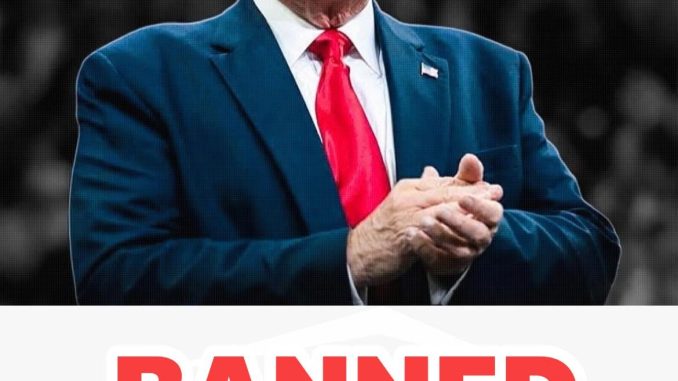
Reports circulating across social media and sports commentary circles on Tuesday have ignited a fresh wave of controversy surrounding the New York Knicks and former U.S. President Donald J. Trump, with unverified claims suggesting that team officials have allegedly banned him from attending future games at Madison Square Garden following New York’s Game 3 defeat in the NBA Finals.
The claims, which remain unconfirmed by the Knicks organization, the NBA, or Madison Square Garden Sports Corp., surfaced in the immediate aftermath of the Knicks’ 115–111 loss to the San Antonio Spurs in Game 3 of the championship series. The game, played inside the iconic Madison Square Garden, marked a pivotal swing in the Finals, cutting New York’s early series lead and shifting momentum toward a surging Spurs squad.
According to the viral reports, Trump’s presence at the arena was seen by some fans as an unusual subplot to an already intense championship atmosphere. The former president, who has attended various major sporting events over the years, was reportedly in attendance as a high-profile guest during one of the most closely watched NBA Finals games in recent memory. However, the Knicks have not issued any statement confirming attendance details, nor have they acknowledged any disciplinary or access-related decisions involving the former president.
Still, that has not stopped speculation from escalating rapidly online.
By Tuesday morning, hashtags referencing the alleged “ban” began trending across multiple platforms, with users debating whether the Knicks organization would or even could restrict entry to such a prominent public figure. Sports commentators, political analysts, and media personalities weighed in from multiple angles—some dismissing the claims outright as internet-fueled misinformation, while others treated the rumors as a symbolic reflection of the increasingly blurred intersection between sports, celebrity, and politics.
The Knicks, one of the most valuable and scrutinized franchises in global sports, have long been accustomed to high-profile courtside guests. Celebrity appearances at Madison Square Garden are routine, particularly during playoff runs. However, the idea of a formal ban targeting a former head of state—even one as polarizing as Donald Trump—has raised eyebrows due to both its logistical implications and potential public relations fallout.
As of this report, neither Knicks officials nor representatives from New York Knicks have confirmed the existence of any internal decision or policy change related to Trump’s attendance. Likewise, the NBA has not commented on the matter, and no credible documentation has surfaced to substantiate the claim beyond anonymous online posts and unverified reports.
The timing of the controversy has added fuel to an already emotionally charged postseason environment. Game 3 itself was a dramatic contest that saw the Spurs claw back late in the fourth quarter behind disciplined execution and timely shot-making, overcoming a hostile road environment to secure a critical win. The result tightened the series to 2–1 in favor of New York, but shifted psychological momentum heading into Game 4.
Inside the arena, the atmosphere was described as electric but tense, with Knicks fans expecting to push their team to a commanding 3–0 stranglehold on the series. Instead, San Antonio’s composure in clutch moments flipped the narrative, leaving the home crowd in stunned silence as the final buzzer sounded.
In the aftermath, attention quickly drifted away from Xs and Os and toward the celebrity presence courtside. Trump’s attendance—while not unusual in the broader context of high-profile political figures attending sporting events—became a lightning rod for discussion once the alleged “ban” narrative began circulating.
Political figures attending NBA games is not unprecedented. Over the years, sitting and former presidents have occasionally appeared at major sporting events, often without incident. However, the NBA Finals, with its heightened media scrutiny and global audience, tends to amplify even minor off-court developments into full-scale talking points.
Analysts note that the Knicks, in particular, operate within one of the most media-intense markets in the world. Every decision—whether roster-related, operational, or ceremonial—faces immediate public examination. That reality has only intensified in the social media era, where unverified claims can spread globally within minutes, regardless of their authenticity.
Several sports media insiders have urged caution in interpreting the circulating reports, emphasizing that no official source has confirmed any restriction involving Trump or any other attendee from Game 3. “There’s nothing verified here at this point,” one league-connected reporter noted. “It’s a classic case of postgame narrative inflation meeting political speculation.”
Still, the story continues to gain traction because of its symbolic weight rather than its factual foundation. The idea of a sports franchise allegedly restricting access to a former president touches on broader cultural debates about the role of politics in sports spaces, particularly in cities like New York where public events often carry political undertones.
Inside the Knicks organization, focus remains squarely on basketball. Head coach Tom Thibodeau and the team’s leadership have emphasized discipline and execution throughout the postseason, and there is no indication that off-court narratives have impacted the locker room. Players have remained publicly silent on the controversy, sticking strictly to basketball messaging as they prepare for Game 4.
The Spurs, meanwhile, have continued to embrace their underdog narrative, with head coach Gregg Popovich reportedly praising his team’s resilience after Game 3. San Antonio’s victory not only shifted momentum but also reinforced the belief that the series could stretch deep into the Finals if New York fails to respond with urgency.
Yet even as the on-court battle intensifies, the off-court discourse has taken on a life of its own. Social media debates have ranged from skepticism to outright mockery, with some fans questioning how such a ban would even be enforced in a venue as large and security-heavy as Madison Square Garden. Others argue that the entire story reflects the modern media ecosystem, where rumor and reality often collide in real time.
Security protocols at high-profile venues like MSG are typically strict and coordinated with law enforcement agencies, especially when hosting former heads of state. Any formal restriction would likely require extensive internal documentation and coordination, making the idea of an informal or reactive “ban” highly unlikely without immediate public acknowledgment.
Despite this, the narrative persists, fueled by the emotional aftermath of a high-stakes Finals game and the constant churn of online speculation. For now, the Knicks organization has remained silent, neither confirming nor denying the claims, a posture that is standard in situations involving unverified reporting.
The broader NBA community appears focused on the basketball itself. With Game 4 looming, both teams are preparing for what could be a series-defining stretch. New York still holds a 2–1 advantage, but San Antonio’s Game 3 win has injected new uncertainty into what once looked like a controlled Knicks push toward a championship.
As the Finals continue, it is likely that attention will gradually shift back to matchups, adjustments, and player performances. Yet the Trump-related narrative serves as a reminder of how quickly modern sports discourse can be overtaken by viral claims, especially when high-profile figures and iconic venues are involved.
Whether the alleged ban ever materializes as fact or fades as another internet-driven rumor, it has already succeeded in doing what most off-court stories aim for in today’s NBA landscape: capturing attention, driving debate, and blurring the line between sports reality and digital speculation.
For now, Madison Square Garden remains focused on hosting the next chapter of the Finals. And in a series already defined by momentum swings, clutch performances, and heightened emotion, the only certainty is that Game 4 will bring its own set of headlines—hopefully centered on basketball rather than the noise surrounding it.
Be the first to comment