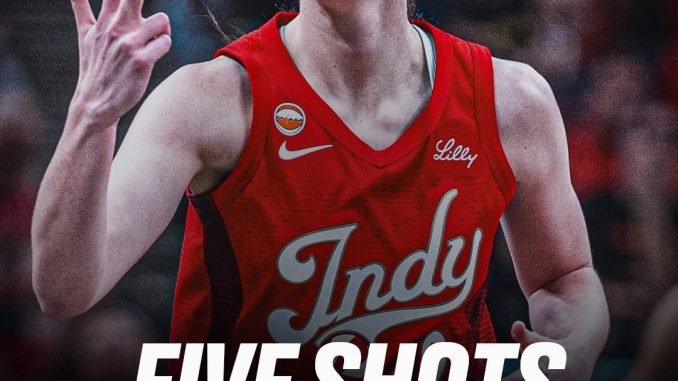
Caitlin Clark has never been shy about distance. But this WNBA season, she has turned the logo-range three-pointer into something more than a highlight-reel novelty—it has become a statistical edge, a defensive problem, and a nightly reminder that basketball’s traditional shooting map may no longer apply when she crosses half court.
According to league tracking data circulating this season, Clark leads the WNBA with five made shots from 30 feet or beyond, a mark that once belonged almost exclusively to end-of-clock desperation heaves or preseason trick-shot routines. Now, it is part of Indiana Fever’s offensive identity. And for opponents, it is becoming an unavoidable dilemma: step up too far, and she beats you off the dribble; play back, and she pulls up from distances that would have been considered irrational just a few years ago.
It is not just that Clark is taking these shots. It is that she is making them often enough—and early enough in possessions—that defenses are being forced to recalibrate their entire half-court geometry around her shooting range. In a league where the average three-point attempt still comes from well inside 30 feet, Clark’s willingness to fire from several steps beyond the arc has effectively stretched the floor into a different dimension.
For the Indiana Fever, that gravity has become both a weapon and a statement.
Clark’s five makes from beyond 30 feet this season don’t exist in isolation. They sit on top of a broader shooting profile that has long defined her game—from her Iowa days through her transition into the professional ranks. Her deep range was never a mystery. It was a known feature, scouted and respected. What has changed is the frequency, the confidence, and the context. These are not just late-clock bailouts or heat-checks after she’s already gotten hot. Increasingly, they are intentional attempts, often early in possessions, that force defenses to make immediate choices they are not comfortable making.
Opponents have tried a variety of answers. Some teams pick her up near half court, attempting to eliminate the runway she uses to generate rhythm. Others switch more aggressively on screens, trying to prevent her from stepping into space. But both approaches come with costs. Overcommitment opens lanes for Indiana’s cutters and rollers, while conservative coverage allows Clark to operate in the exact zones where she is most dangerous—those few steps beyond the arc where shot contests arrive a fraction too late.
What makes Clark’s deep shooting particularly disruptive is that it is not dependent on set plays. It can happen in semi-transition, off a simple dribble handoff, or even out of broken spacing when the offense looks stagnant. That unpredictability forces defenders to defend not just actions, but intentions. And intentions, in basketball, are much harder to read.
Inside the Fever locker room, the impact is felt well beyond the box score. Teammates have repeatedly emphasized how Clark’s shooting range alters defensive coverages before the ball even swings to her side. Defenders are reluctant to help off her, even when she is several steps behind the line, because the cost of a single step of hesitation can be a momentum-shifting three.
That effect compounds across possessions. Indiana’s interior players see more single coverage. The driving lanes for guards widen slightly. Closeouts become longer, more chaotic, and more prone to fouls. In a league where margins are thin and defensive rotations are often the difference between winning and losing, Clark’s ability to bend those rotations from extreme distance is a structural advantage.
But the conversation around her deep shooting has never been purely celebratory. It also carries the familiar tension that follows any player who pushes the boundaries of shot selection: efficiency versus audacity, analytics versus instinct, sustainability versus spectacle.
Critics have long argued that ultra-deep threes can be low-percentage shots that risk disrupting offensive rhythm. In Clark’s case, however, the calculus is more complicated. Her deep attempts are not random; they are often tied to defensive positioning, late switches, or moments when defenders go under screens expecting her to pull up from standard NBA-range distance. In those situations, the “bad shot” argument becomes less clear, because the alternative is often an equally contested mid-range look or a reset that allows the defense to fully recover.
There is also the psychological layer. When Clark hits from 30-plus feet early in a game, it changes how opponents defend her for the next 30 minutes. Bigs step higher. Guards fight over screens more aggressively. Defensive schemes become more reactive. In that sense, the value of the shot is not just in the three points it produces, but in the space it creates afterward.
Across the league, players have started to adjust. Younger guards in particular are experimenting with deeper shooting windows, inspired in part by Clark’s willingness to let it fly without hesitation. Coaches, meanwhile, are grappling with how to teach shot selection in a league where one of the most influential offensive players regularly succeeds from areas once considered out of bounds.
What separates Clark from simple trend-setters is that her deep shooting is not a gimmick layered onto an otherwise conventional game. It is integrated into her identity as a scorer and playmaker. Defenders cannot scheme for it in isolation because it exists alongside her elite passing vision and her ability to manipulate pick-and-roll coverage.
If a defender sags too far, she shoots. If they overplay the shot, she drives and collapses the defense. If help arrives early, she hits cutters or skips passes to the weak side. That triad—shoot, drive, pass—is what turns her range from a novelty into a system.
Indiana’s coaching staff has leaned into this evolution rather than trying to restrain it. The spacing around Clark is increasingly designed to maximize her decision-making from deep positions on the floor. Bigs are encouraged to set higher screens. Wings are instructed to stay ready for kick-outs even when the ball appears to be drifting far from conventional scoring zones. The goal is not to force Clark into safer shots, but to ensure that her deepest attempts still occur within an offensive structure that supports second-chance opportunities and offensive rebounding positioning.
The Fever’s season trajectory has only amplified the significance of Clark’s shooting evolution. As Indiana continues to push toward playoff positioning in a competitive WNBA landscape, every possession carries weight. In that environment, a player who can generate efficient offense from 30 feet or more becomes more than a highlight machine—it becomes a stabilizing force in late-game situations where defenses tighten and space shrinks.
There is also the matter of momentum. Few shots in basketball carry the emotional swing of a logo three, especially when it comes from well beyond the arc. When Clark connects from that range, it does not just add points—it shifts energy. Opponents feel it. Crowds respond instantly. Teammates feed off it. It is the kind of play that can turn a two-possession deficit into a psychological reset within seconds.
Still, the sustainability question will linger throughout the season. Maintaining efficiency from extreme range requires rhythm, conditioning, and shot discipline that few players in the history of the sport have consistently managed. Defenses will continue to adjust, forcing Clark into more contested attempts and varying coverages designed specifically to take away her comfort zones.
But even as teams adapt, there is a growing sense that adaptation itself is the point. Clark is not just responding to modern basketball—she is accelerating it. The spacing she creates, the range she normalizes, and the defensive adjustments she demands all feed into a broader shift in how the game is played at the professional level.
For now, the number is simple and striking: five made shots from 30 feet or beyond, the most in the WNBA this season. But the meaning behind it is far more complex. It represents not just shooting range, but offensive influence. Not just individual skill, but structural disruption. Not just highlights, but a changing blueprint.
And as the season continues, every time Caitlin Clark crosses half court with daylight in front of her, the same question will echo through opposing benches: is this the possession where she pulls the trigger from distance again?
Increasingly, the answer across the league has become clear—if there is space, she will.
Be the first to comment