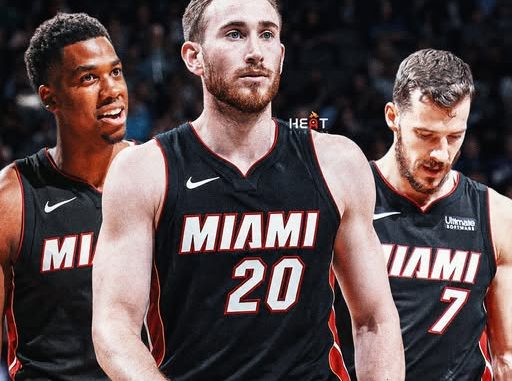
The summer of 2017 represented one of the most fascinating crossroads in recent NBA history. While the league’s attention was largely focused on superstar movement and the growing dominance of the reigning champion Golden State Warriors, another free-agency storyline quietly carried the potential to alter the balance of power in the Eastern Conference. At the center of that story stood Gordon Hayward, an All-Star wing entering the prime of his career and weighing one of the most important decisions of his basketball journey.
Ultimately, Hayward chose the Boston Celtics, reuniting with former college coach Brad Stevens and joining a franchise with championship aspirations. But for a period during that free-agency process, the Miami Heat emerged as one of the most serious contenders for his signature. Led by legendary executive Pat Riley, Miami aggressively pursued the versatile forward, envisioning him as the missing piece that could accelerate the franchise’s return to contention in the post-Big Three era.
Nearly a decade later, the question remains one of the most intriguing “what ifs” of the modern NBA: What would have happened if Gordon Hayward had chosen Miami instead of Boston?
To understand the significance of that possibility, it is important to revisit where all parties stood entering the summer of 2017.
Hayward was coming off the finest season of his career with the Utah Jazz. He averaged 21.9 points, 5.4 rebounds, and 3.5 assists per game while earning All-Star recognition and leading Utah to the second round of the playoffs. At 27 years old, he had developed into one of the league’s most complete wings—a player capable of scoring at all three levels, creating offense for teammates, defending multiple positions, and thriving both on and off the ball.
Miami, meanwhile, had just completed one of the most remarkable turnarounds in league history. After stumbling to an 11-30 start, the Heat surged to a stunning 30-11 finish and narrowly missed the playoffs at 41-41. The late-season run transformed perceptions of the franchise. Rather than entering a lengthy rebuild following the departures of stars from previous years, Miami suddenly appeared positioned for a rapid return to relevance.
The roster featured a compelling blend of veterans and young talent. Goran Dragic was playing arguably the best basketball of his career as the team’s floor general. Hassan Whiteside remained one of the league’s premier rim protectors and rebounders. Emerging wings such as Josh Richardson and Justise Winslow offered defensive versatility, while rookie Bam Adebayo was preparing to begin what would eventually become an All-Star-caliber career.
Adding Hayward to that foundation would have dramatically changed Miami’s trajectory.
The most immediate impact would have been offensive. During that period, Miami often struggled to generate efficient half-court scoring against elite defenses. Hayward’s arrival would have addressed that weakness instantly. His ability to create shots in isolation, operate in pick-and-roll situations, and facilitate from the wing would have provided the Heat with a legitimate primary scoring option.
Dragic and Hayward would have formed one of the Eastern Conference’s most underrated duos. Dragic excelled at attacking downhill and putting pressure on defenses in transition, while Hayward’s versatility would have complemented those strengths perfectly. Opposing teams would have faced difficult choices when defending Miami’s offense. Focusing too much attention on Dragic’s penetration would create opportunities for Hayward on the perimeter. Overcommitting to Hayward would open driving lanes for Dragic.
The spacing benefits also would have been significant. Hayward shot efficiently from beyond the arc and possessed the ability to punish defenders who gave him even a small amount of space. His presence would have created cleaner looks for Richardson and Winslow while making life easier for Whiteside around the basket.
Yet the most fascinating aspect of this hypothetical scenario may involve Adebayo.
In reality, Adebayo entered the league as a promising but raw rookie. Over time, he developed into one of the NBA’s most versatile big men and a cornerstone of Miami’s identity. Had Hayward arrived in 2017, the young center would have been able to develop in an environment with even less offensive pressure placed upon him.
Instead of needing to gradually evolve into a primary playmaker and offensive hub, Adebayo could have focused initially on defense, rebounding, and energy plays while learning alongside established veterans. The long-term development path might have looked different, but there is little doubt that Miami’s overall talent level would have risen significantly.
Defensively, the potential lineup would have been equally intriguing.
One of the defining characteristics of Heat basketball under head coach Erik Spoelstra has been versatility. Hayward’s ability to guard multiple positions would have fit seamlessly into Spoelstra’s system. Richardson and Winslow were already known for their defensive instincts and athleticism. Adebayo’s switchability was beginning to emerge. Whiteside protected the rim at an elite level.
That combination could have produced one of the Eastern Conference’s most disruptive defenses.
Imagine a closing lineup featuring Dragic, Richardson, Hayward, Winslow, and Adebayo. Such a group would have possessed length, mobility, and positional flexibility across the board. Against modern offenses increasingly built around switching and spacing, Miami would have had the personnel to adapt to a variety of opponents.
The timing of this alternate reality also makes the discussion particularly compelling because of the state of the Eastern Conference in 2017.
At the top stood the Cleveland Cavaliers, led by LeBron James. The Celtics were ascending after acquiring Hayward and later trading for Kyrie Irving. The Toronto Raptors remained a consistent playoff force behind DeMar DeRozan and Kyle Lowry.
A Hayward-led Heat team would have immediately inserted itself into that conversation.
Rather than entering the season as a fringe playoff contender, Miami likely would have been viewed as a legitimate top-four seed candidate. The addition of a 22-point-per-game scorer in his prime could have transformed the Heat from a 41-win team into a club capable of winning 50 games or more.
The ripple effects across the conference would have been enormous.
Boston’s entire outlook would have changed. Without Hayward, the Celtics would have entered the season with fewer expectations and a different roster structure. Ironically, Hayward’s actual Celtics tenure was derailed almost immediately by the devastating ankle injury he suffered during the opening game of the 2017-18 season. That injury altered not only his career but also the trajectory of Boston’s championship ambitions.
One cannot help but wonder whether joining Miami might have led to a different outcome. Injuries are impossible to predict, and there is no guarantee circumstances would have changed. Still, the mere possibility adds another layer of intrigue to this alternate history.
Assuming Hayward remained healthy in Miami, the Heat’s ceiling becomes especially interesting.
The 2017-18 season demonstrated that the Eastern Conference was more open than many expected. Cleveland reached the NBA Finals, but numerous teams experienced inconsistency throughout the year. Boston won 55 games despite losing Hayward immediately and later playing much of the postseason without Irving.
A healthy Hayward in Miami could have shifted the balance considerably.
The Heat ultimately finished 44-38 that season and secured the sixth seed before losing in the first round. Adding an All-Star-caliber wing likely improves both their regular-season record and playoff outlook. Reaching the second round appears realistic. Challenging for a conference finals appearance is not out of the question.
The partnership between Hayward and Spoelstra is another element worth examining.
Spoelstra has built a reputation as one of basketball’s most creative tacticians, consistently maximizing the strengths of his personnel. Throughout his career, he has successfully tailored systems around stars with varying skill sets, from LeBron James to Adebayo and Jimmy Butler.
Hayward’s all-around game would have provided Spoelstra with countless options. He could function as a primary ball handler, secondary creator, off-ball scorer, or small-ball forward. Few coaches are better equipped to leverage that versatility than Spoelstra.
The cultural fit also appears natural in retrospect.
Miami has long valued conditioning, discipline, and professionalism. Hayward was known throughout his career for his work ethic, team-first mentality, and willingness to embrace different roles. Those qualities align closely with what has become known around the league as Heat Culture.
In many ways, it is easy to envision Hayward thriving in that environment.
The long-term implications become even more fascinating when projecting beyond a single season.
A healthy and productive Hayward could have accelerated Miami’s rise years before the franchise eventually returned to championship contention. Perhaps the organization becomes a more attractive destination for future stars. Perhaps playoff success arrives sooner. Perhaps the roster evolves differently around a core featuring Hayward, Adebayo, Richardson, and other developing players.
There are, of course, legitimate reasons to believe the experiment might not have reached its highest possible potential.
Whiteside’s fit within Miami’s evolving style of play was already becoming a topic of discussion. Winslow’s offensive development remained uncertain. Richardson was still emerging. The roster, while talented, lacked the proven superstar presence that typically anchors championship teams.
Hayward, excellent as he was, had never consistently operated as a top-10 player in the league. Expecting him alone to elevate Miami into a title favorite may be unrealistic.
Yet championship contention is not the only measure of success.
For a franchise seeking to bridge the gap between rebuilding and competing, Hayward represented precisely the type of player capable of changing the equation. His arrival could have accelerated development, raised expectations, improved playoff positioning, and provided Miami with a clear offensive centerpiece during a pivotal transitional period.
Looking back today, the scenario feels even more intriguing because of how events unfolded. Hayward’s Boston tenure never fully matched expectations due to injury setbacks. Miami eventually found success through a different path, building around Adebayo and later acquiring Butler. Both organizations remained competitive, but neither followed the route envisioned during that dramatic free-agency summer.
That is what makes sports hypotheticals so captivating. They offer a glimpse into alternate realities where a single decision reshapes careers, franchises, and perhaps even entire conferences.
If Gordon Hayward had chosen Miami in 2017, the Heat likely would have become an immediate force in the Eastern Conference. The combination of Hayward’s offensive versatility, Dragic’s leadership, Whiteside’s interior presence, Adebayo’s emerging talent, and Spoelstra’s coaching brilliance would have produced one of the conference’s deepest and most balanced rosters.
Would they have reached the NBA Finals? That remains difficult to predict in an era still heavily influenced by LeBron James and the Cavaliers. Would they have become a perennial contender? The possibility certainly exists.
What seems far less debatable is that Miami’s trajectory would have changed dramatically. An All-Star entering his prime joining a franchise renowned for maximizing talent is the type of partnership that often produces meaningful results.
Nearly nine years later, it remains one of the NBA’s most compelling unanswered questions. In a league where legacies can turn on a single free-agency decision, Gordon Hayward’s choice between Boston and Miami stands as a reminder of how differently history can unfold. For Heat fans, the thought of Hayward wearing black and red alongside a young Bam Adebayo will always inspire curiosity. And for basketball observers, it remains one of those fascinating alternate timelines that continues to spark debate long after the decision itself was made.
Be the first to comment