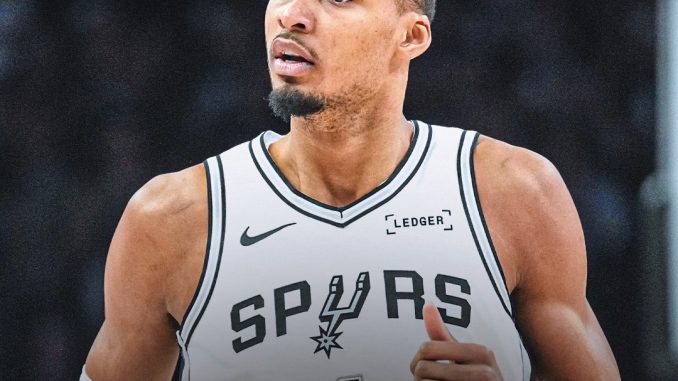
The Western Conference Finals took a decisive turn in Game 5, and it wasn’t just the final score that told the story—it was the rhythm, the resistance, and the rare off-night from a generational talent. On a night when expectations were sky-high for the young superstar at the center of the spotlight, Victor Wembanyama and the San Antonio Spurs instead found themselves overpowered, out-executed, and outpaced as the Oklahoma City Thunder surged to a 127–114 victory to grab a 3–2 series lead and move within one win of the NBA Finals.
For a series that has already lived up to its billing as a clash of rising dynasties, Game 5 felt like a pivot point. The Spurs arrived believing they could reclaim control after fluctuating momentum in Games 3 and 4. Instead, they watched as the Thunder imposed their identity early and never truly relinquished it. And at the heart of San Antonio’s struggles was an uncharacteristically inefficient night from Wembanyama, who finished just 4-of-15 from the field as Oklahoma City’s defense turned the screws at every opportunity.
From the opening tip, the Thunder’s approach was clear: make everything difficult for Wembanyama. That meant physicality without fouling, length at every passing lane, and constant bodies collapsing the moment he touched the ball near the elbow or low block. The Spurs’ offensive blueprint—centered around spacing Wembanyama as a hub—never fully stabilized because Oklahoma City disrupted timing before it could settle into rhythm.
What made the night especially notable was how deliberate the Thunder were in their coverage. Rather than overreacting to Wembanyama’s gravity, they trusted their rotations. When he caught the ball in space, he was immediately met with a second defender showing high, forcing him into rushed decisions or uncomfortable midrange attempts. When he tried to establish deeper post position, Oklahoma City fronted early and sent weak-side digs that stripped away clean looks.
The result was a game where Wembanyama looked visibly frustrated at times, not because of a lack of effort, but because the usual windows simply weren’t there. Shots that typically fall for him—soft touch finishes over contests, quick turnarounds before help arrives, and long strides into paint separation—were replaced by heavily contested looks and disrupted mechanics. The final line, 4-of-15, underscored a night where efficiency evaporated under pressure.
On the other end, the Thunder’s offensive machine hummed with the confidence of a team that knows it has found its rhythm at the right time. Shai Gilgeous-Alexander dictated pace with his usual blend of patience and precision, manipulating defenders into impossible choices. Every time San Antonio attempted to narrow the gap, Oklahoma City answered with a steady dose of midrange execution and downhill pressure that kept the Spurs from building any defensive momentum.
The supporting cast amplified the pressure. Jalen Williams attacked closeouts with decisiveness, while Chet Holmgren’s floor spacing forced Wembanyama to stretch defensively in ways that limited his help presence at the rim. That subtle chess match—stretching San Antonio’s defensive backbone thin—proved just as important as any scoring run.
The defining stretch of the night came late in the third quarter. With the game still within reach, the Spurs attempted to recalibrate by pushing tempo and generating transition opportunities. For a brief moment, it worked. A quick 7–0 run injected life into the building, and the possibility of another fourth-quarter duel between two young Western Conference giants flickered into existence.
But Oklahoma City responded with veteran-like composure. They slowed the game down, forced San Antonio into half-court possessions, and leaned into their advantage in shot creation. Gilgeous-Alexander’s ability to draw fouls at critical moments halted the Spurs’ momentum entirely. By the time the quarter ended, the Thunder had rebuilt a comfortable cushion, and the tone of the game had shifted for good.
Wembanyama’s struggles were not isolated to scoring alone. His influence as a defensive anchor remained impactful in spurts, but even there, the Thunder’s spacing limited his ability to roam freely. Oklahoma City’s guards were disciplined in attacking gaps rather than directly challenging him at the rim, a strategy that reduced his highlight-block opportunities and forced him into more positional defense.
What stood out most, however, was the mental strain of the night. For a player who has dominated stretches of the postseason with otherworldly efficiency, Game 5 represented a different kind of test: patience against schemes designed specifically to blunt his strengths. Every catch was contested. Every dribble was crowded. Every shot came with a hand in his face and a body waiting for a rebound battle.
Still, even in an off night, Wembanyama’s presence warped the geometry of the floor. The Spurs’ offense still bent around him, still searched for mismatches, still trusted that his gravity would eventually create openings. But Oklahoma City never allowed that gravitational pull to become decisive.
As the fourth quarter unfolded, the Thunder’s control only tightened. The lead hovered in double digits, and every Spurs push was met with a calculated response. Whether it was a timely three-pointer, a transition finish, or a defensive stop that led to a runout, Oklahoma City consistently delivered answers.
By the final buzzer, the scoreboard reflected a deserved victory for the Thunder, who now sit one win away from punching their ticket to the NBA Finals. For San Antonio, the message was equally clear: without efficiency from Wembanyama and more consistent secondary scoring, the margin for error against this Oklahoma City team is razor-thin.
The significance of Game 5 extends beyond the numbers. Series basketball, especially at the conference finals level, is often about adjustments and counter-adjustments. Through five games, Oklahoma City has shown an ability to evolve faster between contests, tightening defensive schemes around Wembanyama while simultaneously expanding their offensive versatility. That adaptability is now the defining edge in the series.
For the Spurs, the challenge heading into Game 6 is not just tactical—it is psychological. Young teams often learn the hardest lessons in moments like this, when the margin for error disappears and the opponent exposes every weakness. Wembanyama, despite his extraordinary talent, is experiencing the full weight of playoff game-planning at its highest level. There is no mystery anymore in how opponents will defend him; the question is whether he can still impose himself regardless.
What makes this series compelling is that nothing about Game 5 felt like a final judgment on San Antonio’s trajectory. Even on an inefficient night, Wembanyama altered shots, commanded defensive attention, and kept the Spurs within striking distance longer than most players could under similar pressure. But Oklahoma City’s collective cohesion simply outweighed individual brilliance on this night.
The Thunder, meanwhile, continue to look like a team peaking at exactly the right moment. Their spacing, defensive communication, and late-game poise have become defining traits. More importantly, they are no longer playing like a young team surprised to be here—they are playing like a contender that expects to advance.
As the series shifts back for Game 6, all eyes will remain on Wembanyama. Great players are often defined not by their best nights, but by how they respond to their worst. A 4-of-15 performance in a conference finals loss is a scar on the box score, but it is also fuel for what comes next.
Oklahoma City will arrive with confidence, knowing that one more disciplined performance sends them to the NBA Finals. San Antonio, on the other hand, will arrive with urgency, aware that the window is closing quickly in a series where control has slipped away at the worst possible moment.
Game 5 was not the ending of the story—but it was undeniably a turning point.
Be the first to comment