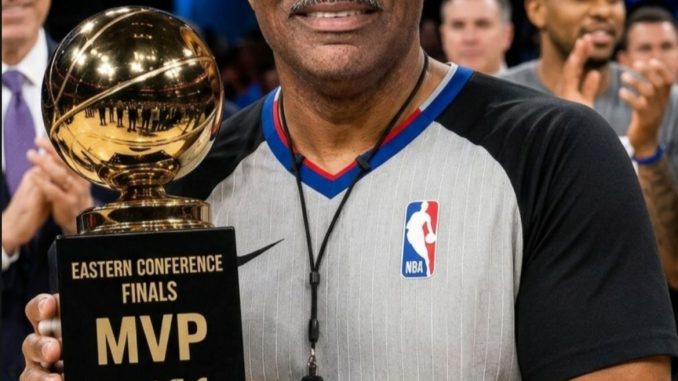
In one of the most surreal moments the league has ever seen, the NBA Western Conference Finals MVP announcement turned what was supposed to be a celebration of elite postseason basketball into a scene of stunned silence, confused laughter, and instant viral chaos across the sports world. What unfolded inside the arena felt less like a traditional award reveal and more like a glitch in the basketball universe, as veteran referee Tony Brothers was announced as the recipient of the honor—an outcome nobody in the building, and arguably nobody on Earth, had remotely anticipated.
The ceremony had begun in standard fashion, with the atmosphere fitting for a decisive stretch of the postseason. Fans had gathered expecting the usual spotlight on superstar performers who had defined the grueling series in the Western Conference Finals. Cameras were locked on the league’s biggest names, analysts were already preparing post-announcement breakdowns, and players stood shoulder-to-shoulder anticipating the moment one of them would be crowned the series’ most valuable performer.
Instead, the announcement shattered every expectation in the building.
When the presenter opened the envelope, there was a brief pause—long enough for the crowd to assume dramatic effect was being added for suspense. But when the words finally came out, they did not land with clarity so much as disbelief.
“Tony Brothers.”
For several seconds, there was no reaction at all. Not applause. Not boos. Just silence—the kind that suggests collective cognitive delay. On the bench, players turned to each other as if someone had misheard. In the stands, fans looked around for confirmation that the moment was real. Even broadcasters struggled to maintain composure as the broadcast feed lingered on the court, where no MVP candidate stood ready to accept the honor.
What followed was immediate chaos.
Within minutes, social media erupted as fans attempted to verify whether the announcement was a joke, an error, or an unprecedented expansion of eligibility rules. The idea that a veteran official—one of the league’s most recognizable referees—had been selected as Western Conference Finals MVP instantly broke the internet’s ability to process information in real time.
Across the arena, confusion turned into audible reaction. Some fans laughed in disbelief, others booed, and a few simply filmed in stunned silence as arena staff scrambled to make sense of the situation. On the court, security personnel were briefly unsure whether an acceptance speech was even expected.
But the league proceeded.
Tony Brothers eventually emerged from the tunnel, maintaining his trademark composed demeanor. Clad in a tailored suit rather than a referee uniform, he walked onto the court to a mixture of bewilderment and reluctant applause. Cameras zoomed in on his face, searching for any hint of irony or acknowledgment that the moment was unusual even by playoff standards.
He did not smile.
He did not gesture.
He simply accepted the trophy.
The broadcast team struggled to contextualize what they were witnessing. The award, traditionally reserved for the most impactful player in the Western Conference Finals, had seemingly been extended—or reinterpreted—in a way no one had been briefed on. Analysts attempted to recall whether any precedent existed in league history. None came to mind.
Within minutes, the league office issued a brief statement confirming the selection, though it offered no immediate clarification on criteria. That silence only fueled speculation.
Across the basketball world, reactions ranged from disbelief to outright satire. Former players posted cryptic messages. Coaches reportedly contacted team staff seeking clarification. Even rival broadcasters struggled to maintain professional tone while addressing what had quickly become the most unusual award decision in modern playoff history.
One former player-turned-analyst summed up the sentiment bluntly during a live segment: “I’ve seen a lot in this league, but I’ve never seen a referee win a Finals MVP. That’s new territory.”
The decision immediately sparked debates about whether the league had intentionally expanded the scope of the award or whether a procedural anomaly had occurred. Some suggested the selection was symbolic, recognizing officiating consistency during a highly physical series. Others dismissed that theory entirely, pointing out that no prior indication had ever been given that officials were eligible.
What made the moment even more surreal was the timing. The Western Conference Finals had been defined by intense performances from star players, clutch scoring runs, and pivotal defensive stands that typically dominate MVP conversations. Yet none of those narratives appeared to factor into the final outcome that night.
Instead, attention shifted away from the court entirely and toward the implications of the announcement.
Inside the locker rooms, players were reportedly stunned. One assistant coach described the atmosphere as “like somebody paused reality and nobody pressed play again.” Another staff member noted that the team’s postgame meeting barely touched on basketball, as everyone attempted to understand what had just happened.
Meanwhile, the broadcast replayed the moment repeatedly, each angle reinforcing the same unanswered question: how did Tony Brothers become Western Conference Finals MVP?
Online discourse quickly evolved into competing theories. Some fans joked that the league had introduced a “game control impact” metric. Others insisted it was a viral marketing stunt. A smaller group attempted to analyze officiating patterns throughout the series, arguing that game management had indirectly shaped outcomes in ways previously unacknowledged.
But even those theories struggled to explain the formal presentation of a trophy typically reserved for players.
Historically, MVP honors in the league are grounded in statistical dominance, leadership, and direct influence on wins. The idea of extending that recognition to an official represented a philosophical departure so extreme that commentators found themselves re-evaluating the structure of postseason awards entirely.
As clips of the ceremony circulated globally, the moment became instant meme material. Broadcast screenshots of Tony Brothers holding the trophy were paired with captions questioning reality itself. Fans joked about “defensive foul MVPs,” “whistle efficiency ratings,” and “elite game management stats.” Within hours, the phrase “Tony Brothers MVP” had trended across multiple platforms worldwide.
Despite the chaos, the league did not retract the announcement.
Instead, the focus shifted to interpreting its meaning.
Some analysts suggested that the decision, if intentional, could represent an attempt to acknowledge the often-overlooked role of officiating in high-stakes playoff environments. Others argued that even if such recognition were warranted, the MVP label was a misstep that blurred the line between player achievement and game administration.
Former coaches weighed in as well, noting that while referees play a crucial role in maintaining game flow, awarding one the series’ top individual honor fundamentally alters the spirit of competitive recognition.
Yet amid the confusion, one undeniable truth emerged: the moment had captured global attention in a way few playoff games ever do.
Inside the league office, silence persisted as executives reportedly assessed the public reaction. No additional clarification was issued in the immediate aftermath, leaving the basketball world to interpret the decision in real time.
On television panels, analysts attempted to pivot back to basketball breakdowns, but discussion repeatedly circled back to the same point. How could a series defined by star performances culminate in an award going to someone not actively scoring, defending, or assisting on the court?
Even long-time commentators struggled for precedent. One veteran broadcaster noted, “We’ve had controversial MVP votes before. We’ve had disagreements. But this… this is something else entirely.”
As the night wore on, the moment only grew in magnitude. Replays of Tony Brothers walking to the podium were looped endlessly, each repetition adding to the surreal quality of the event. The silence of the players in the background became almost as discussed as the announcement itself.
For the athletes who competed in the series, the moment was particularly difficult to process. Several were reportedly left speechless, not out of frustration alone, but from the sheer unexpected nature of the outcome. One player was overheard asking staff, “So what were we playing for then?”
That question, more than any other, began to define the aftermath.
The Western Conference Finals had always been about legacy-building performances, about moments that define careers and shift franchise trajectories. But this unexpected turn reframed the narrative entirely, turning attention away from individual brilliance and toward institutional interpretation.
As the dust slowly settled, one thing became clear: whether the decision was symbolic, experimental, or the result of an unprecedented procedural shift, it had already altered the conversation around postseason awards in ways the league could not easily reverse.
In the end, Tony Brothers’ name being etched into Western Conference Finals MVP history will be remembered not for statistical dominance or game-winning performances, but for the shockwave it sent through the sport.
And in a league defined by constant reinvention, this moment may stand as one of its most bewildering chapters yet—one that blurred the boundaries between officiating, recognition, and the unpredictable theater of professional basketball.
For now, the trophy sits in a space no one quite knows how to categorize, and the basketball world is left with a lingering question that may define this postseason more than any buzzer-beater or breakout performance: what, exactly, just happened?
Be the first to comment