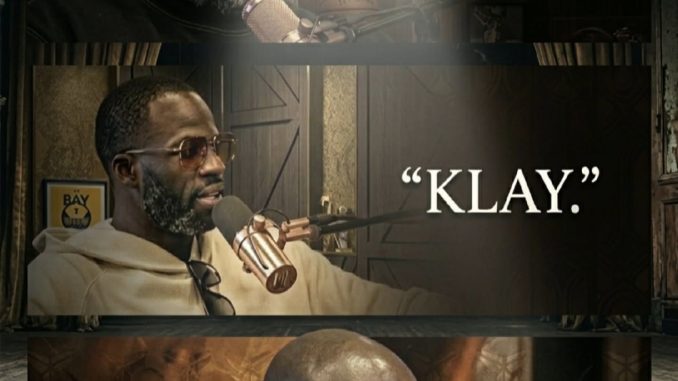
The debate over NBA eras has always been one of basketball’s favorite pastimes, but few arguments have generated as much laughter—and disbelief—as the moment when Draymond Green confidently told Shaquille O’Neal that the 2015 Golden State Warriors would have defeated the legendary 2001 Los Angeles Lakers.
It was the kind of basketball conversation that instantly captured attention. On one side stood Green, the emotional engine and defensive mastermind of a Warriors dynasty that changed the way modern basketball is played. On the other sat O’Neal, the most dominant interior force the league has ever seen and the centerpiece of one of the greatest championship teams in NBA history.
The exchange quickly became unforgettable when Green doubled down on his belief that Golden State’s 2015 championship squad would have found a way to overcome the Lakers team that stormed through the postseason with near-unmatched dominance. The suggestion alone was enough to leave O’Neal visibly stunned, producing one of the funniest reactions basketball fans have seen in a crossover-era debate.
The argument centered around a hypothetical matchup that has fueled barbershop discussions for years. The 2015 Warriors finished the regular season with a league-best 67-15 record and introduced a revolutionary style built on pace, spacing, three-point shooting, ball movement, and defensive versatility. Led by Stephen Curry, Klay Thompson, Green, Andre Iguodala, Harrison Barnes, and Andrew Bogut, Golden State captured the franchise’s first championship in four decades and ushered in a new era of basketball.
The 2001 Lakers, however, occupy a different level of historical reverence.
Featuring O’Neal at the absolute peak of his powers alongside Kobe Bryant entering superstardom, Los Angeles delivered one of the most dominant playoff runs ever recorded. The Lakers finished the postseason 15-1, sweeping through the Western Conference before defeating the Philadelphia 76ers in five games in the NBA Finals. Their combination of overwhelming size, star power, experience, and championship confidence made them one of the most feared teams the sport has ever witnessed.
That is why Green’s confidence caught so many people off guard.
Rather than approaching the matchup cautiously, Green argued that Golden State’s style would have presented problems even for a team as dominant as the 2001 Lakers. His belief rested largely on the Warriors’ ability to spread the floor, switch defensively, and force traditional big men into uncomfortable situations away from the basket.
For Green, basketball evolution matters.
The Warriors were not simply another championship team. They represented a philosophical shift in how the game could be played. Opponents struggled to keep up with their movement, spacing, and shooting volume. Curry’s ability to stretch defenses beyond the three-point line changed defensive schemes across the league, while Thompson’s perimeter shooting created constant pressure on opposing defenses.
Green believed that style would have translated against any era.
The discussion became even more entertaining when the topic turned to defensive assignments, specifically who would guard Bryant.
Green suggested that Thompson would take on the challenge of defending Kobe, a statement that immediately raised eyebrows. While Thompson developed into one of the NBA’s premier perimeter defenders and frequently accepted difficult assignments against elite scorers, comparing the task of defending Bryant in his prime to anything seen in the modern game was enough to make O’Neal pause.
The reaction from Shaq was priceless.
As someone who witnessed Bryant’s greatness up close and shared three championships with him, O’Neal understood better than almost anyone what Kobe represented during that period. Bryant in 2001 was a relentless scoring machine who averaged 29.4 points per game during the playoffs and produced some of the most memorable performances of his career.
During that postseason run, Bryant repeatedly dismantled elite defenses. He torched opponents on the perimeter, attacked the basket fearlessly, and thrived under the brightest spotlight. His combination of athleticism, footwork, skill, and competitiveness made him one of the most difficult players in league history to contain.
Hearing that Thompson would simply neutralize that threat understandably left O’Neal struggling to hide his disbelief.
The visual of Shaq reacting to Green’s argument became almost as memorable as the debate itself. Fans immediately embraced the moment because it represented the clash between two basketball generations.
O’Neal embodies an era defined by physical dominance, interior scoring, and overwhelming size. The Lakers imposed their will on opponents by controlling the paint and punishing smaller lineups. Their offense revolved around feeding the ball to Shaq, who routinely overpowered defenders with a combination of strength, agility, and touch that remains unmatched.
Green’s Warriors represent the opposite end of basketball’s evolutionary spectrum.
Instead of dominating the paint through sheer size, Golden State attacked defenses with speed, skill, and spacing. Their philosophy forced opponents to defend every inch of the court. They transformed the three-point shot from a complementary weapon into the centerpiece of an offensive revolution.
The hypothetical matchup therefore becomes fascinating because each team would attempt to force the game onto its preferred battleground.
The Lakers would likely focus on exploiting their massive advantage inside. O’Neal routinely overwhelmed centers significantly larger and stronger than Bogut, making the idea of Golden State containing him a difficult sell for many observers. Every possession could potentially become an entry pass to Shaq, followed by a trip to the free-throw line or a powerful finish at the rim.
At the same time, the Warriors would seek to stretch Los Angeles beyond its comfort zone.
Curry and Thompson would force Lakers defenders to navigate screens and defend far from the basket. Green’s playmaking and versatility would challenge traditional defensive coverages. Golden State’s pace could create transition opportunities before Los Angeles established its half-court defense.
These competing strengths explain why the debate remains so compelling.
Supporters of the Warriors point to the transformational nature of their system. They argue that Golden State’s shooting would create mathematical advantages impossible to ignore. Even the greatest teams in history, they contend, would struggle against the spacing and offensive firepower that became the Warriors’ trademark.
Supporters of the Lakers counter with a simple question: who is guarding Shaq?
It is a fair point.
Throughout his prime, O’Neal forced opponents to alter entire roster-building strategies. Teams signed extra centers solely to absorb fouls against him. Defensive schemes often failed before games even began because there simply was no effective answer for his size and power.
The 2001 version of O’Neal was particularly devastating. He averaged 30.4 points, 15.4 rebounds, and 2.4 blocks during the Finals while controlling games on both ends of the floor. His presence transformed every matchup.
That reality is likely what fueled O’Neal’s reaction to Green’s confidence.
For Shaq, discussions about all-time great teams inevitably begin with the dominant force standing in the paint. When Green suggested that the Warriors could not only compete but actually defeat the Lakers, it challenged a deeply held belief shared by many basketball historians.
Yet Green’s perspective reflects the mindset that helped make the Warriors champions.
Confidence has always been central to Golden State’s identity. Whether facing established contenders or defending champions, the Warriors never viewed themselves as underdogs. They believed their style could defeat anyone, regardless of reputation or historical standing.
That mentality fueled their rise from an exciting young team into a dynasty.
Green, perhaps more than any other Warrior, embodied that fearlessness. His willingness to challenge conventional wisdom helped define Golden State’s culture. He never hesitated to voice his opinions, regardless of how controversial they might seem.
In that sense, his argument against O’Neal was entirely consistent with his personality.
What makes the moment endure years later is not necessarily whether Green was right or wrong. Rather, it is the combination of conviction and reaction. Green delivered his take with complete confidence, while O’Neal responded with the kind of stunned amusement that instantly resonated with fans.
The exchange highlighted one of sports’ greatest attractions: the endless possibility of comparison.
Because teams from different eras can never actually meet, debates like these have no definitive answer. Every argument relies on assumptions about rules, styles, pace, officiating, and adaptation. Would the Lakers adjust to modern spacing? Would the Warriors find a way to survive against overwhelming interior dominance? Could Curry’s shooting offset O’Neal’s presence in the paint?
Those questions remain impossible to answer.
What is certain, however, is that both teams occupy legendary places in NBA history.
The 2001 Lakers are remembered as one of the most dominant postseason teams ever assembled. O’Neal and Bryant formed a partnership that overwhelmed opponents and delivered championship basketball at the highest level.
The 2015 Warriors, meanwhile, launched a dynasty that reshaped the sport. Their influence continues to be felt throughout every level of basketball, from the NBA to youth leagues around the world.
Perhaps that is why Green felt comfortable making such a bold claim.
Championship teams are built on belief. Players who reach the top rarely spend time wondering whether they could compete with legends. They assume they can. That confidence is often what separates champions from everyone else.
Years after the debate first surfaced, fans still revisit the moment because it perfectly captures the spirit of basketball discourse. One Hall of Famer defends the legacy of a dominant champion. Another championship star challenges conventional thinking and backs his own team without hesitation.
And somewhere in the middle sits Shaquille O’Neal, wearing an expression that seemed to say what millions of fans were already thinking after hearing Green’s argument.
Could Klay Thompson really contain Kobe Bryant? Could the Warriors’ revolutionary offense overcome the most dominant force the paint has ever seen? Could Golden State’s 2015 championship team actually defeat the mighty 2001 Lakers?
Those questions remain unanswered.
But the image of Draymond Green confidently making the case while Shaq sat stunned in disbelief remains one of the funniest and most memorable throwback moments in basketball debate history—a reminder that when NBA legends start comparing eras, entertainment is guaranteed.
Be the first to comment