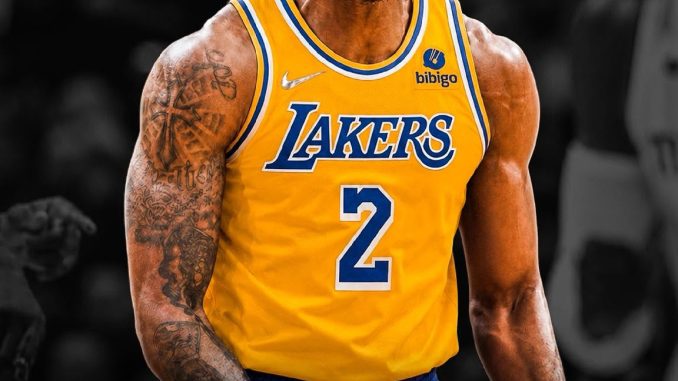
According to league sources, the Los Angeles Lakers are in the final stages of completing what could become one of the most seismic transactions of the modern NBA era, with franchise officials actively working toward finalizing a blockbuster trade for superstar forward Kawhi Leonard. While the deal has not yet been officially announced and details remain fluid as of early Saturday morning, multiple league insiders describe negotiations as “advanced,” with both sides engaged in continuous dialogue aimed at resolving final structural and asset-related components before the agreement is formally completed.
If completed as currently discussed, the move would instantly reshape the balance of power in the Western Conference and send shockwaves throughout the league, pairing Leonard with the Lakers’ existing championship core in what would be one of the most talent-loaded rosters in basketball. For Los Angeles, a franchise that has consistently operated under the pressure of championship expectations, the pursuit of a player of Leonard’s caliber signals an unmistakable win-now directive and a belief that the current competitive window demands another elite two-way force to elevate the roster back to title-contending certainty.
Leonard, a two-time NBA champion and two-time Finals MVP, remains one of the most dominant two-way players in the sport when fully healthy. His ability to control games on both ends of the floor has long made him one of the most coveted assets in the league, even as his availability has been carefully managed in recent seasons due to ongoing load management and injury considerations. For the Lakers, however, the calculus appears centered not only on availability concerns but on the unique postseason value Leonard provides—particularly in half-court settings where defensive versatility, isolation scoring, and late-game shot creation become paramount.
Sources close to the discussions indicate that the Lakers have been aggressively pursuing a third elite perimeter option to complement their existing star framework, believing that the Western Conference has become increasingly dominated by multi-wing, switch-heavy lineups that punish defensive mismatches. Leonard’s presence would immediately address that need, giving Los Angeles a perimeter defender capable of guarding positions one through four at an elite level while also functioning as a primary or secondary offensive engine depending on lineup configurations.
For the front office, the move is not being framed as a short-term gamble but rather a calculated escalation of championship probability. The Lakers have spent recent seasons oscillating between flashes of elite contention and stretches of inconsistency, often dependent on health, depth, and perimeter shot creation. Adding Leonard would significantly reduce the offensive burden on the team’s primary ball handlers while also stabilizing defensive rotations that have, at times, struggled against elite Western Conference offenses.
Still, league executives familiar with the negotiations caution that the final framework of the deal remains complex. Any transaction involving a player of Leonard’s salary level and contractual structure requires careful balancing of outgoing assets, draft capital, and matching salaries under the league’s collective bargaining rules. As of now, multiple scenarios are reportedly still on the table, with discussions centered around whether the Lakers would need to part with a combination of rotation players and future draft control to satisfy the opposing franchise’s valuation.
What makes the situation particularly delicate is Leonard’s unique status as both a franchise-altering talent and a player whose long-term availability is often factored into trade valuation. Despite his proven playoff résumé, teams acquiring Leonard must weigh the physical management strategy that has defined much of his recent career. That tension has historically made negotiations involving him highly complex, with acquiring teams demanding flexibility protections and asset protections in return for absorbing both his contract and injury profile.
From the Lakers’ perspective, however, the urgency appears rooted in timing. With the core of their roster still performing at a high level but clearly operating within a finite competitive window, the front office is believed to view this moment as pivotal. The Western Conference landscape has become increasingly crowded with rising contenders built around younger, faster, and more dynamic two-way wings, forcing veteran-heavy teams to adapt or risk falling behind. In that context, Leonard is viewed as a rare “bridge player”—someone who can dominate both in the present and in high-stakes playoff environments.
The potential pairing of Leonard with the Lakers’ existing star foundation would immediately create one of the most formidable defensive trios in the league, while also significantly improving late-game offensive reliability. Leonard’s mid-range efficiency, ability to create separation in isolation, and calm execution under postseason pressure have historically translated into playoff success, even in series where opposing defenses have otherwise limited offensive flow.
Yet, while the upside is undeniable, internal league conversations also reflect a cautious undertone. Executives around the NBA have long debated whether aggressive consolidation of star talent still guarantees postseason dominance in an era defined by depth, spacing, and relentless pace. The modern championship blueprint has increasingly leaned toward roster balance rather than star accumulation alone, raising questions about whether the Lakers’ potential move is a decisive edge or a high-risk consolidation strategy.
Still, within the Lakers’ organization, confidence reportedly remains high that Leonard’s presence would provide exactly the kind of postseason stabilizer the team has lacked in recent deep playoff runs. His reputation as a player who elevates his performance in critical moments is viewed as especially valuable in a Western Conference that routinely produces seven-game playoff battles defined by execution in the final minutes.
For Leonard, a move to Los Angeles would represent yet another significant chapter in an already storied career. After cementing his legacy with championship runs in both San Antonio and Toronto, he has remained one of the league’s most scrutinized stars due to his selective availability and strategic long-term health management. A transition to the Lakers would place him on one of the league’s most visible stages, alongside another high-profile roster and under the constant national spotlight that comes with playing for one of basketball’s most iconic franchises.
Sources also suggest that competitive considerations may have played a role in Leonard’s openness to exploring the situation. The opportunity to join a roster already positioned for contention, rather than undertaking a full rebuild or transitional phase, is believed to be an appealing factor. While no formal statements have been made by Leonard or his representatives, league insiders emphasize that he has remained professionally engaged throughout the process and has not expressed opposition to potential relocation scenarios discussed between teams.
As negotiations continue, front office personnel are working through final layers of detail, including medical evaluations, long-term asset protections, and financial structuring. These elements are often the final hurdles in deals of this magnitude, particularly when dealing with a player whose health management strategy is as carefully monitored as Leonard’s. The Lakers, meanwhile, are believed to be fully engaged in scenario planning, preparing for multiple roster configurations depending on what the final return package requires.
Around the league, reaction has been swift and divided. Rival executives have privately acknowledged that such a move, if completed, would immediately elevate the Lakers into the upper tier of championship contenders, while also reshaping trade market dynamics for the remainder of the season. Other teams are reportedly monitoring the situation closely, aware that a finalized deal could trigger a ripple effect across the league as franchises adjust to the new competitive hierarchy.
At the same time, skepticism persists in some front offices about the sustainability of assembling multiple high-usage, high-profile players on a single roster. The challenge of balancing offensive touches, maintaining defensive consistency across long stretches, and preserving player health over an 82-game season remains a central concern in any star-driven construction model.
Even so, the Lakers’ front office appears undeterred. The franchise’s history has long been defined by bold swings and high-stakes acquisitions, and this latest pursuit fits squarely within that tradition. The belief internally is that championship opportunities are rarely linear and that elite talent acquisition remains the most reliable path to contention when executed correctly.
As of now, the deal is not yet finalized, but momentum continues to build. League sources describe conversations as “active and progressing,” with optimism growing that an agreement could be reached in short order if final structural issues are resolved. Until then, the NBA landscape remains on alert, awaiting confirmation of what could become one of the most transformative trades in recent memory.
Should the Lakers successfully complete the acquisition of Kawhi Leonard, the message to the rest of the league would be unmistakable: Los Angeles is not simply aiming to compete, but to dominate the current championship cycle with one of the most formidable collections of talent assembled in recent years.
Be the first to comment