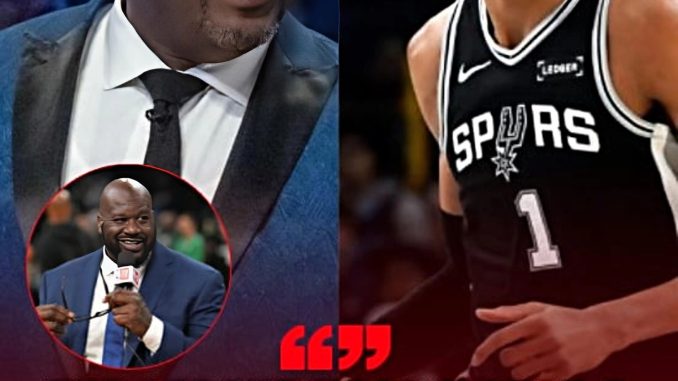
Shaquille O’Neal’s long-standing reputation as one of the most dominant forces the NBA has ever seen has never been in doubt, but his recent endorsement of San Antonio Spurs sensation Victor Wembanyama has reignited conversation across the basketball world about what it truly means to be a “perfect big man” in the modern era. The Hall of Famer, four-time NBA champion, and cultural icon has never been shy about offering strong opinions on today’s game, but his latest praise carries a different kind of weight—because it centers on a player many already believe is redefining basketball possibilities in real time.
The conversation began with Shaquille O’Neal reflecting on the evolving nature of dominant frontcourt players. In his assessment, Wembanyama represents something the league has never fully seen before: a towering presence who combines traditional rim protection with perimeter shooting, ball-handling fluidity, and a level of defensive range that disrupts entire offensive schemes before they can even develop. For O’Neal, who spent his career overpowering opponents in the paint, the emergence of a seven-foot-plus unicorn who can guard all five positions while also stretching the floor is not just impressive—it is transformative.
What made O’Neal’s comments resonate even more was the clarity of his admiration. He described Wembanyama as the “perfect big man,” a label that carries enormous historical weight when coming from someone who once defined the position himself. For decades, the archetype of a dominant center was built around physical dominance, paint scoring, rebounding, and interior defense. Players like Shaq himself, Hakeem Olajuwon, and David Robinson embodied that mold in different ways. But Wembanyama, at just the beginning of his professional journey, is already blending that traditional dominance with skills that were once reserved for guards and wings.
O’Neal’s endorsement is not merely about highlights or potential. It is about sustainability, adaptability, and impact across all phases of the game. He pointed out that Wembanyama’s ability to protect the rim at an elite level while also stepping out to contest three-point shots fundamentally alters how opponents construct their offenses. In the modern NBA, spacing and pace are everything, and a defender who can erase driving lanes while also recovering to shooters is essentially a schematic nightmare for coaching staffs.
But what separates Wembanyama even further in O’Neal’s eyes is his offensive versatility. Unlike traditional big men who rely heavily on post positioning and interior scoring, Wembanyama can initiate offense from the perimeter, knock down jump shots consistently, and even handle the ball in transition. That combination forces defenders into impossible decisions: play him tight and risk getting beaten off the dribble, or give space and allow him to shoot over the top with ease. According to O’Neal, that dual-threat nature is what makes the “perfect big man” label more than just hype.
Around the league, the sentiment is increasingly shared by analysts, former players, and coaches who are struggling to find historical comparisons. The closest parallels often include names like Kevin Durant for shooting at size, Rudy Gobert for defensive impact, or Hakeem Olajuwon for two-way dominance. Yet none of those comparisons fully capture the total package Wembanyama brings to the floor. He is not simply a tall scorer or a defensive anchor—he is both, layered with perimeter skills that continue to expand.
O’Neal’s praise also extended to Wembanyama’s impact on teammates, a factor often overlooked in early-career evaluations. Great big men do more than accumulate stats; they elevate the performance of everyone around them. By altering defensive attention, Wembanyama creates spacing advantages for guards and wings that would otherwise be unavailable. Driving lanes open up, perimeter shots become cleaner, and offensive sets gain an additional layer of unpredictability simply because defenses are forced to account for his presence at all times.
In San Antonio, that ripple effect is already visible. The Spurs’ system, long known for discipline and player development, has quickly adapted to maximize Wembanyama’s unique skill set. Ball movement has improved, transition opportunities have increased, and defensive rotations are more aggressive knowing they have a last line of defense capable of erasing mistakes. While the franchise remains in a developmental phase, the foundation being built around its young star suggests a future shaped heavily by his versatility.
Shaq’s perspective carries additional significance because of his own experience dominating the league as a physical force. During his prime, O’Neal was nearly unstoppable in the paint, requiring double and triple teams to contain his strength and footwork. However, even he acknowledges that the game has changed in ways that would have challenged traditional centers of his era. Floor spacing, three-point shooting, and positional fluidity have shifted the center position from a purely interior role into something far more dynamic. Wembanyama, in many ways, represents the culmination of that evolution.
What makes the comparison particularly striking is how differently both players impose their will on the game. Shaq’s dominance was rooted in overwhelming physicality, while Wembanyama’s influence is more systemic and spatial. One forces defenders backward through force; the other stretches them across the court through versatility. O’Neal’s recognition of that difference highlights not just respect for Wembanyama’s talent, but an acknowledgment that the league may be entering a new era of positional identity.
Still, with all the praise, there is also a measured tone beneath O’Neal’s comments. He has often cautioned against premature comparisons and expectations placed on young stars too early in their careers. While he clearly sees Wembanyama as a generational talent, he also understands that longevity, health, and sustained production ultimately define greatness. The physical demands placed on a player of Wembanyama’s size are unlike those faced by most athletes, and maintaining durability across an 82-game season plus playoffs will be a critical factor in shaping his legacy.
Even so, the trajectory is undeniable. Each game adds new layers to his reputation, whether through defensive masterclasses, offensive outbursts, or subtle plays that shift momentum without showing up prominently in box scores. For O’Neal, that cumulative impact is what separates promising talent from true franchise-altering greatness.
Around the basketball world, reactions to O’Neal’s comments have sparked renewed debate about how big men are evaluated in the modern era. Some argue that versatility has become more important than raw dominance in the paint, while others insist that championship basketball still requires physical interior presence in high-pressure moments. Wembanyama’s emergence challenges both perspectives by offering a hybrid model that blends traditional and modern ideals.
Coaches and executives are now forced to rethink roster construction when facing players like him. Defensive schemes that once relied on switching or drop coverage become significantly less effective when a center can step out and shoot or recover quickly enough to contest perimeter actions. Offensive spacing, meanwhile, must be recalibrated to avoid congestion in the paint while still respecting his shot-blocking presence. The strategic ripple effect extends far beyond individual matchups.
O’Neal’s endorsement also reinforces a broader cultural shift in how legends engage with the next generation. Where once there was skepticism or guarded comparison, there is now more openness to celebrating evolution. Shaq, who once embodied the pinnacle of old-school dominance, now stands as one of the most vocal supporters of the new wave of unicorn talents reshaping the game.
For fans, the excitement lies not only in what Wembanyama has already accomplished, but in what still lies ahead. The “perfect big man” label is not a conclusion—it is a challenge, a benchmark, and a statement of belief in potential still unfolding. Every performance adds weight to that conversation, and every improvement pushes the boundaries of what was once thought possible for a player of his size.
As the NBA continues to evolve, players like Victor Wembanyama are redefining positional limits, while voices like Shaquille O’Neal provide historical grounding for how extraordinary that evolution truly is. When one of the most dominant centers in basketball history openly acknowledges that the modern prototype may have surpassed even traditional greatness in versatility, the conversation shifts from speculation to validation.
In that sense, O’Neal’s praise is more than commentary—it is a bridge between eras. It connects the era of bruising post play and paint control with a new age defined by spacing, skill, and positional fluidity. And at the center of that bridge stands Wembanyama, a player whose development continues to stretch the imagination of what basketball excellence can look like.
If the trajectory continues, the label of “perfect big man” may evolve from a bold statement into a widely accepted truth. For now, it remains one of the strongest endorsements a young player can receive—delivered by a legend who knows better than most what true dominance looks like, and who now sees its future taking shape in real time.
Be the first to comment