San Antonio’s playoff atmosphere was at its loudest and most hostile in Game 3, but none of it seemed to matter to Shai Gilgeous-Alexander, who delivered a composed, almost detached performance under the weight of relentless crowd noise and targeted chants from Spurs supporters.
From the opening minutes inside a packed arena roaring for the San Antonio Spurs, the tension was unmistakable. Every dribble SGA took was met with a rising wave of boos. Every hesitation in the half court was dissected by a fan base determined to disrupt rhythm and force frustration. And then came the chant that defined the night’s crowd energy: “flopper.”
It was loud, coordinated, and repeated in waves whenever Gilgeous-Alexander attacked the paint. A label that has followed him in pockets of opposing arenas throughout his career was amplified in San Antonio, where fans attempted to turn perception into pressure. But instead of reacting emotionally or trying to silence the building with theatrics, the Oklahoma City star leaned into the same calm that has become his trademark.
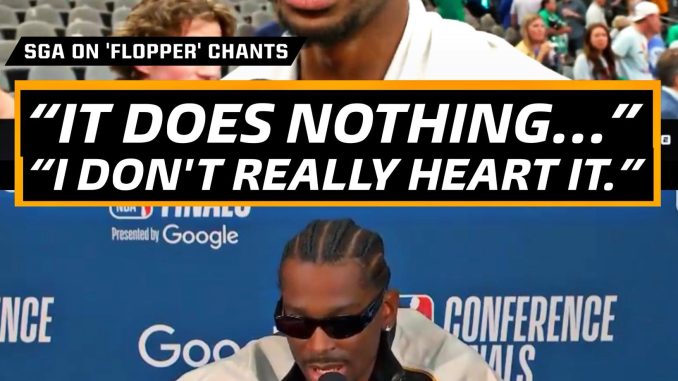
“It does nothing. Doesn’t fuel me, doesn’t discourage me,” Gilgeous-Alexander said afterward. “I’ve been dealing with it for a long time. I don’t really hear it.”
That single statement encapsulated the entire tone of his night: controlled, unaffected, and completely locked in on execution rather than emotion.
For the Oklahoma City Thunder, Game 3 was another chapter in a growing playoff identity built on composure under pressure. And for SGA, it was another reminder that external narratives rarely dictate his internal rhythm. While the crowd tried to tilt the game into psychological warfare, he kept returning to the same steady formula—change of pace, probing dribble, mid-range patience, and surgical decision-making.
What made the atmosphere more intense than a typical road playoff setting was not just the noise, but the specificity of it. “Flopper” chants are designed to challenge a player’s reputation, to suggest manipulation rather than skill, and to provoke visible frustration that officials might notice. But Gilgeous-Alexander’s style of play—built on footwork, balance, and subtle contact absorption—has long lived in that contested space between artistry and accusation.
Rather than engage with it, he did what elite playoff performers tend to do: he removed it from the equation entirely.
On multiple possessions, he drove into traffic where contact was inevitable. On others, he pulled up from mid-range areas where defenders could only contest late. Each time he returned to the bench, there was no visible acknowledgment of the crowd’s provocations, no gestures toward officials, and no emotional spike that suggested distraction.
Teammates noticed it too. The Thunder’s bench remained engaged but calm, mirroring their leader’s demeanor. In a playoff environment where momentum swings often begin with emotional reactions, Oklahoma City’s discipline stood out even amid the chaos.
The Spurs’ defensive strategy was physical from the outset, attempting to crowd driving lanes and force Gilgeous-Alexander into uncomfortable angles. Help defenders rotated aggressively, and San Antonio’s perimeter defenders tried to meet him early in possessions to disrupt rhythm before it could form. But every adjustment seemed to meet the same outcome: SGA finding space that didn’t look like space until he was already in it.
That ability to manipulate defenders without explosive speed is what makes him one of the most difficult players in the league to contain. He changes tempo rather than simply accelerating through it. He decelerates into defenders, draws them into mistakes, and then slips into scoring pockets that open for only a split second.
Even as the crowd tried to escalate the emotional stakes, Gilgeous-Alexander’s game stayed mathematically consistent—shot selection sharp, turnovers limited, and decision-making unhurried.
By halftime, the chants had not faded, but their impact had clearly diminished. The Spurs’ home crowd remained loud, but the psychological edge they hoped to establish never materialized into momentum on the court. Instead, Oklahoma City weathered the environment possession by possession, refusing to let the game drift into chaos.
The second half followed a similar pattern. Every Spurs push was met with a calculated response from the Thunder, and every attempt to rattle SGA seemed to reinforce his steadiness rather than disrupt it. When defenders tightened, he passed. When help collapsed, he finished. When switches appeared, he isolated with patience rather than urgency.
The result was a performance that felt less like resistance and more like absorption—taking everything the environment offered and neutralizing it without visible strain.
For the Spurs, the frustration was not simply that Gilgeous-Alexander scored or created offense, but that he did so without reacting to the noise around him. Crowd energy in San Antonio is often used as a weapon, particularly in playoff settings where young stars can be rattled by the intensity. But SGA did not offer the emotional feedback loop the arena was seeking.
Instead, he maintained a consistent expression, a steady pace, and a refusal to acknowledge any narrative beyond the possession in front of him.
After the game, his comments reinforced that mindset. He did not frame the chants as disrespectful, nor did he dismiss the fans outright. He simply minimized their relevance.
That approach is becoming a defining trait of his postseason identity. While many stars lean into crowd interactions—responding to taunts, celebrating provocations, or engaging in visible exchanges—Gilgeous-Alexander has increasingly chosen the opposite path. His response is internal, not external. His communication is through execution, not emotion.
It is a mentality that has served the Thunder well throughout their playoff run. In high-pressure environments where young teams often unravel under sustained hostility, Oklahoma City has shown a growing ability to remain structurally intact.
Much of that stability stems from their leader’s tone-setting. Gilgeous-Alexander does not escalate situations, nor does he shrink from them. He simply processes them and continues.
The Spurs, meanwhile, will likely revisit their defensive approach heading into the next game. While physicality and crowd energy are standard tools in their home-court arsenal, neither produced the intended disruption against a player who appears increasingly insulated from external influence.
There were moments where San Antonio’s strategy created brief discomfort, forcing tougher shots or slowing transition flow. But none of it built into a sustained breakthrough. And as the game wore on, it became clear that the psychological battle they hoped to win was not unfolding as planned.
Instead, the story of Game 3 became less about the crowd’s attempt to define Gilgeous-Alexander and more about his refusal to be defined at all.
In a league where narratives often form as quickly as they are reinforced, SGA’s resistance to external framing is becoming one of the most consistent storylines of his playoff career. The “flopper” chants may echo through the arena, but they do not appear to echo in his performance.
If anything, they seem to fade faster each time they are introduced.
For the Thunder, that may be the most valuable trait of all. Because in the playoffs, talent is expected. Execution is required. But emotional insulation—the ability to remain unchanged by environment—is what separates stars who survive from those who control the series.
And on this night in San Antonio, Gilgeous-Alexander did not just survive the noise. He erased its relevance entirely without ever needing to acknowledge it beyond a single, calm sentence.
“It does nothing,” he said.
And for the Spurs’ crowd, trying to pull him out of rhythm, that was the most decisive answer of the night.
Be the first to comment