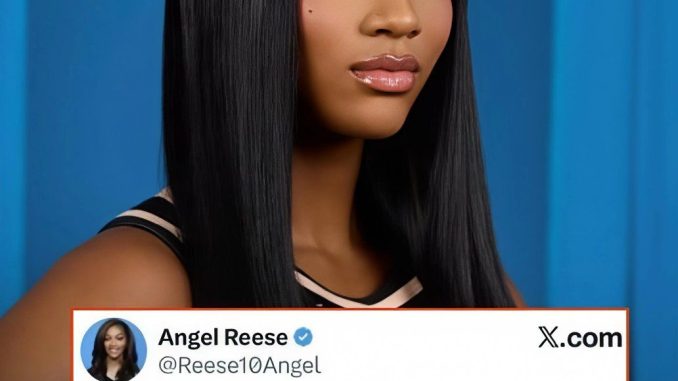
A viral social media exchange between two of basketball’s most recognizable figures has once again blurred the line between competition, commentary, and culture, as NBA superstar Kevin Durant appeared to fire back at WNBA standout Angel Reese following a remark that quickly spread across platforms and ignited debate about performance expectations, media scrutiny, and the modern athlete’s relationship with public opinion.
The moment began when a clip featuring Reese discussing inconsistency in elite-level performances circulated online, with the WNBA forward referencing “bad games” in the context of how stars are judged when they fail to meet expectations. While the comment was not directed at any specific NBA player, fans online quickly tied it to Durant’s long-standing reputation as one of the league’s most scrutinized superstars, particularly given his history of outspoken exchanges on social media and his willingness to engage directly with critics.
Within hours, Durant responded in a manner that instantly went viral. In a short but pointed message, the Phoenix Suns forward wrote, “Yours be every game,” a line widely interpreted as a subtle but sharp rebuttal aimed at Reese’s framing of inconsistency and criticism. The phrase, though brief, carried the tone of Durant’s familiar social media persona—measured but cutting, cryptic yet unmistakably reactive.
The internet immediately seized on the exchange, with fans, analysts, and commentators dissecting both the original remark and Durant’s response. Some interpreted Durant’s comment as a reminder of the relentless expectations placed on elite athletes, where even a “bad game” becomes a headline. Others viewed it as an unnecessary escalation directed at a younger player whose comments were more general than personal.
What made the situation more compelling was the contrast in their career stages and public positioning. Durant, a two-time NBA champion, former MVP, and one of the most accomplished scorers in basketball history, has spent nearly two decades under an intense microscope. Every slump, every playoff exit, and every decision to switch teams has been analyzed in real time across multiple media cycles.
Reese, on the other hand, has quickly become one of the most recognizable faces in women’s basketball since her rise to national prominence in college and her transition into the WNBA. Known for her confidence, rebounding dominance, and unapologetic on-court demeanor, she has embraced a public persona that thrives on competitiveness and emotional expression. That visibility has also brought increased scrutiny, particularly as she navigates the early stages of her professional career.
In that context, the exchange between Durant and Reese reflects a broader generational and cultural dynamic in basketball: the intersection of confidence, criticism, and constant visibility in the digital age. Athletes today are no longer insulated from real-time reaction. A single quote, clipped video, or post can become global discourse within minutes.
Durant, who has long been one of the most active superstar voices on social media, is no stranger to such moments. His online interactions have frequently sparked headlines, ranging from lighthearted exchanges with fans to more pointed disputes with analysts and critics. Over the years, he has openly defended his right to engage directly with narratives surrounding his performance, often pushing back against what he perceives as misrepresentation or oversimplification.
In this instance, his response to Reese was brief but carried weight precisely because of his reputation. “Yours be every game,” though ambiguous, was widely interpreted as a critique of blanket statements about performance inconsistency. Some fans suggested Durant was emphasizing that at the highest level, every athlete—including Reese—experiences fluctuation, and that singling out “bad games” ignores the broader reality of professional sports.
Others pushed back, arguing that Durant’s comment was unnecessary and risked mischaracterizing Reese’s original intent. Many pointed out that Reese’s comment appeared to be a general observation about expectations placed on athletes, particularly in high-pressure environments where performance is constantly evaluated and compared.
The discourse quickly expanded beyond the individuals involved, evolving into a larger conversation about how men’s and women’s basketball intersect in media narratives. Supporters of Reese highlighted how women athletes often face amplified scrutiny and are frequently judged through different standards, especially when confidence is expressed openly. Meanwhile, Durant’s supporters emphasized his right to respond and his long-standing stance on engaging directly with public commentary.
On television panels and sports talk shows, the exchange became a talking point almost immediately. Analysts debated whether Durant’s response was playful, dismissive, or defensive. Some suggested it was simply another example of his well-documented tendency to engage in social media banter without necessarily intending deeper confrontation. Others viewed it as a reflection of how seriously elite athletes take perceived commentary about performance standards.
The timing of the exchange also added fuel to the conversation, as both the NBA and WNBA seasons continue to draw heightened attention in a year marked by increased crossover visibility between leagues. With women’s basketball experiencing a surge in popularity and NBA stars frequently acknowledging WNBA players’ influence, interactions—direct or indirect—between athletes across leagues carry more cultural weight than ever before.
Durant’s presence in such conversations is not new. Throughout his career, he has frequently been at the center of debates about legacy, leadership, and public perception. His candid engagement on social platforms has made him one of the most transparent superstar athletes of his generation, but also one of the most polarizing. Every remark, even those made in passing, tends to generate significant interpretation.
Reese, meanwhile, has emerged as a figure unafraid of attention. From her college championship run to her transition into professional basketball, she has embraced both praise and criticism with visible confidence. That approach has made her a central figure in discussions about the evolving identity of women’s sports, particularly in how athletes manage fame in real time.
In many ways, the viral exchange underscores how modern basketball discourse no longer stays confined to the court. A single phrase can travel across platforms, be reframed by fans, and eventually become a headline involving two athletes who may not have directly intended confrontation. The speed of that transformation is now part of the sport itself.
For Durant, moments like this are familiar territory. He has previously engaged with fans and media narratives in ways that have both endeared him to supporters who appreciate his honesty and frustrated those who prefer athletes remain detached from commentary. His response to Reese fits neatly into that pattern—succinct, reactive, and immediately open to interpretation.
For Reese, the situation highlights the challenges of being a young star in an era where visibility comes with amplified context. Every comment can be detached from its original setting and placed into broader narratives that may or may not reflect the speaker’s intent. As her profile continues to rise, such moments are likely to become more frequent.
What remains clear is that neither athlete has indicated any ongoing dispute beyond the viral exchange itself. There has been no extended back-and-forth, no formal statements, and no indication that the interaction was anything more than a momentary collision of commentary and interpretation. Still, in today’s sports environment, even fleeting interactions can take on extended life cycles in the public sphere.
The phrase “Yours be every game” has since been dissected across platforms, with interpretations ranging from humorous to critical. Some fans have turned it into memes, while others have used it as a talking point about consistency and pressure in elite sports. As with many viral sports moments, its meaning has become shaped as much by audience reaction as by its original intent.
In the broader picture, the exchange between Kevin Durant and Angel Reese serves as another example of how basketball’s cultural footprint extends far beyond game nights. It is a reminder that the modern athlete exists in a constant feedback loop—between performance, perception, and public commentary—where even a few words can become a global talking point.
Whether interpreted as a light jab, a philosophical remark about performance, or simply another instance of Durant engaging in online discourse, the moment reflects the evolving nature of sports communication. Athletes are no longer just subjects of analysis; they are active participants in shaping the narrative in real time.
As the conversation continues to circulate, both players remain focused on their respective seasons and responsibilities. But in the digital age of sports, moments like this rarely fade quickly. Instead, they become part of an ongoing dialogue about greatness, scrutiny, and the increasingly thin line between personal expression and public interpretation in professional basketball.
Be the first to comment