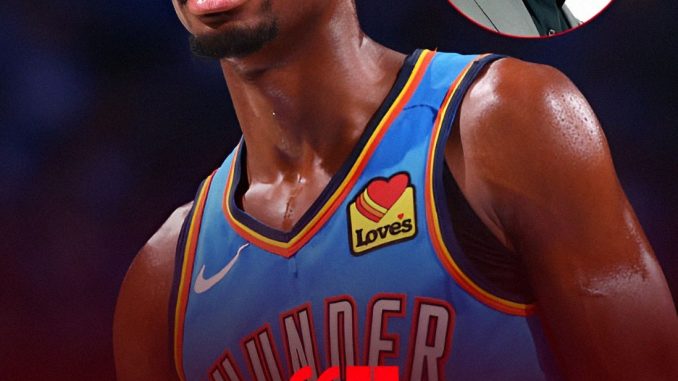
OKLAHOMA CITY — In a Western Conference Finals series already defined by pace shifts, tactical adjustments, and star power on full display, Game 5 turned into yet another chapter where composure at the free-throw line became the quiet separator. At the center of it all was Oklahoma City’s MVP-caliber guard Shai Gilgeous-Alexander, who authored one of the most efficient and controversial scoring nights of the postseason, drawing 17 free throw attempts in a game that immediately sparked debate across the basketball world.
By the time the final buzzer sounded on Oklahoma City’s 127–114 victory over San Antonio, the box score told a story that felt both familiar and polarizing. Gilgeous-Alexander’s ability to manipulate defenses, get downhill, and force contact once again tilted the margins in the Thunder’s favor. But beyond the numbers, the reaction that reverberated across television screens and social media came from one of the league’s most outspoken voices—Shannon Sharpe—whose on-air response captured the shock, admiration, and frustration that often follow performances built at the foul line.
“Seventeen free throws?” Sharpe reacted, visibly stunned during a live discussion segment after Game 5 highlights aired. “At some point, you just have to ask how you’re guarding him without fouling him, because he lives at the line.”
That sentiment has become increasingly common whenever Gilgeous-Alexander steps into the postseason spotlight. His scoring style—patient, methodical, and relentlessly angled toward contact—has made him one of the most difficult guards in basketball to contain without crossing into foul territory. Game 5 was no exception. Every drive seemed to place defenders in a split-second dilemma: give up the layup or risk sending one of the league’s premier free throw shooters to the line.
From the opening quarter, Oklahoma City made it clear they intended to attack San Antonio’s interior defense. Gilgeous-Alexander set the tone early, probing the half-court defense with controlled hesitation dribbles, shifting gears at the elbows, and forcing Spurs defenders into awkward recovery positions. It didn’t take long before whistles began to accumulate.
San Antonio’s defensive game plan had centered on physicality—bodying up on drives, sending help from the weak side, and trying to force the ball out of Gilgeous-Alexander’s hands before he could gather momentum. But that strategy came with a dangerous tradeoff. Each overcommitment opened driving lanes, and once Gilgeous-Alexander reached the paint, the Spurs were often left reacting rather than dictating.
By halftime, he had already reached double digits from the line, a number that immediately shifted the rhythm of the game. Every foul stoppage slowed San Antonio’s defensive momentum, while simultaneously allowing Oklahoma City to settle into half-court organization and control the tempo. In a series where both teams had traded bursts of transition dominance, Game 5 tilted toward half-court execution—and that is where Gilgeous-Alexander thrives.
What makes his free throw volume particularly notable is not simply the frequency, but the consistency with which he generates it under playoff pressure. In the regular season, foul drawing can sometimes be dismissed as officiating variance or game flow. In the postseason, however, every whistle carries amplified scrutiny, and every trip to the line becomes a mental reset point that can swing momentum.
Gilgeous-Alexander treated those moments like a metronome. Each trip to the stripe was deliberate. No rush. No visible frustration. Just repetition, routine, and results. By the end of the night, he had converted the majority of his attempts, quietly stacking points that never required a jumper to fall or a three-pointer to splash.
San Antonio head coach Gregg Popovich’s defensive adjustments reflected the growing problem. The Spurs experimented with earlier help rotations, switched more aggressively on perimeter screens, and even briefly deployed a zone look to limit direct drives. But none of it fully removed Gilgeous-Alexander’s ability to initiate contact at the elbow or snake into the lane.
The result was a game where the Thunder’s star guard did not necessarily overwhelm with highlight dunks or explosive scoring runs, but instead dissected the defense through leverage, timing, and an almost surgical understanding of defender positioning. For every possession where San Antonio managed to contest cleanly, there were two more where a half-step of misalignment led to a whistle.
By the fourth quarter, the fatigue factor became visible. Defenders hesitated just long enough to avoid fouling, and that hesitation opened cleaner driving lanes. Gilgeous-Alexander capitalized, either finishing through contact or drawing yet another trip to the line. The psychological impact was just as important as the scoreboard.
Meanwhile, Oklahoma City’s offense fed off the stability. When a team knows it can generate points without needing to rely on perimeter shooting variance, it changes the entire offensive structure. The Thunder spaced the floor accordingly, allowing Gilgeous-Alexander to operate as both scorer and pressure point, collapsing the defense and kicking out when necessary.
The Spurs, for their part, struggled to find an answer that didn’t compromise their defensive identity. Overhelping led to open shooters. Staying home on shooters led to more isolation drives. And isolation against Gilgeous-Alexander, especially in rhythm, often ends in either a bucket or a whistle.
The conversation after the game quickly shifted beyond the result itself and toward the broader implications of Gilgeous-Alexander’s style of play. Analysts debated whether his ability to draw fouls is a skill comparable to elite shot creation, or whether it places excessive pressure on officiating in high-stakes playoff environments.
Sharpe’s reaction embodied that split perspective. On one hand, there was clear acknowledgment of Gilgeous-Alexander’s brilliance—his footwork, patience, and ability to force defenders into compromised positions. On the other, there was visible disbelief at how often those possessions ended with a trip to the free-throw line rather than a contested shot.
“It’s not accidental,” Sharpe added during his breakdown. “You don’t get to the line 17 times in a playoff game by chance. That’s craft. That’s understanding angles. That’s knowing how defenders are going to react before they react.”
Inside the Thunder locker room, the focus remained more grounded. Teammates emphasized discipline, ball movement, and trusting the system that has carried Oklahoma City throughout the postseason. While Gilgeous-Alexander’s scoring drew headlines, the collective execution—defensive rotations, rebounding control, and timely perimeter shooting—helped secure the double-digit win.
Still, it is impossible to separate Oklahoma City’s identity from their star guard’s ability to dictate games without relying solely on jump shooting. In a league increasingly defined by spacing and three-point variance, Gilgeous-Alexander has carved out a different kind of dominance—one rooted in pressure, angles, and free-throw efficiency.
For San Antonio, Game 5 will likely be remembered as a missed opportunity to tighten the series. Despite stretches of strong offensive rhythm and competitive shot-making, the inability to contain dribble penetration without fouling proved costly. Every defensive stand seemed to come with a caveat, and over the course of four quarters, those small infractions accumulated into a decisive gap.
As the series now shifts back toward elimination stakes, the Spurs face a difficult recalibration. Defend him less aggressively, and risk allowing clean looks at the rim. Defend him physically, and risk another night where the scoreboard is shaped as much at the free-throw line as anywhere else on the floor.
For Gilgeous-Alexander, however, Game 5 was simply another entry in a growing postseason résumé defined by control. Not just control of pace or scoring, but control of defensive reactions themselves. Every drive becomes a negotiation, and more often than not, he wins the terms.
And as Shannon Sharpe’s reaction made clear, the broader basketball world is still trying to fully reconcile how to interpret that dominance. Shock, admiration, frustration—it all exists in the same space when a player can bend a defense to the point where 17 free throws feel less like an anomaly and more like a blueprint.
In a series where every possession carries weight, Gilgeous-Alexander once again proved that sometimes the most powerful scoring tool is not speed, not range, and not even explosiveness—but the ability to force inevitability.
Be the first to comment