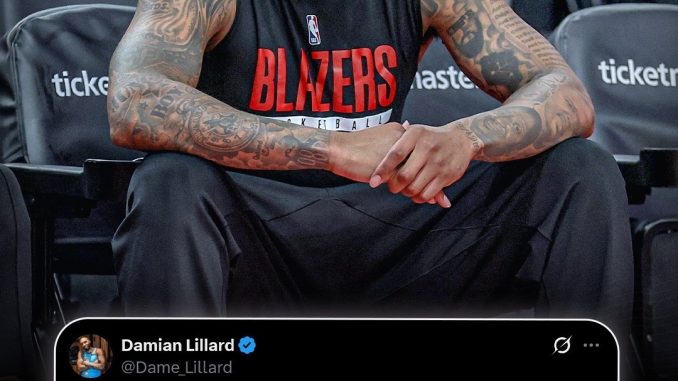
When the conversation turns to the greatest shooters in NBA history, one name has become untouchable in the modern era: Stephen Curry. The revolution he sparked changed basketball forever, stretching defenses beyond recognition and making the three-point shot the centerpiece of the league’s offensive identity. But now another superstar believes his place in that conversation deserves more respect. Damian Lillard recently made it clear that when it comes to the greatest shooters the NBA has ever seen, he sees himself directly behind Curry — and perhaps closer to the top than many fans are willing to admit.
It is the kind of statement guaranteed to ignite debate across locker rooms, television studios, barbershops, and social media timelines. Basketball fans love ranking greatness, especially when it comes to an art form as visually spectacular as shooting. Yet while some immediately dismissed Lillard’s claim as self-confidence crossing into exaggeration, others believe the longtime superstar guard from Oakland has a legitimate argument backed by years of unforgettable shot-making, impossible range, and postseason heroics that few players in league history can match.
Lillard has never lacked belief in himself. From the moment he entered the NBA as the sixth overall pick in 2012, he carried himself with the confidence of a player destined for stardom. Playing for the Portland Trail Blazers, he quickly established a reputation as one of the league’s most fearless guards. Big moments seemed to energize him rather than intimidate him. Deep pull-up threes became routine. Game-winning daggers became expected. Defenders learned quickly that crossing half court against Lillard meant the danger had already started.
Over time, his range evolved from impressive to absurd. While many elite shooters rely heavily on catch-and-shoot opportunities created by offensive systems, Lillard built his reputation on some of the toughest shot diets imaginable. Step-backs from 35 feet. Pull-ups off high screens. Deep transition bombs with defenders draped all over him. He did not simply make threes — he weaponized them psychologically. Opponents often looked defeated before possessions even ended because they understood no lead was safe once Lillard entered rhythm.
That reputation exploded into global basketball lore during the 2019 playoffs. In Game 5 against the Oklahoma City Thunder, Lillard delivered one of the coldest moments in NBA postseason history. With the clock winding down in a tied game, he casually launched a 37-foot three over Paul George and buried it at the buzzer to eliminate the Thunder from the playoffs. His now-iconic wave goodbye instantly became part of NBA history. The shot was not merely memorable because it won the series — it symbolized how comfortable Lillard had become taking attempts most players would never dare consider.
Moments like that are central to Lillard’s case. Pure percentages alone rarely tell the full story of shooting greatness. Context matters. Difficulty matters. Defensive attention matters. Pressure matters. Lillard has spent much of his career carrying enormous offensive responsibility without the luxury of superstar-heavy rosters around him. Opposing defenses game-planned almost entirely around stopping him, yet he still produced elite scoring numbers year after year while maintaining remarkable shooting efficiency from distances that barely seemed realistic.
Of course, the challenge for Lillard is that the player ahead of him is Curry — a basketball phenomenon who permanently altered how the game is played. Curry’s résumé as a shooter is nearly impossible to attack. The four-time NBA champion with the Golden State Warriors owns records that once seemed unreachable. He became the NBA’s all-time leader in three-pointers made while consistently shooting at percentages that would be elite even for specialists taking far easier attempts. Curry’s off-ball movement, lightning release, and limitless range transformed him into arguably the most dangerous offensive player the sport has ever seen.
For many basketball observers, that alone settles the debate. Curry occupies Tier 1 alone, while everyone else fights for second place. That reality may actually strengthen Lillard’s argument rather than weaken it. Few players in league history can realistically enter the conversation with Curry at all. The fact that Lillard’s name consistently appears in those discussions says everything about how respected his shooting ability truly is across the league.
The debate becomes fascinating when comparing Lillard to the other legendary snipers who shaped NBA history. Ray Allen long represented the gold standard before Curry arrived. Allen’s textbook form and relentless consistency helped define an era. His iconic corner three in Game 6 of the 2013 NBA Finals remains one of the most important shots ever made. Then there is Reggie Miller, whose clutch gene terrorized opponents throughout the 1990s. Klay Thompson may be the greatest catch-and-shoot weapon the sport has ever produced. Legends like Larry Bird and Steve Nash also deserve mention for redefining perimeter excellence during their eras.
What separates Lillard from many of those names is the degree of difficulty attached to his attempts. Modern analytics emphasize efficiency, but they also highlight how extraordinary Lillard’s shot profile really is. Many of his threes are self-created off the dribble from distances closer to the logo than the arc. Coaches actively discourage most players from attempting those shots because they are considered low-percentage looks. For Lillard, they became signature weapons. His ability to normalize shots from 30 to 35 feet fundamentally altered defensive schemes in the same way Curry’s did.
Former players and analysts around the league have repeatedly acknowledged this unique aspect of Lillard’s game. Defenders often must pick him up immediately after he crosses half court, stretching defensive structures to uncomfortable levels. That pressure opens driving lanes and offensive opportunities not just for him, but for entire teams. It is the type of gravity typically associated only with Curry.
Lillard’s confidence in declaring himself second on the all-time shooting list also reflects the mentality elite scorers must possess. Great shooters are built on irrational confidence. Hesitation ruins greatness. Every legendary marksman believes the next shot is going in regardless of circumstance. Lillard’s willingness to publicly place himself among the greatest ever is consistent with the mindset that helped him survive and thrive in the NBA for more than a decade.
Still, critics of his claim point toward numbers and accolades. Curry’s efficiency surpasses nearly everyone in basketball history despite taking impossible shots. Allen and Miller built legendary postseason résumés across deep playoff runs. Thompson owns historic single-game shooting explosions and championship moments. Some fans argue that Lillard’s lack of Finals appearances weakens his standing historically compared to others frequently mentioned in the debate.
But basketball history is often more nuanced than championships alone. Individual brilliance does not always align perfectly with team success. Lillard spent much of his prime in a brutally competitive Western Conference loaded with dynasties and superstar pairings. Despite that reality, he consistently elevated Portland into playoff contention while producing unforgettable individual moments. Few players in league history have carried smaller-market franchises with the level of loyalty and consistency Lillard displayed during his tenure with the Trail Blazers.
His move to the Milwaukee Bucks alongside Giannis Antetokounmpo also reignited conversations about how his legacy may ultimately evolve. Sharing the floor with a dominant interior force opened new possibilities for Lillard offensively, while also giving him another opportunity to compete for a championship. Injuries and inconsistency complicated portions of the Bucks’ recent seasons, but Lillard’s shooting brilliance still appeared regularly in flashes that reminded everyone why defenses continue fearing him from virtually anywhere on the court.
There is also an emotional element to this debate that statistics alone cannot fully capture. Basketball fans remember feelings as much as percentages. Lillard’s deep threes carry drama. They feel cinematic. Every time he rises from near the logo late in games, arenas collectively hold their breath because history suggests there is a real chance the shot is going in. That aura matters. Fear matters. The psychological impact a shooter has on opponents matters.
Few players have inspired the kind of defensive panic Lillard routinely creates. Coaches redesign coverages specifically to limit his range. Big men are dragged into uncomfortable territory defending screens near half court. Traps arrive earlier than against almost any other player in basketball. Those adjustments reflect extraordinary respect from opposing teams.
Interestingly, several current and former NBA players likely agree more with Lillard’s claim than the general public might expect. Players understand the difficulty of creating shots under pressure better than anyone. They recognize how exhausting it is to consistently generate offense against elite defenders with limited spacing. Many within NBA circles view Lillard as one of the most naturally gifted deep-range shooters the game has ever seen.
The evolution of the modern NBA also strengthens his argument historically. Today’s league is built around spacing and perimeter shooting more than ever before. Players like Curry and Lillard accelerated that transformation. Young guards across basketball now imitate shots that would have gotten players benched 20 years ago. Pull-up threes from 30 feet are no longer shocking because stars like Lillard normalized them.
That influence on basketball culture matters when discussing greatness. Being a great shooter is one thing. Changing what future generations believe is possible is another. Curry unquestionably sits at the center of that revolution, but Lillard belongs among the players who helped expand basketball’s imagination. Kids in gyms everywhere now practice logo threes because players like Dame made them iconic.
Whether fans ultimately rank him second all-time remains deeply subjective. Some will always prefer the pure shooting mechanics and efficiency of Allen. Others will prioritize Miller’s playoff résumé or Thompson’s championship pedigree. Basketball debates rarely produce unanimous conclusions, especially across eras with different rules and playing styles.
But dismissing Lillard’s claim outright would ignore one undeniable truth: he has accomplished things as a shooter that very few human beings in basketball history could even attempt. His range is historic. His shot-making under pressure is legendary. His confidence is unmatched. And his impact on how defenses operate is profound.
Perhaps the strongest evidence supporting Lillard’s belief is how natural the statement actually sounds in today’s NBA landscape. Ten years ago, placing him that high may have felt outrageous. Now, it feels debatable — and that alone is a testament to the career he has built.
As the league continues evolving deeper into the three-point era, discussions surrounding shooting greatness will only intensify. Records will fall. New stars will emerge. But the names at the center of the conversation will remain difficult to move. Curry’s throne appears secure for now, yet the battle for the spot directly behind him is wide open depending on what qualities matter most to each observer.
For Damian Lillard, there is no uncertainty at all. In his mind, the combination of range, difficulty, clutch performance, and consistency places him directly behind Curry among basketball immortals. Considering the unforgettable moments he has delivered throughout his career, there are plenty around the NBA who believe that claim deserves far more respect than criticism.
Be the first to comment