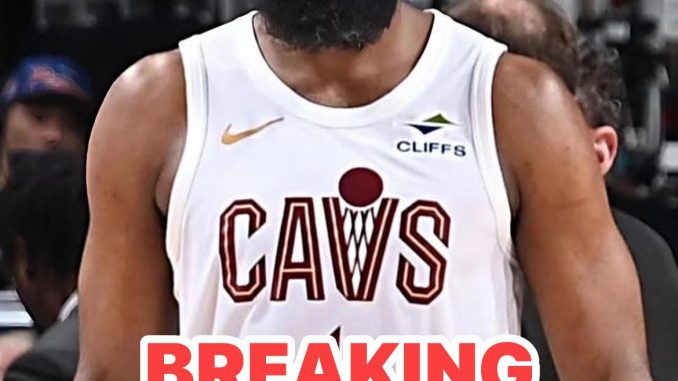
BREAKING: In a stunning development that has sent shockwaves throughout the basketball world, James Harden has reportedly announced his retirement from the NBA, bringing an end to a 17-year professional career defined by scoring brilliance, offensive innovation, MVP-caliber dominance, and one of the most distinctive playing styles the league has ever seen.
Multiple league sources indicate that Harden’s decision comes after what insiders describe as “weeks of internal reflection,” with the former MVP ultimately choosing to step away from the game rather than pursue another contract or extend his career into a 18th season. While official confirmation from Harden or his representatives is still pending, early reports suggest the decision is final, marking the end of an era for one of the most prolific offensive guards in modern basketball history.
Harden’s retirement immediately closes the chapter on a career that began when he entered the league as the No. 3 overall pick in the 2009 NBA Draft out of Arizona State University. Drafted by the Oklahoma City Thunder, Harden arrived in the league as a promising left-handed guard with elite vision and an unorthodox scoring arsenal that would later evolve into one of the most unstoppable offensive skill sets the NBA has ever witnessed.
He first made his mark in Oklahoma City as part of a young core alongside Kevin Durant and Russell Westbrook, helping the Thunder reach the 2012 NBA Finals. Though he came off the bench during that run, his impact was undeniable, earning him the NBA Sixth Man of the Year Award and signaling the emergence of a future superstar. That Finals appearance would ultimately serve as the launching pad for a career that would soon shift into full superstardom.
The turning point came in 2012 when Harden was traded to the Houston Rockets, a move that would reshape both his career and the NBA’s offensive landscape. In Houston, Harden transformed from a promising young guard into the league’s premier offensive engine, becoming the centerpiece of a system designed around his scoring, playmaking, and ability to manipulate defenses like few players in history.
Over the course of his Rockets tenure, Harden captured the 2018 NBA Most Valuable Player Award, led the league in scoring for three consecutive seasons, and delivered one of the most statistically dominant offensive stretches in modern basketball. His step-back three-pointer became a signature weapon, his foul-drawing craft became a subject of league-wide debate, and his nightly scoring explosions turned Houston into must-watch television for nearly a decade.
Beyond the numbers, Harden’s Houston era represented a philosophical shift in the sport. The Rockets built an offense that leaned heavily on analytics, spacing, and isolation creation, with Harden at the center of every possession. Critics often questioned the sustainability of the style, but the results were undeniable: year after year, Houston remained a Western Conference contender, pushing the league’s best teams to the limit, including multiple deep playoff runs that came within striking distance of the NBA Finals.
After his time in Houston ended, Harden’s career took on a new chapter filled with movement, adaptation, and continued excellence. He was traded to the Brooklyn Nets in 2021, forming one of the most star-studded trios in recent NBA memory alongside Kevin Durant and Kyrie Irving. Though injuries and chemistry issues ultimately limited the team’s championship aspirations, Harden’s playmaking evolved dramatically during this period, as he led the league in assists and embraced a more traditional facilitator role.
In Brooklyn, Harden demonstrated that his greatness was not limited to scoring alone. He orchestrated offenses with precision, controlled tempo at an elite level, and proved capable of adjusting his game to fit alongside other high-usage superstars. While the championship dream in Brooklyn ultimately fell short, Harden’s stint there reinforced his versatility and basketball IQ, further cementing his status as one of the most complete offensive guards in NBA history.
His journey then continued with the Philadelphia 76ers, where he reunited with MVP center Joel Embiid. In Philadelphia, Harden once again shifted his role, balancing scoring bursts with elite playmaking responsibilities. His arrival immediately elevated the 76ers into contention, and his chemistry with Embiid produced some of the most efficient pick-and-roll basketball the league had seen in years.
Though postseason success remained elusive, Harden delivered several signature playoff performances, including clutch scoring stretches and high-assist outings that reminded fans of his peak Houston dominance. His ability to adjust to different systems, teammates, and coaching philosophies became one of the defining features of the latter half of his career.
In what would become his final NBA stop, Harden joined the Los Angeles Clippers, reuniting with former rivals and forming yet another veteran-led contender. In Los Angeles, Harden embraced a more complementary role alongside established stars, focusing on orchestration, spacing, and situational scoring. Even in a reduced usage environment, his influence on offensive flow remained unmistakable, with his presence often dictating defensive attention and opening opportunities for teammates.
Across 17 seasons, Harden’s statistical résumé places him among the most productive offensive players in league history. A former MVP, multiple-time scoring champion, and perennial All-NBA selection, his career numbers reflect a level of consistency and dominance rarely seen in the modern era. More importantly, his stylistic impact on the game—particularly the rise of isolation-heavy guard play and step-back three-point shooting—has permanently altered how offenses are designed at every level of basketball.
Reaction to the retirement announcement has been swift and emotional. Former teammates, coaches, and analysts have taken to social media to reflect on Harden’s legacy. Many have emphasized not only his scoring brilliance, but also his durability, adaptability, and willingness to evolve his game across different systems and eras.
One former teammate described Harden as “one of the most unpredictable offensive forces ever—every possession felt like something historic could happen.” Another longtime coach noted that “you don’t game-plan for James Harden, you just try to survive him.”
Within league circles, Harden’s retirement is being viewed as the conclusion of one of the most unique offensive careers in NBA history. Unlike traditional superstars who defined their legacy through defense or championship rings, Harden’s greatness was built on nightly offensive mastery—an unrelenting ability to bend defenses, generate scoring opportunities, and control games with a combination of skill, deception, and pace manipulation.
His influence extends beyond accolades. Young guards across the league continue to emulate his step-back jumper, his hesitation dribble, and his ability to draw fouls in tight spaces. Even as rule changes have attempted to limit certain aspects of his offensive toolkit, Harden’s impact on the evolution of perimeter scoring remains deeply embedded in the modern game.
At the international level, Harden’s style has also influenced basketball development programs, with coaches incorporating elements of his isolation and spacing principles into training for guards at earlier stages. His career, in many ways, represents the transition of the NBA into a perimeter-driven, efficiency-focused league.
As the basketball world processes the news, attention now turns to what comes next for Harden. While no official post-retirement plans have been confirmed, speculation has already begun about potential ventures into coaching, broadcasting, or basketball ownership. Given his deep understanding of offensive systems and long-standing presence in the league’s inner circles, many believe Harden will remain connected to the game in some capacity.
For now, however, the focus remains on reflection. A 17-year journey that began in Oklahoma City, reached its peak in Houston, and concluded across multiple franchises has now come to an end. The league that Harden helped reshape offensively will move forward without one of its most inventive minds on the floor.
As the news continues to develop and official confirmation is awaited, one reality is already clear across the basketball world: the era of James Harden is over, and with it closes one of the most influential offensive careers the NBA has ever seen.
Be the first to comment