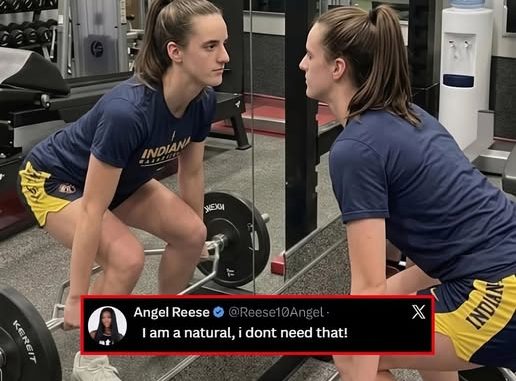
The rivalry between Angel Reese and Caitlin Clark has once again ignited the sports world, as a viral online back-and-forth centered on “natural strength” comments sent social media into a frenzy and reignited one of basketball’s most talked-about modern storylines.
What began as a seemingly subtle exchange on social platforms quickly escalated into a full-blown talking point across the WNBA community, sports media circles, and fanbases divided along familiar lines. Without needing an on-court collision or playoff implication, the latest chapter of this evolving rivalry proved that in today’s game, narratives travel just as fast as the ball.
At the center of the storm were remarks and reactions that touched on physicality, conditioning, and what it means to be “naturally strong” at the professional level. While neither player directly escalated things into personal territory, the interpretations online did the heavy lifting, as fans and analysts dissected every word, emoji, and repost for hidden meaning.
The conversation reportedly gained traction after comments circulated online comparing different playing styles and physical profiles between the two stars. Clark, known for her deep range shooting, elite passing vision, and finesse-driven offensive orchestration, has often been described as a skill-first guard whose impact comes from timing, IQ, and shooting gravity. Reese, meanwhile, has built her reputation on rebounding dominance, interior presence, physical toughness, and a relentless motor around the basket.
Those contrasting identities have long fueled debate. But this latest episode sharpened the discourse around how strength is defined in women’s basketball—and whether that definition is being fairly applied across different player archetypes.
As the conversation spread, fans began framing the discussion around a familiar binary: skill versus strength, finesse versus physicality, and perception versus performance. Social media posts highlighted highlight clips, statistical comparisons, and even slow-motion breakdowns of contact situations, all attempting to support one side or the other.
But what made this moment go viral was not just the basketball—it was the tone. The phrase “natural strength” became a lightning rod, interpreted in multiple ways depending on perspective. Some saw it as praise for innate physical gifts and athletic advantage. Others viewed it as a subtle critique or comparative jab embedded in a broader discussion about how different players are officiated, defended, or analyzed.
As the discourse intensified, reactions from fans of both players added fuel to the fire. Supporters of Reese emphasized her dominance in the paint, her ability to absorb contact, and her consistent production on the glass as evidence that her physicality is an elite skill in its own right. Supporters of Clark countered by pointing to her ability to manipulate defenses, create separation with footwork, and score efficiently despite constant defensive attention and physical pressure from opponents.
In many ways, the debate reflected a broader tension in basketball analysis itself: how to properly value different types of excellence without reducing one style to superiority over another.
Around the league, the conversation was met with a familiar mix of amusement and caution. Players and coaches understand that online narratives rarely stay contained. What starts as a clipped quote or a reposted highlight often evolves into a storyline that follows athletes into games, press conferences, and even locker rooms.
For Reese and Clark, who have been linked since their college basketball battles and carried into the professional stage as two of the league’s brightest young stars, this is not unfamiliar territory. Their history includes high-profile matchups, emotionally charged moments, and national attention that has at times overshadowed team context.
Yet despite the intensity of fan-driven narratives, both players have consistently maintained a focus on competition rather than controversy. Clark’s approach has largely emphasized execution, leadership, and adapting to the physical demands of the WNBA. Reese, similarly, has leaned into her identity as an enforcer on the boards and a vocal competitor who thrives in high-pressure environments.
That contrast in temperament only adds another layer to how their rivalry is perceived externally. One is often framed as composed and methodical; the other as expressive and confrontational. But insiders around the league are quick to point out that these labels are often exaggerated by media framing and social media amplification.
The “natural strength” discourse also exposed a deeper conversation about how women athletes are evaluated physically. In men’s basketball, physicality is often assumed and rarely isolated as a defining trait of debate unless it is extreme. In women’s basketball, however, discussions about strength, speed, and contact tolerance frequently become central talking points, sometimes overshadowing tactical or technical analysis.
That dynamic has long shaped how players like Reese are discussed. Her rebounding and interior presence are often framed through the lens of strength and effort, while Clark’s perimeter brilliance is discussed through skill and creativity. The latest online exchange brought that contrast back into focus in a way that quickly escaped its original context.
As clips circulated and commentary multiplied, former players and analysts weighed in with measured perspectives, emphasizing that elite basketball performance is never the product of a single attribute. Strength in the modern game is not just physical—it is positional awareness, endurance, balance, and the ability to maintain effectiveness under constant pressure.
In that sense, both Reese and Clark represent different but equally valuable interpretations of what it means to be dominant at the highest level.
Reese’s game thrives in chaos—rebounding traffic, second-chance opportunities, and physical defensive assignments that require constant engagement. Her presence alters how opponents attack the paint and forces strategic adjustments that do not always show up in box scores.
Clark’s impact, on the other hand, is often systemic. Her shooting range stretches defenses beyond conventional limits, opening driving lanes for teammates and forcing defensive schemes to extend farther than they are comfortable. Her passing vision punishes even the smallest breakdowns in coverage, making her one of the most closely guarded perimeter players in the league.
When placed side by side, the comparison becomes less about superiority and more about basketball philosophy. One style collapses defenses inward; the other pulls them outward. One thrives on contact; the other manipulates space. Both are difficult to contain. Both demand game-planning at the highest level.
Still, the internet rarely stays in nuance for long.
As the “natural strength” conversation trended, fan edits and reaction threads began framing it as another chapter in an ongoing rivalry narrative that refuses to settle. Some described it as competitive fire spilling into digital space; others criticized it as unnecessary comparison between two players still early in their professional careers.
The league itself has benefited from the attention, even as it walks a careful line between celebrating rivalries and avoiding manufactured tension. Viewership spikes, merchandise sales, and mainstream media coverage have all reflected the growing visibility of women’s basketball, with Reese and Clark often positioned—fairly or unfairly—at the center of that growth.
But within that spotlight lies pressure. Every interaction, every gesture, and every ambiguous comment becomes subject to interpretation. And in the modern sports ecosystem, interpretation often matters as much as intention.
For teammates and coaches, the priority remains performance. Games are decided not on social media timelines, but on defensive rotations, rebounding margins, shooting efficiency, and late-game execution. Yet they also recognize that external narratives can influence perception, momentum, and even officiating scrutiny.
As the dust begins to settle on this latest viral moment, one thing remains clear: the Reese-Clark dynamic continues to be one of the most compelling storylines in basketball today—not because of constant confrontation, but because of contrast.
It is a contrast that extends beyond individual matchups and into the broader identity of the league itself. The WNBA is experiencing a surge in attention, driven in part by a new generation of stars who bring different styles, personalities, and fanbases into the same competitive ecosystem.
Reese represents a brand of basketball rooted in physical dominance, emotional energy, and relentless interior play. Clark represents a brand defined by precision, range, and creative control of tempo. Together, intentionally or not, they symbolize the diversity of modern basketball excellence.
The viral “natural strength” debate will likely fade as quickly as it rose, replaced by the next highlight, the next quote, or the next matchup. But the underlying conversation it sparked—about how players are perceived, compared, and celebrated—will persist.
And when they meet again on the court, as they inevitably will, the noise will follow. The cameras will zoom in. The narratives will resurface. And once again, basketball will be asked to carry the weight of a debate that extends far beyond the hardwood.
Because in this era, rivalry is no longer just played—it is also posted, clipped, shared, and debated in real time. And few athletes embody that reality more than Angel Reese and Caitlin Clark.
Be the first to comment