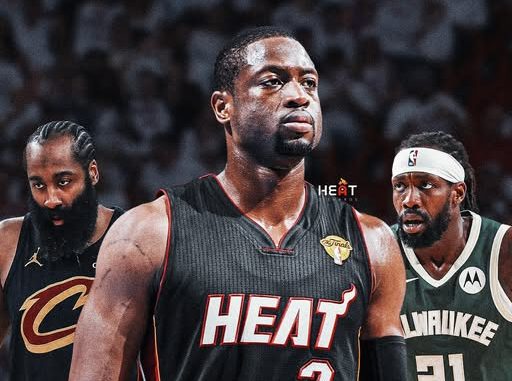
Patrick Beverley is no stranger to bold takes, but this time the former NBA guard is finding himself in unfamiliar territory: second-guessing one of his own hottest opinions. After Cleveland’s dominant sweep in the postseason spotlight reignited debate across the basketball world, Beverley has walked back his earlier comparison between James Harden and Dwyane Wade, admitting the optics are “awful” in hindsight and acknowledging that the conversation may have been framed too aggressively given recent results.
It’s a rare moment of public recalibration for a player known for his unwavering confidence and unapologetic commentary. Beverley has built a reputation not just as a defensive pest during his playing career, but also as one of the league’s most outspoken analysts since transitioning into media. He has never been afraid to challenge consensus opinions, especially when it comes to the legacies of modern NBA stars. But as the fallout from Cleveland’s sweep continues to ripple through the basketball discourse, Beverley appears to be reassessing how his earlier argument landed.
The original claim, which sparked debate across social media and sports talk shows, centered on where James Harden stands historically in comparison to Dwyane Wade. Beverley, a longtime teammate and defender of Harden during their shared Houston Rockets tenure, previously leaned toward elevating Harden’s offensive dominance and statistical production as enough to place him above Wade in certain all-time conversations. At the time, the argument was framed around Harden’s scoring titles, his unprecedented offensive workload, and his role as the engine of multiple 50-plus win teams in the Western Conference.
But basketball conversations rarely exist in a vacuum, and postseason outcomes have a way of reshaping narratives overnight. Cleveland’s emphatic sweep in the latest playoff series became the latest reference point for critics of Harden’s playoff résumé and for supporters of Wade’s championship pedigree. The Cavs’ defensive execution, physical intensity, and ability to neutralize star ball-handlers reignited long-standing questions about how elite scorers are judged when the game slows down in the postseason.
For Beverley, watching the series unfold seemed to trigger a shift in perspective. In recent remarks, he acknowledged that the comparison looks far less favorable when viewed through the lens of playoff pressure and team success. “It looks awful,” he admitted, reflecting on how his previous stance has aged in light of Cleveland’s dominant performance and the renewed scrutiny around Harden’s playoff legacy.
What makes this reversal particularly notable is not just the content of the statement, but the source. Beverley has consistently been one of Harden’s most vocal defenders in media spaces, often pushing back against narratives that he believes oversimplify Harden’s career. Their history as teammates in Houston created a bond that has lingered into their post-playing careers, with Beverley frequently emphasizing the difficulty of being the focal point of an NBA offense night after night.
However, even loyalty has its limits when the broader basketball conversation shifts under the weight of postseason results. The Cleveland sweep became a symbolic moment in the ongoing Harden-Wade debate, not because either player was directly involved, but because it reinforced the standards by which championship-caliber guards are ultimately judged.
Dwyane Wade’s legacy, long cemented by three NBA championships, a Finals MVP award, and countless iconic playoff performances, has often served as the benchmark for two-way excellence at the shooting guard position. Wade’s ability to elevate his game on the biggest stage, particularly during the 2006 Finals and later alongside LeBron James and Chris Bosh in Miami, remains one of the defining pillars of his Hall of Fame résumé.
Harden’s career, by contrast, has been defined by offensive brilliance that borders on historic. His scoring title streak, his step-back revolution, and his ability to control an offense with surgical precision have made him one of the most unique offensive players the league has ever seen. Yet the postseason narrative has consistently followed him, with critics pointing to series losses, late-game struggles, and fluctuating production in elimination games as key counterarguments in any all-time comparison.
Beverley’s initial defense of Harden leaned heavily on the idea that offensive output at Harden’s peak was simply unmatched in NBA history. He often highlighted how Harden carried massive offensive responsibilities, sometimes without the same level of supporting talent that other all-time great guards enjoyed. In his view, that level of burden should matter when evaluating greatness.
But Cleveland’s sweep has added another layer to the discussion. The Cavaliers’ defensive schemes showcased how disciplined team structures can disrupt even elite offensive systems when executed at the highest level. Their ability to limit rhythm, close driving lanes, and force uncomfortable possessions became a talking point across the league, especially among analysts revisiting how superstars are contained in playoff environments.
Beverley’s reflection seems rooted in that reality. The postseason has a way of compressing arguments into results, and results, in this case, were unforgiving. Watching a team dismantle its opponent in four straight games while maintaining defensive control over key perimeter actions forces a reevaluation of how individual offensive brilliance translates when everything is on the line.
Still, Beverley has not completely abandoned his broader point about Harden’s place among all-time great guards. Instead, his tone suggests a shift in emphasis rather than a full reversal. Rather than focusing solely on scoring numbers or offensive peaks, he now appears more willing to weigh playoff impact, adaptability, and championship-level execution as equal, if not greater, components of the conversation.
That subtle shift reflects a broader trend in modern NBA discourse. As analytics and advanced metrics continue to evolve, so too does the way players are evaluated historically. Efficiency, playoff performance, defensive versatility, and leadership under pressure all play increasingly significant roles in shaping legacy debates. In that context, Wade’s résumé—anchored by championships and two-way impact—often gains favor in comparisons against purely offensive juggernauts.
Beverley’s candid admission also underscores the evolving role of former players in media. Unlike traditional analysts, ex-players bring firsthand experience into debates, but they also carry personal relationships, locker room dynamics, and competitive biases that can influence their perspectives. Beverley has never hidden his loyalty to teammates or his admiration for players he respects, but this moment shows how external results can force even the most confident voices to re-evaluate their positions.
The reaction across the basketball community has been predictably split. Some fans applauded Beverley’s honesty, viewing it as a refreshing example of intellectual flexibility in a sports media landscape often dominated by stubborn takes. Others criticized the original comparison altogether, arguing that Wade’s championship résumé has always placed him in a different tier regardless of offensive statistics.
What remains clear is that the Harden vs. Wade debate is far from settled. It is one of those generational comparisons that resurfaces every few months, often triggered by playoff outcomes, statistical milestones, or media commentary. Each new postseason adds another layer to the discussion, and Cleveland’s sweep has become the latest reference point in that ongoing conversation.
For Harden, the narrative remains complex. Even as he continues to add to his career totals and evolve his game in different roles, the question of postseason success continues to shape how he is perceived historically. For Wade, his legacy remains relatively stable, anchored by team success and iconic playoff performances that have stood the test of time.
Beverley’s recalibration does not change those facts, but it does highlight how fluid basketball discourse can be. One series, one performance, or one dominant sweep can ripple outward and influence how careers are contextualized in real time. It also reinforces the reality that legacy debates are rarely about numbers alone—they are about moments, timing, and perception under pressure.
As Beverley steps back from his earlier stance, his revised tone adds yet another chapter to a debate that refuses to fade. His willingness to publicly acknowledge that his previous take “looks awful” in hindsight may not end the conversation, but it does add nuance to it. In a sports landscape where certainty is often rewarded more than reflection, that kind of honesty carries its own weight.
And as the playoffs continue to shape narratives across the league, one thing is certain: comparisons like Harden versus Wade will keep resurfacing, each time filtered through the latest postseason performance, each time re-argued with new evidence, and each time reminding everyone that in basketball, legacy is never truly static.
Be the first to comment