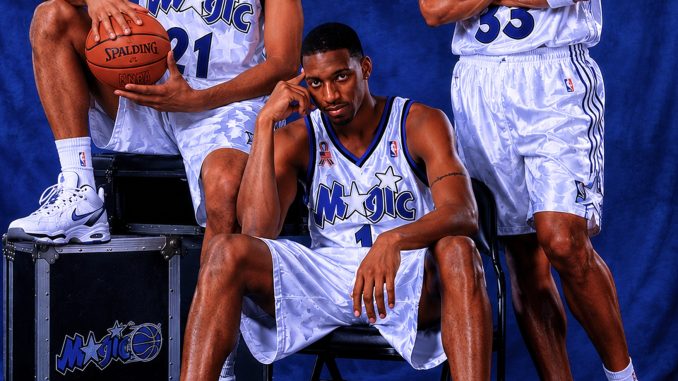
There are moments in NBA history when an entire dynasty hangs on a single sentence, a small decision, or even one misunderstood conversation. Few “what if” scenarios remain as haunting as the summer of 2000, when the possibility of Tim Duncan joining forces with Tracy McGrady and Grant Hill nearly became reality for the Orlando Magic. It was a move that could have altered the balance of power in the league for an entire decade. Instead, it became one of basketball’s greatest unanswered questions, all because of what many believe was one word from then-head coach Doc Rivers.
At the turn of the millennium, the NBA was entering a new era. The reign of Michael Jordan and the Chicago Bulls had officially ended. Teams across the league were scrambling to position themselves as the next great powerhouse. The Los Angeles Lakers had a young and explosive duo in Shaquille O’Neal and Kobe Bryant. The San Antonio Spurs already possessed a foundational superstar in Duncan, who had quickly established himself as the most fundamentally dominant big man in basketball.
Duncan was not flashy. He did not dominate headlines with controversy or theatrics. Yet within three seasons, he had already won an NBA championship, Finals MVP honors, Rookie of the Year, and multiple All-NBA selections. Around the league, executives viewed him as the perfect franchise cornerstone — disciplined, selfless, elite defensively, and nearly impossible to scheme against offensively.
Meanwhile, Orlando was quietly preparing one of the boldest free-agency plans the league had ever seen.
The Magic had cap space, ambition, and a vision. After the painful breakup of the Shaquille O’Neal and Penny Hardaway era several years earlier, the organization desperately wanted another superstar core capable of competing for championships. Team executive John Gabriel engineered the financial flexibility to pursue multiple stars in the loaded 2000 free-agent market.
The plan was stunningly ambitious: pair Hill, one of the league’s most versatile superstars, with McGrady, a rising phenom hungry to step out of his cousin Vince Carter’s shadow in Toronto, and then complete the trio with Duncan himself.
For a brief moment, the dream was terrifyingly close to becoming reality.
Hill agreed to come to Orlando through a sign-and-trade deal with the Detroit Pistons. McGrady, only 21 years old at the time, also committed to the Magic, believing Orlando offered him the chance to become a true superstar. Suddenly, the franchise had momentum. All that remained was convincing Duncan to leave San Antonio.
And by many accounts, Duncan seriously considered it.
The attraction made sense. Orlando offered warm weather, financial flexibility, and the chance to play alongside two elite perimeter stars perfectly suited to complement his game. McGrady’s scoring brilliance and Hill’s all-around versatility would have created a nightmare matchup problem for every team in the NBA. Duncan would not need to carry the entire offensive burden, while Orlando’s athletic wings would thrive with the defensive stability and interior dominance he provided.
The trio had the potential to become basketball’s next dynasty before ever sharing the court together.
What made the possibility even more believable was Duncan’s growing frustration over certain issues within the Spurs organization at the time. Despite winning a championship in 1999, Duncan reportedly had concerns about family accommodations and aspects of team culture. He valued stability and personal comfort as much as basketball success. Orlando recognized that and aggressively targeted those concerns during free-agency meetings.
The famous meeting between Duncan and the Magic has since become part of NBA folklore.
According to numerous reports over the years, Duncan traveled to Orlando with significant interest in signing there. Team executives believed they had positioned themselves well. Hill and McGrady were already onboard. The basketball fit was undeniable. Excitement within the organization began growing rapidly.
Then came the story that would live forever in NBA circles.
One of Duncan’s priorities during free agency involved his family, particularly whether spouses and family members could travel on team planes. Duncan’s relationship with family was central to his decision-making process, and Orlando understood the importance of creating a welcoming environment.
During discussions, Rivers reportedly told Duncan that family members would not be allowed on team flights.
That response changed everything.
Years later, McGrady reflected on the moment with visible frustration, suggesting that Rivers’ refusal may have cost Orlando a dynasty. McGrady famously described it as “one word” that altered NBA history. Whether Rivers intended the answer strictly as organizational policy or simply misspoke in the moment, the damage was done. Duncan was reportedly turned off by the response and began reconsidering his options.
Soon afterward, he chose to remain in San Antonio.
Just like that, one of the most fascinating superteams never materialized.
Instead of joining Orlando, Duncan stayed with the Spurs and proceeded to build one of the greatest careers in NBA history. Alongside Tony Parker, Manu Ginóbili, and legendary coach Gregg Popovich, Duncan became the centerpiece of a model franchise defined by consistency, discipline, and championships.
The Spurs went on to win five NBA titles with Duncan leading the way. He earned two regular-season MVP awards, three Finals MVPs, and became universally regarded as the greatest power forward the game has ever seen. San Antonio established a dynasty built not on glamour, but on execution and professionalism.
Yet even with all that success, the Orlando scenario continues to fascinate basketball fans because of how overwhelming that roster might have been.
At the time, Hill was still viewed as one of the league’s premier all-around talents. Before injuries devastated his career trajectory, he was often compared to Jordan for his versatility and leadership. McGrady was evolving into one of the NBA’s most gifted scorers, a player capable of effortlessly dropping 30 points on any defense. Duncan, meanwhile, was already an elite two-way force entering his prime.
Together, they would have formed perhaps the league’s most balanced trio.
Imagine the matchup nightmares. Duncan controlling the paint offensively and defensively. Hill attacking in transition while functioning as a secondary playmaker. McGrady creating impossible perimeter scoring situations with his length and shot-making ability. The combination of skill, size, athleticism, and basketball IQ would have rivaled any Big Three assembled in league history.
Many around the NBA believe Orlando would have immediately challenged the Lakers for Western — and eventually league-wide — supremacy. At the time, Shaq and Kobe were ascending into dominance, but the Magic trio could have presented a uniquely dangerous counterbalance.
The irony, of course, is that Orlando’s dream eventually unraveled in painful fashion anyway.
Hill’s ankle injuries became one of the great tragedies of that NBA era. What was supposed to be the start of a championship partnership instead became a long rehabilitation process that limited him severely during his early Orlando years. McGrady exploded into superstardom individually, winning scoring titles and becoming one of the league’s most electrifying players, but the Magic never truly became contenders.
Without Duncan anchoring the franchise, Orlando lacked the interior presence and stability necessary to survive in the increasingly physical Eastern Conference landscape. McGrady eventually departed, and the championship aspirations faded.
For Rivers, the story has followed him throughout his coaching career.
To his credit, Rivers has disputed some versions of the narrative over the years, insisting the plane-policy story became exaggerated and that there were more factors involved in Duncan’s decision. He has argued that Duncan simply felt more comfortable remaining in San Antonio and that the situation has unfairly become simplified into a single conversation.
Still, the perception remains impossible to erase.
McGrady himself has openly stated that Rivers’ response hurt Orlando’s chances. Fans continue debating whether flexibility on such a minor issue could have changed everything. In a league where franchises spend years searching for one superstar, Orlando was potentially hours away from securing three.
That reality continues to haunt discussions about NBA history.
The story also serves as a reminder of how fragile championship windows truly are. Dynasties are often viewed in hindsight as inevitable, but the truth is far messier. A misunderstood conversation, a medical report, or a single organizational decision can redirect the course of sports history forever.
Had Duncan gone to Orlando, the Spurs dynasty may never have happened. Parker and Ginóbili might never have developed into champions within San Antonio’s system. Popovich’s legacy could look dramatically different. The Lakers’ early-2000s dominance may have faced a much stronger rival. McGrady’s career narrative might center around championships instead of playoff heartbreak.
Even the broader evolution of the NBA could have shifted.
Superteams are often associated with later eras — from Miami Heat combinations led by LeBron James, Dwyane Wade, and Chris Bosh to the Golden State Warriors adding Kevin Durant. But Orlando’s pursuit of Duncan, Hill, and McGrady showed that front offices were already envisioning superstar alliances years earlier.
The difference is that Orlando’s version never officially happened.
Instead, it survives as one of the NBA’s ultimate alternate-history scenarios, endlessly revisited by fans, analysts, and former players who still marvel at how close it came to reality.
There is also something poetic about the fact that Duncan ultimately stayed exactly where he belonged. His quiet personality, team-first mentality, and disciplined professionalism fit San Antonio perfectly. The Spurs became synonymous with stability largely because Duncan embodied it himself. In another environment — even one loaded with talent — perhaps the chemistry would not have unfolded the same way.
Yet that does not stop the imagination.
Basketball fans still picture what a healthy Hill, an ascending McGrady, and prime Duncan could have accomplished together. Multiple championships seem almost inevitable on paper. The blend of offense, defense, leadership, and versatility would have given Orlando a foundation capable of dominating the Eastern Conference for years.
Instead, history remembers the trio as the dynasty that never existed.
And at the center of the story remains that unforgettable detail: one word, one policy, one moment that may have redirected the future of the NBA.
For Orlando fans, it remains a painful reminder of what slipped away. For Spurs fans, it is the moment their franchise’s future survived by the narrowest of margins. For the league itself, it stands as proof that basketball history is often shaped not only by what happens on the court, but by the smallest conversations behind closed doors.
In a sport built on giant personalities and unforgettable moments, few stories capture the fragile unpredictability of the NBA quite like the summer Tim Duncan nearly left San Antonio. One conversation preserved a dynasty in Texas while erasing another before it ever began.
Be the first to comment