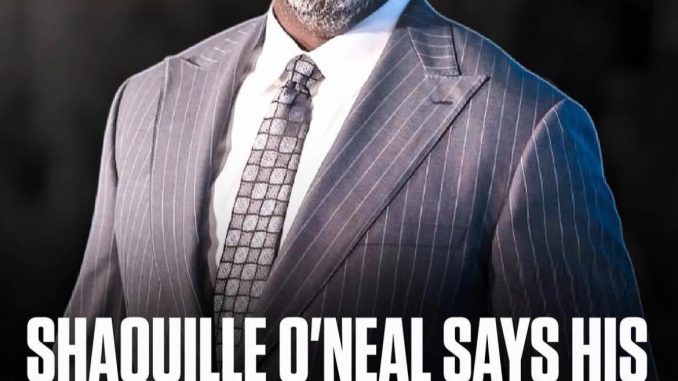
For much of the last three decades, few figures have loomed larger over the basketball world than Shaquille O’Neal. Standing 7-foot-1 and weighing well over 300 pounds during his playing career, O’Neal dominated opponents with a combination of power, skill, charisma, and personality that transformed him into one of the most recognizable athletes in sports history. His résumé is filled with accomplishments that most players can only dream about: four NBA championships, three NBA Finals MVP awards, a regular-season MVP trophy, 15 All-Star selections, and a place among the greatest centers to ever play the game.
Yet despite the championships, accolades, business ventures, television success, and global fame that have followed him throughout his remarkable journey, O’Neal recently revealed that one of the most significant decisions he has ever made had nothing to do with basketball. Instead, it was a deeply personal commitment that he says has shaped his life in ways that transcend sports.
The Hall of Fame legend shared that dedicating his life to Jesus Christ remains one of the most important choices he has ever made, emphasizing that his faith has continued to serve as a guiding force through every stage of his life. While millions of fans know O’Neal for his dominance on the hardwood and his larger-than-life public image, the basketball icon indicated that his spiritual foundation has played a central role in helping him navigate both success and adversity.
For athletes operating at the highest level of professional sports, fame often brings immense pressure. Careers are scrutinized daily, every performance is analyzed, and personal decisions frequently become public discussion points. O’Neal experienced all of those realities throughout a playing career that spanned nearly two decades. From the moment he entered the league as the first overall pick in the 1992 NBA Draft, expectations followed him everywhere.
Selected by the Orlando Magic, O’Neal immediately established himself as one of basketball’s brightest young stars. His rare combination of size, athleticism, and personality made him a sensation almost overnight. He captured Rookie of the Year honors and quickly transformed Orlando into a legitimate contender in the Eastern Conference.
As his popularity exploded, so did the demands associated with stardom. O’Neal became the face of advertising campaigns, appeared in movies, released music albums, and emerged as one of the NBA’s premier attractions. While many players spend years attempting to reach national prominence, O’Neal achieved it within a remarkably short period.
His rise continued when he joined the Los Angeles Lakers in 1996. The move marked the beginning of one of the most dominant eras in league history. Alongside Kobe Bryant, O’Neal helped lead the Lakers to three consecutive NBA championships from 2000 through 2002.
During that stretch, he was nearly unstoppable. Defenders struggled to contain his physical presence in the paint, and opposing teams often had no answer for his overwhelming strength. The championships cemented his place among the game’s all-time greats, while his popularity reached unprecedented heights.
For many athletes, achieving that level of success might represent the ultimate destination. Championships, financial security, endorsements, and international recognition are often viewed as the pinnacle of professional sports. However, O’Neal’s recent comments suggest that his priorities extend beyond the accomplishments that made him a basketball icon.
His reflections highlight a perspective that is shared by many athletes across professional sports. While trophies and records are celebrated publicly, personal faith often serves as a source of stability behind the scenes. For O’Neal, that spiritual commitment appears to have remained a constant throughout the various chapters of his life.
Following his championship run with the Lakers, O’Neal added another title with the Miami Heat in 2006. The victory gave him a fourth championship ring and further strengthened his Hall of Fame credentials. Yet even as his collection of achievements continued to grow, O’Neal has repeatedly emphasized the importance of values that cannot be measured by statistics or trophies.
Those values became especially significant during the transitions that followed his playing career. Retirement can be a challenging adjustment for professional athletes. The routine, competition, and identity that accompany a sports career suddenly disappear, forcing many former players to redefine themselves.
O’Neal managed that transition more successfully than most. He became a prominent television analyst, entrepreneur, philanthropist, and business leader. His presence on basketball broadcasts helped him remain closely connected to the game, while his ventures outside sports demonstrated an ability to thrive beyond the court.
Even so, O’Neal’s comments suggest that faith has remained a foundational element throughout those endeavors. Rather than viewing spirituality as something separate from daily life, he described it as a guiding influence that has helped shape his decisions and outlook.
The revelation also offers fans a different perspective on a man who is often associated with humor and entertainment. O’Neal’s public persona has long been defined by his infectious personality, playful interactions, and ability to connect with audiences. Whether appearing on television, participating in community events, or engaging with fans on social media, he frequently projects confidence and positivity.
Behind that image, however, lies a deeper commitment that he says has influenced the direction of his life. By speaking openly about his faith, O’Neal joins a growing number of current and former athletes who have discussed the role spirituality plays in their personal journeys.
Faith has long been intertwined with sports. Across generations, athletes have spoken about relying on religious beliefs to handle pressure, overcome obstacles, and maintain perspective. In a profession where victories and defeats can dramatically impact public perception, many players turn to faith as a source of balance.
O’Neal’s comments resonate because of the extraordinary scope of his career. Few athletes have experienced the level of fame he achieved. His accomplishments extended beyond basketball and into popular culture, making him one of the most recognizable sports figures in the world.
Yet despite reaching heights that many people could scarcely imagine, O’Neal’s message centered not on championships or personal accomplishments but on spiritual fulfillment. It was a reminder that success can be defined differently depending on one’s values and beliefs.
Throughout his career, O’Neal frequently spoke about family, community, and personal responsibility. Those themes have continued to surface during his post-playing years. Whether supporting charitable initiatives, mentoring younger athletes, or discussing life lessons on television, he has often emphasized the importance of character alongside achievement.
His recent reflections fit naturally within that broader philosophy. While basketball provided a platform for his success, O’Neal indicated that his faith helped provide purpose and direction beyond the game itself.
The timing of such comments is noteworthy in an era when athletes are increasingly willing to share personal experiences and beliefs. Modern sports culture often encourages players to speak openly about the influences that shape their lives, whether those influences involve family, mental health, education, or spirituality.
For younger athletes, hearing those perspectives from established legends can be particularly impactful. O’Neal’s journey offers a unique example because it encompasses virtually every level of basketball success imaginable. He reached the pinnacle of the sport, achieved financial prosperity, and built a global brand. Yet he continues to point toward faith as one of the defining elements of his life.
That perspective challenges the notion that external achievements alone guarantee fulfillment. While O’Neal’s career was undeniably extraordinary, his comments suggest that personal conviction and spiritual grounding have played an equally important role in shaping his identity.
The basketball community has long admired O’Neal for his dominance on the court, but many also respect the authenticity he brings to public discussions. Whether addressing basketball topics, business advice, or personal experiences, he often speaks candidly and directly.
His willingness to discuss faith reflects that same openness. Rather than focusing solely on accolades, he highlighted a deeply personal decision that continues to influence his life. In doing so, he offered fans insight into the principles that guide him away from the spotlight.
As one of the most influential figures in NBA history, O’Neal’s voice carries considerable weight. Generations of fans watched him dominate games, while younger audiences know him as a television personality and ambassador for the sport. His reflections therefore reach far beyond traditional basketball conversations.
The significance of his statement lies not only in what he said but also in who said it. O’Neal has experienced levels of success that few athletes ever attain. His career serves as a testament to talent, determination, and hard work. Yet when discussing the most important decisions of his life, he pointed not to a championship victory, a contract signing, or a business achievement, but to his commitment to Jesus Christ.
For many observers, that message underscores the distinction between professional accomplishments and personal fulfillment. While sports can bring fame and recognition, athletes often find meaning through relationships, values, and beliefs that extend beyond competition.
O’Neal’s career legacy is already secure. His place among basketball’s all-time greats has been established through years of excellence and a collection of accolades that speak for themselves. Future generations will continue to study his dominance, celebrate his achievements, and remember the impact he had on the game.
But as the Hall of Famer continues to reflect on his journey, it is clear that he views his story through a broader lens than basketball alone. The championships, records, and honors remain important chapters, yet they are not the entirety of his narrative.
Instead, O’Neal’s recent remarks reveal a perspective rooted in faith, gratitude, and personal conviction. They offer a glimpse into the values that have guided him through triumphs and challenges alike, reinforcing the idea that the most meaningful victories are not always the ones recorded in box scores or celebrated with championship parades.
For a player whose career was defined by towering achievements, that message may be among the most powerful statements he has shared. While fans will forever remember the dunks, championships, and unforgettable performances, O’Neal has made it clear that the decision he considers most important occurred far away from the bright lights of an NBA arena. In his view, committing his life to Jesus Christ stands above every trophy, every accolade, and every milestone, serving as the foundation that has guided one of basketball’s most remarkable journeys.
Be the first to comment