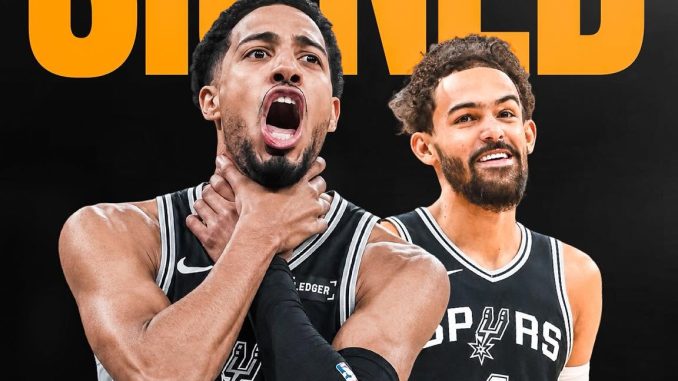
In one of the most shocking roster developments the NBA has seen in recent memory, league sources told ESPN that the San Antonio Spurs have reportedly agreed to 10-day contracts with two of the league’s most recognizable All-Star guards—Tyrese Haliburton and Trae Young—in a move that has sent immediate shockwaves through front offices, agents’ circles, and social media timelines across the basketball world.
The timing alone has fueled disbelief. With the NBA Finals still ongoing and the Spurs locked in a high-pressure series against the New York Knicks, the idea that a franchise would bring in two franchise-level ball handlers on short-term 10-day deals stretches conventional roster logic to its breaking point. Yet, according to multiple league insiders, the discussions escalated rapidly over the last 48 hours, culminating in what one source described as “an unprecedented emergency basketball decision driven by necessity, opportunity, and competitive urgency.”
For San Antonio, a franchise built on stability, development, and long-term planning, this alleged maneuver represents a dramatic departure from its traditional identity. The Spurs have long been known for patience—drafting, developing, and structuring their roster with surgical precision rather than making impulsive, high-profile mid-series additions. But with injuries reportedly thinning the backcourt rotation and offensive production fluctuating at key moments in the Finals, the organization appears to have explored every possible avenue to stabilize its offense.
The decision to bring in Tyrese Haliburton, a premier playmaker known for his elite passing vision and pace control, is viewed by some league analysts as an attempt to inject structure into a half-court offense that has at times struggled against New York’s physical perimeter defense. Haliburton’s ability to orchestrate pick-and-roll actions, manipulate weak-side defenders, and create efficient perimeter looks would theoretically give the Spurs an additional layer of offensive creativity during high-pressure stretches.
Meanwhile, the reported addition of Trae Young brings an entirely different dynamic—one built on deep-range shooting gravity, foul pressure, and explosive scoring bursts. Young’s offensive profile is among the most unique in the league, capable of bending defenses from well beyond the arc and generating instant momentum swings. For a Spurs team that has struggled at times to manufacture quick scoring runs against the Knicks’ disciplined defensive schemes, his presence—however temporary—would represent a radical shift in approach.
What makes the situation even more extraordinary is the contractual structure itself. Ten-day contracts are typically reserved for developmental players, emergency replacements, or roster experimentation during the regular season—not for established All-NBA-caliber stars in the middle of a championship series. That alone has led to widespread skepticism around the league, with several executives privately questioning how such agreements could even be structured under current collective bargaining rules.
Still, sources insist the framework is being treated as a short-term competitive exception, with the Spurs reportedly leveraging hardship provisions and roster flexibility mechanisms to make the arrangement viable. While details remain fluid, one league official described it as “a creative interpretation of emergency roster construction in a uniquely compressed postseason scenario.”
Inside the Spurs locker room, reactions are believed to be mixed but professional. Veterans reportedly understand the competitive stakes of the Finals and the need for immediate reinforcements, but integrating two high-usage guards into an established system on such short notice presents obvious basketball complications. Chemistry, timing, and role clarity become major variables when introducing players of this caliber into a team that has spent months building its identity.
The basketball fit between Haliburton and Young also raises intriguing strategic questions. Both are elite ball-dominant guards who thrive with spacing, tempo control, and decision-making autonomy. While Haliburton often operates as a pass-first orchestrator and Young leans toward scoring pressure and self-created offense, their overlapping need for on-ball responsibility could challenge lineup construction if both are on the floor simultaneously.
Some analysts believe the Spurs could stagger their minutes heavily, using Haliburton as the primary connector with bench units while deploying Young as a high-octane scoring weapon against second units or in late-clock scenarios. In theory, the dual acquisition gives San Antonio two different offensive identities to deploy depending on matchup context—one structured and cerebral, the other aggressive and explosive.
Across the league, rival executives have expressed confusion and concern. One Eastern Conference scout described the reported move as “something out of a video game roster experiment,” while another front office source questioned whether the precedent could open the door for future playoff roster volatility if left unchecked.
For the New York Knicks, who currently hold momentum in the series, the news adds an unexpected layer of complexity to their preparation. Defensive game planning typically relies on stable scouting reports and predictable rotations, but the introduction of two elite guards—even on short-term arrangements—forces recalibration. The Knicks will now have to prepare for multiple offensive structures that may or may not appear depending on how Spurs head coach Gregg Popovich chooses to deploy his newly expanded backcourt options.
Fan reaction has been immediate and polarized. Some view the move as a bold, aggressive championship gamble, a sign that the Spurs are unwilling to let the series slip away without exhausting every available resource. Others see it as a disruption to competitive balance, arguing that introducing star-level talent on temporary contracts during the Finals undermines the integrity of roster continuity that defines playoff basketball.
On social media, speculation has run rampant about how quickly either guard could realistically adapt to Spurs terminology, conditioning demands, and in-game chemistry. While both Haliburton and Young are considered high-IQ offensive players, even elite talent typically requires significant time to integrate into new systems—time that the Spurs simply do not have in the middle of a Finals series.
Financial implications are also being scrutinized. While 10-day contracts are relatively modest in cost, the symbolic significance of two All-Star-level guards entering a Finals roster under such agreements raises questions about competitive equity and future rule interpretations. League officials are expected to monitor the situation closely, with some already signaling that a post-Finals review of emergency roster provisions could be on the table.
From a pure basketball standpoint, the Spurs are betting on immediacy. This is not a long-term roster construction decision—it is a win-now gamble aimed at altering the rhythm of a series that has tightened with every game. If the reported deals are finalized and both guards are made available, San Antonio would suddenly possess one of the most talent-rich backcourt rotations ever assembled for such a short window.
Yet the biggest question remains unchanged: can talent acquired under such extraordinary circumstances translate into cohesion at the highest level of playoff basketball? History suggests that even the most gifted players require time, trust, and repetition to fully integrate into championship-level systems. The Spurs are attempting to compress that timeline into days, not weeks.
As the NBA world waits for official confirmation, the story continues to evolve rapidly. Front offices are monitoring developments, players across the league are reacting in real time, and analysts are scrambling to contextualize what could become one of the most unconventional roster decisions in modern playoff history.
Whether this reported move becomes a masterstroke or a cautionary tale will depend not only on the individual brilliance of Tyrese Haliburton and Trae Young, but on how quickly the San Antonio Spurs can transform two newly arrived stars into functional pieces of a championship puzzle already deep into its most pressure-filled chapter. For now, the basketball world is left waiting, questioning, and recalculating what is even possible in the modern NBA postseason landscape.
Be the first to comment