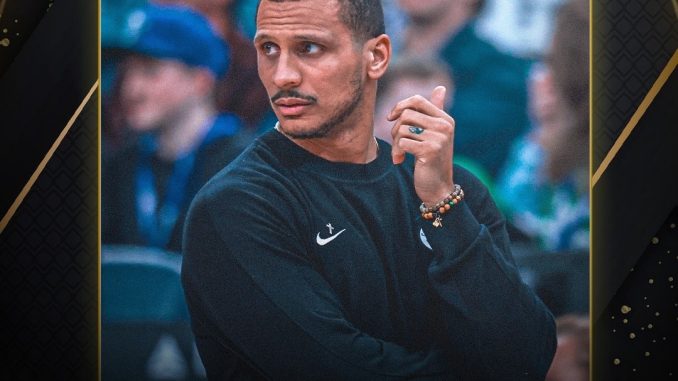
The journey from promising assistant to championship-caliber head coach reached another historic milestone Tuesday night as Joe Mazzulla was officially named the NBA’s 2025-26 Coach of the Year, capping a brilliant season in which he guided the Boston Celtics to 56 wins, the top seed in the Eastern Conference, and another dominant campaign that reaffirmed Boston’s standing as the league’s gold standard.
For Mazzulla, the honor represents far more than a single season of excellence. It is validation of one of the most rapid and impressive coaching ascents in modern NBA history. At just 37 years old, Mazzulla has transformed from an interim replacement thrust into chaos into the architect of one of basketball’s most feared dynasties, earning respect throughout the league for his relentless intensity, tactical creativity, and unwavering command of a championship locker room.
The Celtics entered the season carrying enormous expectations after their previous title run, and with expectations came pressure. In Boston, anything short of dominance is often viewed as disappointment. Yet instead of shrinking beneath the spotlight, Mazzulla elevated the franchise once again, overseeing a campaign built on elite defense, offensive precision, and remarkable consistency from opening night through the final weeks of the regular season.
Boston’s 56-win season was not merely about piling up victories. It was the manner in which the Celtics won that separated them from the rest of the conference. They controlled games early, suffocated opponents defensively, and repeatedly demonstrated an ability to respond when momentum appeared ready to shift elsewhere. Throughout the season, the Celtics looked less like a team surviving the grind of an 82-game schedule and more like a group executing a carefully designed blueprint under a coach fully in command of every detail.
That composure reflected the personality of Mazzulla himself.
Never one for theatrics, Mazzulla built his reputation around discipline, preparation, and accountability. Players consistently spoke about the clarity he brought to the locker room, praising his ability to challenge stars while empowering role players. Under his leadership, Boston became one of the NBA’s most balanced teams, equally capable of winning a defensive slugfest or overwhelming opponents with explosive scoring runs.
What makes Mazzulla’s achievement especially impressive is the evolving nature of the modern NBA. Coaching today requires more than diagrams and halftime speeches. It demands emotional intelligence, adaptability, and the ability to manage superstar personalities while maintaining organizational harmony. Mazzulla mastered each aspect this season, steering Boston through injuries, media scrutiny, and the nightly pressure that accompanies championship expectations.
The Celtics’ identity mirrored their coach. They played with toughness, intelligence, and purpose.
On the defensive end, Boston remained relentless. Opposing stars frequently struggled against the Celtics’ versatile schemes, which blended aggressive perimeter pressure with disciplined interior rotations. Mazzulla emphasized communication and trust, turning Boston into one of the league’s most connected defensive units. Players switched seamlessly, recovered quickly, and rarely lost focus during critical stretches.
Offensively, the Celtics operated with equal efficiency. Ball movement became a defining feature of their attack, with Mazzulla encouraging pace, spacing, and unselfish decision-making. Rather than relying solely on isolation basketball, Boston consistently generated high-quality shots through movement and precision execution. The result was an offense capable of dismantling defenses in a variety of ways.
Perhaps most importantly, Mazzulla cultivated resilience.
Every elite team faces adversity, and Boston encountered its share throughout the season. Injuries forced lineup adjustments. Road trips tested endurance. Opponents treated regular-season matchups against the Celtics like playoff games. Yet Boston rarely lost its identity. The Celtics answered setbacks with poise, often delivering their best performances immediately after difficult losses.
That mental toughness became one of the strongest arguments in Mazzulla’s Coach of the Year campaign.
League executives and analysts repeatedly pointed to Boston’s consistency as evidence of elite coaching. While many contenders experienced dramatic swings in performance, the Celtics maintained their standard night after night. Their attention to detail never appeared to waver, even during the exhausting middle months of the season when focus can easily disappear.
Veteran players credited Mazzulla for setting that tone from training camp onward.
Inside the organization, there was a clear understanding that repeating success would be more difficult than achieving it the first time. Opponents studied Boston’s tendencies more carefully. Every arena treated the Celtics like the measuring stick of the NBA. Mazzulla embraced that challenge, refusing to allow complacency to seep into the locker room.
The Celtics responded by producing one of the Eastern Conference’s most dominant regular seasons in recent memory.
Boston consistently overwhelmed contenders, posting statement victories against fellow playoff powers while protecting home court with remarkable efficiency. TD Garden once again became one of the league’s toughest environments for visiting teams, fueled by a roster that fed off its coach’s intensity and preparation.
Mazzulla’s strategic growth also stood out this season.
Earlier in his coaching career, critics occasionally questioned his in-game adjustments and late-game management. This year, many of those doubts disappeared. Mazzulla displayed greater patience with rotations, sharper timeout usage, and an improved feel for momentum swings. He consistently made the right adjustments in close contests, helping Boston secure critical wins during playoff-positioning battles.
Players noticed the evolution.
Veterans praised Mazzulla for becoming more communicative while maintaining the demanding standards that define his coaching philosophy. Younger players benefited from his developmental focus, with several rotation contributors taking major leaps under his guidance.
That player development proved essential to Boston’s success.
While superstar talent remained the foundation of the Celtics’ roster, depth became one of their greatest strengths this season. Bench players embraced defined roles, rotational pieces delivered key performances, and Boston rarely suffered dramatic drop-offs when stars rested. Mazzulla’s ability to maximize the entire roster separated him from many of his coaching peers.
Around the league, rival coaches openly admired Boston’s structure.
Opponents frequently described the Celtics as one of the hardest teams to prepare for because of their versatility and discipline. Whether facing elite offensive teams or defensive-minded opponents, Boston adapted effectively without abandoning its core principles.
That balance is often the hallmark of elite coaching.
For Mazzulla personally, the award also represents redemption and perseverance. His path to this moment was anything but conventional. When he first assumed control of the Celtics under difficult circumstances years ago, questions surrounded his readiness and experience. Many wondered whether he could handle the immense pressure attached to coaching one of sports’ most iconic franchises.
Instead of crumbling beneath those expectations, Mazzulla evolved into one of the NBA’s premier coaches.
His rise reflects a broader transformation within modern coaching circles, where younger, analytically minded leaders are increasingly reshaping the game. Yet Mazzulla’s success extends beyond analytics or strategy. Players trust him because they believe in his authenticity. He demands accountability while remaining fiercely committed to the collective success of the team.
That trust became visible throughout the season in the Celtics’ chemistry.
Boston consistently played with joy and cohesion, qualities that often distinguish true contenders from talented teams simply going through the motions. The Celtics celebrated each other’s success, defended one another publicly, and maintained focus despite constant attention from national media.
Mazzulla’s calm demeanor played a major role in preserving that culture.
Even during emotionally charged moments, he rarely appeared rattled. His composed presence helped stabilize the locker room during difficult stretches and reinforced the professionalism expected throughout the organization.
The Coach of the Year honor also places Mazzulla in elite historical company within Celtics lore. Boston has been home to some of basketball’s greatest coaching minds, from Red Auerbach to modern championship leaders who helped define eras of dominance. By winning this award, Mazzulla further cements his place within that tradition.
For Celtics fans, the recognition feels especially meaningful because it validates the organization’s long-term vision.
Boston believed Mazzulla could grow into the role despite early turbulence, and that patience has now been rewarded. Rather than chasing constant change, the franchise committed to continuity, empowering a young coach to develop alongside a championship-caliber core.
The results have been extraordinary.
At an age when many coaches are still climbing assistant ranks, Mazzulla has already established himself as one of basketball’s defining sideline figures. His combination of intensity, intelligence, and adaptability has transformed Boston into a perennial powerhouse with championship aspirations every season.
Of course, Mazzulla himself would likely deflect much of the praise toward his players and staff.
Throughout the season, he consistently emphasized collective effort over individual recognition. Assistant coaches, trainers, and support staff all played important roles in sustaining Boston’s elite standards. Still, the Coach of the Year award ultimately recognizes the individual responsible for setting the direction, culture, and expectations of an organization.
That responsibility belongs to Mazzulla.
The numbers alone support the decision. Fifty-six wins. The East’s top seed. Elite rankings on both ends of the floor. Consistent dominance against quality opponents. But beyond statistics, Boston passed the eye test every night. The Celtics looked prepared, connected, and mentally sharp in ways that reflected elite coaching.
In many respects, Mazzulla’s greatest accomplishment may have been sustaining hunger.
Championship-caliber teams often struggle with complacency after reaching the summit. Maintaining urgency through another regular season can become an enormous challenge. Yet Boston played with the edge of a team still chasing validation rather than defending status.
That mindset started with the head coach.
Mazzulla approached every game with obsessive focus, often treating routine regular-season matchups with playoff-level seriousness. Players embraced that mentality, and the Celtics’ consistency became one of the defining stories of the NBA season.
Now, with Coach of the Year honors secured, the spotlight naturally shifts toward an even larger goal.
In Boston, individual awards matter, but banners matter more.
The Celtics entered the postseason believing another championship is within reach, and Mazzulla’s leadership remains central to those ambitions. His ability to keep the roster focused amid growing expectations could ultimately determine whether Boston adds another title to its legendary history.
Regardless of what happens next, this season has already solidified Mazzulla’s standing among basketball’s elite coaches.
From interim uncertainty to Coach of the Year recognition, his rise has been remarkable to witness. He inherited pressure, embraced expectations, and delivered excellence. Along the way, he turned the Celtics into the Eastern Conference’s most complete team and strengthened Boston’s reputation as the NBA’s model franchise.
For a coach once viewed as an unexpected choice, Joe Mazzulla has become something far more significant: the steady heartbeat of a modern Celtics dynasty.
And after a season defined by brilliance, discipline, and dominance, the rest of the basketball world has officially acknowledged what Boston already believed all along — Joe Mazzulla is one of the very best coaches in the game today.
Be the first to comment