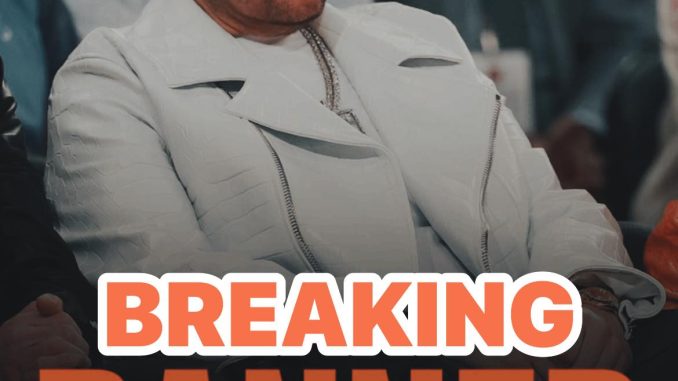
The atmosphere outside Rocket Mortgage FieldHouse had already reached playoff fever hours before tipoff, but by the time Game 4 between the New York Knicks and the Cleveland Cavaliers finally began, the focus around the arena had shifted from basketball to controversy. What was supposed to be another defining night in one of the NBA’s fiercest postseason battles instead became a chaotic collision of celebrity culture, fan passion, and mounting league drama after reports surfaced that rap legend Fat Joe and several outspoken Knicks supporters had allegedly been banned or removed from sections surrounding the nationally televised showdown.
The story exploded across social media within minutes. Videos, fan accounts, and conflicting reports circulated rapidly, turning a heated playoff game into one of the league’s biggest off-court talking points of the week. By the end of the night, discussions about defensive schemes, star performances, and coaching adjustments had been overshadowed by debates about crowd control, celebrity influence, fan treatment, and whether playoff intensity around the NBA is beginning to spiral into something far more combustible.
Game 4 itself carried enormous stakes. The Knicks entered Cleveland with complete momentum after stunning the Cavaliers in the first three games of the Eastern Conference Finals. Jalen Brunson had elevated his postseason legend with another series of fearless performances, while Cleveland found itself searching desperately for answers after a string of defensive collapses and inconsistent offensive execution. The tension surrounding the matchup was already immense before the opening whistle.
But playoff basketball in 2026 has increasingly become as much about atmosphere and spectacle as the actual action on the court. Celebrity appearances, courtside rivalries, and fan interactions now dominate headlines almost as frequently as box scores. In Cleveland, that volatile mixture reached another level entirely.
Fat Joe, long associated with New York basketball culture and one of the Knicks’ most visible celebrity supporters, reportedly arrived at the arena alongside several high-profile fans and guests expecting to sit courtside for the pivotal contest. According to multiple eyewitness accounts circulating online, security tensions began escalating well before halftime. Some fans claimed certain Knicks supporters were warned repeatedly about excessive taunting directed toward Cavaliers players and local fans. Others alleged arena officials had specifically tightened restrictions on visible New York fan celebrations near premium seating areas.
The exact details remain disputed, but reports intensified when rumors emerged suggesting Fat Joe himself had either been denied access to specific courtside areas or asked to relocate amid growing concerns about crowd interactions. Video clips showed heated conversations involving arena personnel, security staff, and several visibly frustrated fans wearing Knicks gear.
As footage spread online, reactions poured in immediately from across the sports world. Knicks supporters accused Cleveland officials of overreacting to visiting fan energy and attempting to suppress New York’s increasingly confident playoff presence. Cavaliers fans countered by arguing that some visiting supporters crossed the line with constant heckling and disrespectful behavior toward players and local attendees.
The NBA, which has spent years attempting to balance fan engagement with stricter arena conduct standards, suddenly found itself facing another public-relations headache during one of the league’s marquee postseason series.
Ironically, the controversy only amplified the edge already defining this rivalry. The Knicks’ resurgence has transformed them from lovable underdogs into one of basketball’s loudest and most polarizing fan bases. After decades of postseason disappointment, New York supporters have embraced every playoff moment with unmatched intensity. Whether inside Madison Square Garden or invading opposing arenas, Knicks fans have become impossible to ignore.
Cleveland, meanwhile, entered the series determined to prove its own legitimacy after years spent rebuilding in the shadow of the franchise’s post-LeBron transition. The Cavaliers viewed this Eastern Conference Finals run as validation of their emergence as a true contender. Instead, the first three games had produced frustration, defensive breakdowns, and growing pressure on a young roster struggling to withstand New York’s relentless energy.
That emotional backdrop created the perfect conditions for tensions to explode.
Inside the arena, every Knicks basket seemed to intensify the hostility between sections of fans. Brunson’s fearless shot-making repeatedly silenced the Cleveland crowd while pockets of New York supporters celebrated loudly after nearly every momentum swing. Cavaliers fans responded with boos, chants, and visible irritation as the game gradually slipped further away from the home team.
Social media only accelerated the chaos. Several viral posts claimed Knicks fans had been unfairly targeted by security while Cavaliers supporters engaged in similar behavior without punishment. Others alleged arena staff acted appropriately in response to increasingly confrontational exchanges near courtside seating.
Fat Joe’s reported involvement elevated the story into mainstream sports entertainment territory almost instantly. Few celebrities carry stronger connections to New York basketball culture. For years, the Grammy-nominated rapper has been synonymous with courtside Knicks appearances, playoff celebrations, and vocal support for the franchise. His presence alone guaranteed additional attention.
The optics of a prominent celebrity supporter allegedly being restricted or removed during a high-profile playoff game sparked fierce debate across television panels, podcasts, and sports radio. Some analysts argued arenas have every right to enforce conduct policies equally regardless of celebrity status. Others questioned whether the situation reflected growing discomfort among teams as traveling fan bases increasingly dominate road environments during playoff games.
That phenomenon has become impossible to ignore throughout the 2026 postseason. Knicks fans, in particular, have overwhelmed opposing arenas in surprising numbers, often turning road contests into near-neutral-site atmospheres. Cleveland reportedly saw thousands of New York supporters descend upon the city before Game 4, with local businesses and hotels flooded by traveling fans throughout the weekend.
For Cavaliers supporters already frustrated by the series trajectory, the invasion only intensified emotions.
As the controversy swirled, the game itself became increasingly lopsided. New York delivered another statement performance, overwhelming Cleveland with physical defense, transition scoring, and relentless confidence. Brunson orchestrated the offense with surgical precision while the Knicks’ supporting cast continued to outplay Cleveland’s rotation on both ends of the floor.
The Cavaliers looked rattled not only by New York’s execution but by the emotional weight hanging over the series. Every missed shot drew groans from the crowd. Every Knicks scoring run intensified the visible anxiety inside the building. By the second half, the atmosphere resembled equal parts playoff desperation and emotional exhaustion.
For the NBA, the situation highlighted a broader challenge facing the modern league. Courtside seating has evolved into a highly visible stage where celebrity culture, fan identity, and sports entertainment intersect constantly. What once amounted to harmless trash talk now frequently becomes headline material capable of dominating national conversations.
League officials have repeatedly emphasized the importance of maintaining respectful fan environments while still preserving the emotional intensity that defines playoff basketball. But striking that balance has grown increasingly difficult in the age of instant viral content and nonstop social media amplification.
Every fan interaction can now become a national story within minutes.
Recent seasons have already seen multiple incidents involving player-fan confrontations, celebrity disputes, and controversial security decisions. From courtside ejections to verbal altercations captured on smartphones, arenas across the league have struggled to adapt to the heightened visibility surrounding fan behavior.
The reported Game 4 controversy in Cleveland now joins that growing list.
For Knicks fans, however, the incident may only deepen the mythology surrounding this playoff run. New York’s postseason resurgence has thrived on a siege mentality. Every hostile arena, every doubting analyst, and every controversy has seemingly strengthened the emotional bond between the team and its supporters.
Players themselves have embraced that energy openly throughout the postseason. Brunson has repeatedly praised the passion of Knicks fans, while teammates have described the traveling support as unlike anything they have experienced elsewhere in the league. Even opposing players have acknowledged the overwhelming presence of New York supporters during road games.
That reality became impossible to ignore in Cleveland.
Meanwhile, Cavaliers players and coaches faced uncomfortable questions after the game regarding crowd behavior and the reported security incidents. While most avoided direct involvement in the controversy, several emphasized the emotional intensity surrounding playoff basketball and the difficulty of controlling charged environments once tensions rise.
The organization itself remained relatively cautious publicly, reportedly reviewing arena footage and security procedures while declining to comment extensively on specific allegations involving Fat Joe or Knicks fans.
That silence only fueled additional speculation online.
Some fans demanded transparency regarding exactly what occurred near courtside seating. Others accused both sides of exaggerating the situation for attention. Without a full public explanation, competing narratives continued spreading rapidly across sports media platforms.
Still, beneath the controversy lies a larger truth about the NBA’s current cultural power.
No other basketball league in the world blends sports, celebrity influence, fan identity, music culture, and social-media storytelling quite like the NBA. Playoff games are no longer isolated athletic events. They are massive entertainment spectacles where every courtside reaction, celebrity appearance, and crowd interaction becomes part of the broader narrative ecosystem surrounding the sport.
Fat Joe’s reported involvement exemplified that reality perfectly. A courtside issue involving an iconic rapper instantly became national sports news because the NBA exists at the intersection of basketball and popular culture in ways unmatched by nearly any other league.
And for the Knicks, whose identity has always been deeply tied to celebrity culture and New York swagger, the incident almost felt inevitable.
Madison Square Garden has long served as basketball’s ultimate celebrity stage. Actors, musicians, athletes, and public figures routinely pack the front rows during major Knicks games. That energy travels with the franchise now more than ever as the team reclaims relevance on the championship stage.
Whether in Boston, Cleveland, Miami, or Philadelphia, Knicks fans have turned road playoff games into traveling productions fueled by noise, confidence, and relentless visibility.
Not everyone welcomes that transformation.
For Cleveland supporters, watching their home arena increasingly dominated emotionally and visually by visiting fans represented another painful reminder of how quickly the series unraveled. What began with championship hopes had turned into frustration, controversy, and looming elimination.
By the final buzzer, social media feeds overflowed with clips of Knicks celebrations, angry fan reactions, debates over arena security, and endless commentary about Fat Joe’s reported treatment. Basketball itself almost became secondary.
Yet perhaps that is precisely what defines modern playoff sports culture.
The game no longer ends when the clock expires. Narratives continue online indefinitely, fueled by viral moments, celebrity involvement, and emotional fan reactions that extend far beyond the hardwood. In Cleveland, one playoff night evolved into a cultural flashpoint reflecting everything chaotic, passionate, and captivating about today’s NBA.
For the Knicks, the victory pushed them another step closer to a return to the NBA Finals and reinforced their growing identity as the league’s loudest postseason force. For Cleveland, the loss deepened questions about resilience, composure, and whether the team was prepared for the emotional magnitude of this stage.
And for the NBA, Game 4 became another reminder that in today’s era, managing the spectacle surrounding the sport can sometimes become just as important as the game itself.
Be the first to comment