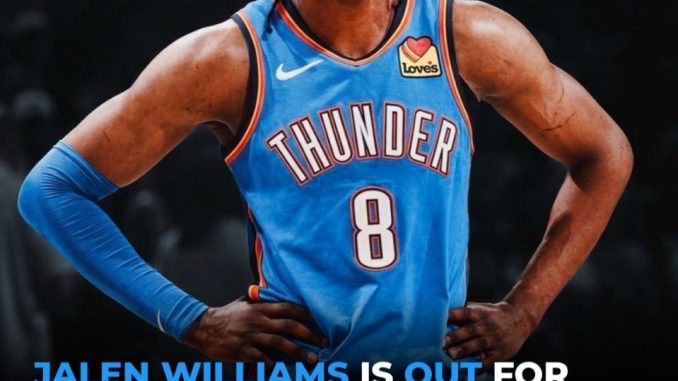
The dream season that the Oklahoma City Thunder have been building toward suddenly feels far more fragile after star forward Jalen Williams exited early with what appears to be a re-aggravated hamstring injury during a pivotal Western Conference Finals showdown against the San Antonio Spurs. For a Thunder team already navigating the enormous pressure of defending its championship aspirations, Williams’ sudden departure sent a wave of concern through the organization, the fan base, and the broader NBA landscape.
Williams, who had only recently returned from a previous hamstring strain that sidelined him for six playoff games, lasted just a short stretch before discomfort forced him out again. The timing could not be worse for Oklahoma City, a team whose identity this season has been built around elite depth, relentless two-way pressure, and the dynamic partnership between Williams and MVP superstar Shai Gilgeous-Alexander. (Reuters)
The Thunder managed to survive the immediate moment, pulling out a 122-113 victory over San Antonio to even the series at 1-1, but the atmosphere surrounding the win felt muted by uncertainty. Instead of celebrating a critical Western Conference Finals response, attention quickly shifted toward the status of one of the franchise’s foundational stars. (Reuters)
Williams’ latest setback is especially troubling because it involves the same hamstring that already caused major concern earlier in the postseason. During Oklahoma City’s first-round matchup against the Phoenix Suns, Williams exited Game 2 after suffering a Grade 1 left hamstring strain. The injury forced him into an extended recovery period that sidelined him throughout much of the playoffs. (NBA)
At the time, Oklahoma City remained optimistic. Head coach Mark Daigneault and the Thunder medical staff carefully managed Williams’ rehabilitation, and there was growing confidence that the versatile wing had recovered fully ahead of the Western Conference Finals. Williams himself publicly declared that he felt healthy entering the series against San Antonio. (ESPN)
That optimism now appears shaken.
Reports from the game indicated that Williams experienced renewed tightness in the hamstring and did not return after leaving the floor. Observers noted that he received treatment on the affected area, and Oklahoma City later ruled him out for the remainder of the contest. (FOX Sports)
The fear surrounding hamstring injuries in the NBA is well understood. Soft-tissue injuries are notoriously difficult to predict and even more difficult to manage during the intensity of playoff basketball. A player may feel healthy during recovery workouts and controlled practices, only for the explosive demands of postseason competition to trigger another setback. For Oklahoma City, the possibility of Williams missing additional games creates enormous strategic questions at the worst possible moment.
This Thunder roster is unquestionably talented, but Williams is not simply another scorer in the rotation. He is one of the central pillars of the franchise’s entire system. His versatility allows Oklahoma City to play multiple styles without sacrificing efficiency on either end of the floor. He can initiate offense, attack the rim, defend elite wings, switch across positions, and relieve pressure from Gilgeous-Alexander when defenses load up against the MVP candidate.
Few players in the league combine size, athleticism, composure, and basketball intelligence the way Williams does. His emergence over the last two seasons transformed Oklahoma City from an exciting young team into a legitimate championship force. After earning All-NBA recognition and helping lead the Thunder to a title run last season, Williams entered this postseason carrying even greater expectations. (Reuters)
The Thunder had already proven capable of surviving without him for stretches. Oklahoma City continued winning during his absence earlier in the playoffs, leaning heavily on Gilgeous-Alexander, Chet Holmgren, and an increasingly deep supporting cast. But there is a major difference between surviving a short-term absence against earlier-round competition and trying to win a brutal conference finals battle against a loaded Spurs team built around generational superstar Victor Wembanyama.
San Antonio presents matchup problems unlike any team Oklahoma City has faced. Wembanyama’s combination of length, skill, and defensive dominance changes the geometry of every possession. The Spurs also continue to receive critical contributions from emerging young stars like Stephon Castle, while veteran experience and disciplined execution have turned San Antonio into one of the league’s most dangerous playoff teams.
Williams was supposed to be one of the Thunder’s primary answers to those challenges.
Even before the injury scare, Game 1 revealed how difficult this series could become for Oklahoma City. Wembanyama delivered a monstrous performance in the opener, overwhelming the Thunder interior and helping San Antonio steal home-court advantage. Oklahoma City responded admirably in Game 2, with Gilgeous-Alexander regaining his aggressive rhythm and the Thunder bench delivering a massive boost, but losing Williams again changes the trajectory of the series entirely. (Reuters)
The concern extends beyond simple production totals. Williams’ absence affects nearly every tactical layer of Oklahoma City’s approach. Offensively, the Thunder lose one of their most reliable secondary creators. Defensively, they lose a switchable wing defender capable of guarding multiple positions and helping contain San Antonio’s perimeter attacks. Emotionally, they lose one of the locker room’s emotional engines and fiercest competitors.
For Gilgeous-Alexander, the pressure now intensifies dramatically.
The Thunder superstar has spent the postseason cementing his place among the NBA’s elite, but Williams’ uncertain status means even more offensive responsibility could shift onto his shoulders. Gilgeous-Alexander was brilliant in the Game 2 response, pouring in 30 points while orchestrating Oklahoma City’s offense with poise and precision. (Reuters)
Yet playoff basketball becomes exponentially harder when defenses can focus almost exclusively on one primary creator.
That reality places greater importance on Holmgren, whose development into an elite two-way big man remains central to the franchise’s long-term future. Holmgren’s rim protection, spacing, and rebounding give Oklahoma City a unique weapon, but the Thunder may now need him to become a far more assertive offensive force if Williams misses significant time.
The ripple effects could also impact Oklahoma City’s rotation structure. Players like Cason Wallace may see expanded roles, while the Thunder coaching staff may need to lean more heavily on bench depth to compensate for Williams’ absence. According to reports, Wallace stepped into a larger role after Williams exited the game. (FOX Sports)
One of the defining traits of this Thunder era has been organizational resilience. General manager Sam Presti constructed a roster designed around versatility, depth, and sustainable success rather than top-heavy dependency. Oklahoma City has consistently demonstrated an ability to withstand adversity, injuries, and lineup changes without collapsing.
But the playoffs are unforgiving.
Championship runs often hinge on health as much as talent, and Oklahoma City now faces the same brutal reality that has derailed countless contenders before them. Even a minor hamstring aggravation can become catastrophic if rushed. Teams must balance urgency against long-term damage, especially with explosive players whose games depend heavily on burst and lateral movement.
That balancing act becomes even more difficult considering Williams’ age and importance to the franchise’s future. Oklahoma City is not merely chasing a single championship window. The Thunder believe they are building a long-term dynasty around Gilgeous-Alexander, Williams, and Holmgren. Risking permanent damage to one of those cornerstones for short-term playoff desperation would be an organizational nightmare.
Still, championship opportunities are never guaranteed.
The Western Conference remains brutally competitive, and Oklahoma City understands how difficult it is to return to this stage year after year. The Thunder are trying to maximize a title defense while the opportunity exists, which creates immense tension around every medical decision moving forward.
Meanwhile, San Antonio senses opportunity.
The Spurs have already proven capable of pushing Oklahoma City to uncomfortable places in this series. Wembanyama’s dominance forces constant adjustments, while San Antonio’s size and defensive activity continue to challenge the Thunder’s offensive rhythm. If Williams is unavailable or limited moving forward, the Spurs will undoubtedly attack the weakened perimeter rotations and force Oklahoma City’s remaining stars into exhausting workloads.
Ironically, San Antonio is also battling injuries of its own. De’Aaron Fox has been dealing with ankle soreness, while rookie Dylan Harper reportedly exited Game 2 with a hamstring issue as well. (Reuters) But Williams’ situation carries particularly massive implications because of how central he is to Oklahoma City’s identity.
The broader NBA world has taken notice because Williams’ rise over the last several seasons has been one of basketball’s best development stories. Drafted outside the spotlight compared to some of his peers, he evolved into an elite two-way star through relentless improvement, high basketball IQ, and fearless confidence in pressure moments.
His postseason résumé has steadily expanded as well. Williams delivered several signature playoff performances during Oklahoma City’s championship run, including a historic 40-point Finals performance that helped define his emergence as a superstar-level talent. (Reuters)
That is why seeing him limp off the floor again carried such emotional weight.
For the Thunder fan base, the image instantly revived fears from earlier in the postseason when the original hamstring injury occurred. Supporters had spent weeks anxiously awaiting his return, believing his presence could push Oklahoma City back to championship form. Now, uncertainty once again dominates the conversation.
The next several days could determine the fate of Oklahoma City’s season.
Medical evaluations will likely dictate whether Williams faces a short-term absence, minute restrictions, or another extended recovery timeline. Even if scans reveal only minor aggravation, hamstrings rarely cooperate on playoff schedules that allow little recovery time between games.
And unlike the regular season, there is no luxury of caution once elimination games begin looming.
Every possession in this series now carries amplified significance. The Thunder no longer simply need to defeat San Antonio. They must also figure out how to preserve the health of one of their franchise cornerstones while navigating the emotional and physical intensity of a championship chase.
For Daigneault and the coaching staff, the challenge becomes psychological as much as tactical. They must keep the locker room focused despite growing uncertainty. Young teams can sometimes fracture under the emotional strain of injuries, particularly when a beloved teammate suddenly disappears from the lineup.
So far, Oklahoma City has consistently responded with maturity beyond its years.
That resilience will be tested again as the series shifts to San Antonio for Game 3. The Spurs crowd will bring enormous energy, Wembanyama will continue demanding double teams, and the Thunder may have to survive without one of their best players.
The burden now falls heavily on Gilgeous-Alexander to steady the franchise. Great playoff runs often require superstars to elevate beyond exhaustion and adversity. Oklahoma City believes its MVP leader is capable of exactly that.
But even MVPs need help.
And right now, the Thunder can only wait anxiously to learn whether Jalen Williams will be able to provide it. (The Times of India)
Be the first to comment