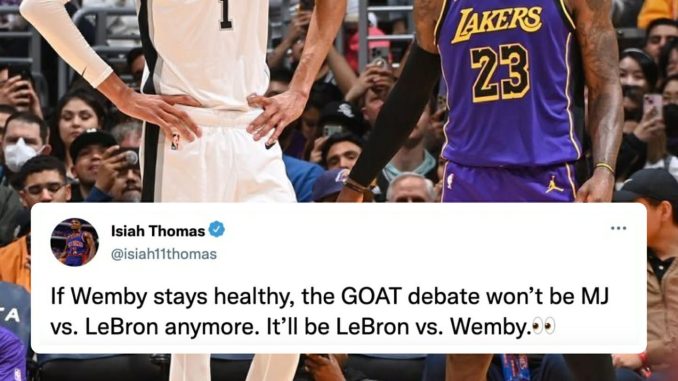
The NBA’s generational conversation about greatness has long been anchored by two towering figures—Michael Jordan and LeBron James—whose careers have shaped the modern definition of dominance, longevity, and cultural impact. But according to Hall of Famer Isiah Thomas, a new name is beginning to surface in the margins of that debate, one so extraordinary in both physical tools and developmental trajectory that it may not be long before he forces his way into conversations once considered closed. That name is Victor Wembanyama.
Thomas, known for his fearless opinions and deep understanding of the league’s evolving dynamics, has reportedly suggested that Wembanyama possesses the rare combination of talent, ceiling, and basketball intelligence that could one day place him in the same sentence as Jordan in the ultimate GOAT conversation. More strikingly, Thomas views the young San Antonio Spurs phenom as a potential long-term rival in legacy discussions that currently orbit around LeBron’s historic résumé. While such projections remain early and speculative, the sentiment reflects a growing consensus within league circles: Wembanyama is not merely a prospect or an All-Star in waiting—he may be a franchise-altering force with generational implications.
At just the beginning of his NBA journey, Wembanyama has already disrupted traditional expectations of what a basketball player can be. Standing at a rare blend of height, mobility, and skill, he has been described as a defensive anchor who can alter shots without leaving his feet, while simultaneously operating as a perimeter threat capable of handling the ball like a guard. His skill set defies positional categorization, and in many ways, it is this unpredictability that fuels the broader narrative around his future. In a league increasingly defined by versatility, spacing, and switch-heavy defense, Wembanyama’s profile appears almost engineered for modern dominance.
Thomas’s reported belief in Wembanyama’s trajectory is rooted not just in physical attributes but in psychological and developmental indicators that often separate great players from all-time greats. The ability to adapt, to evolve within changing defensive schemes, and to carry the burden of franchise expectation are all factors that historically determine whether a player can transcend stardom and enter the realm of legacy. According to those close to the discussion, Thomas sees in Wembanyama a rare calmness under pressure, a willingness to learn, and a competitive edge that is not easily taught or replicated.
The comparison to Jordan, however, is not made lightly. Jordan’s career with the Chicago Bulls set the gold standard for dominance in the NBA, combining scoring prowess, defensive intensity, and an unmatched killer instinct in clutch moments. Any suggestion of a future contender being placed in the same conversation immediately invites scrutiny. Yet Thomas’s stance is not that Wembanyama is already there, but that his ceiling is so unprecedented that he cannot be excluded from long-term projections that involve the greatest players in basketball history.
In parallel, the presence of LeBron James in the discussion underscores the generational overlap that defines modern NBA discourse. LeBron’s two-decade reign has been built on versatility, durability, and sustained excellence across multiple eras of basketball evolution. If Wembanyama is to be mentioned alongside him in the future, it would require not just brilliance, but longevity at an elite level—something that even the most promising young stars struggle to maintain over time. Yet Thomas’s reported perspective suggests that Wembanyama’s trajectory may be unique even among elite prospects, particularly if his development continues at its current pace.
Within the San Antonio Spurs organization, expectations remain carefully managed. The franchise, historically known for its disciplined culture under the legacy of Tim Duncan, Gregg Popovich, and a system-first approach, has shown no inclination to rush Wembanyama into forced superstardom narratives. Instead, the emphasis has been on gradual progression, skill refinement, and physical sustainability. The Spurs’ developmental structure has often produced players who exceed expectations not through early statistical explosions, but through sustained growth and situational mastery.
Still, the broader NBA ecosystem is already adjusting to Wembanyama’s gravitational pull. Opposing teams game-plan differently when facing him, even at this early stage of his career. Coaches design offensive sets specifically to avoid his defensive range, while defensive schemes collapse or stretch in response to his positioning. This level of attention is typically reserved for established superstars, not emerging talents, yet Wembanyama has already begun to occupy that strategic space.
Thomas’s reported comments also highlight a broader philosophical shift in how greatness is evaluated. In previous eras, comparisons to Jordan were often reserved for players who had already accumulated championships or MVP awards. Today, however, the conversation is increasingly projection-based, driven by analytics, skill translation, and contextual fit within modern basketball systems. Wembanyama, in this sense, represents a new archetype—one whose value is not just measured in current production but in projected inevitability.
The idea of a future rivalry with LeBron in the GOAT conversation is particularly compelling because it frames Wembanyama not just as a successor generation talent, but as a potential transitional figure between eras. LeBron’s longevity has already stretched across multiple basketball landscapes—from post-handcheck physicality to the modern three-point revolution. For Wembanyama to enter that conversation, he would need to dominate in a league that continues to evolve around pace, space, and positional fluidity. His ability to anchor defense while stretching offensive schemes suggests he may already be ahead of the curve in that regard.
Yet caution remains essential in any early GOAT framing. The NBA history is filled with players who showed flashes of generational brilliance only to be slowed by injuries, adaptation challenges, or shifting team contexts. The margin between potential and legacy is often defined by factors outside of pure talent. Durability, organizational stability, coaching alignment, and even luck play decisive roles in shaping careers that ultimately reach the highest tier.
Still, what separates Wembanyama from many of his predecessors is the unprecedented nature of his skill combination. Few players in league history have entered the NBA with such a fusion of rim protection, perimeter agility, and offensive versatility. Even fewer have done so while drawing immediate defensive attention that reshapes opposing game plans. In that sense, Thomas’s reported comments reflect not hype alone, but a recognition of structural disruption—Wembanyama changes how basketball is played when he is on the floor.
From a historical standpoint, the NBA has always evolved through transformational figures. Jordan redefined scoring efficiency and competitive mentality in the 1990s. LeBron redefined positional versatility and career longevity in the 2000s and 2010s. If Wembanyama continues on his current developmental curve, he may represent the next evolutionary step: a player who blends interior dominance with perimeter fluidity in a way that erases traditional positional constraints entirely.
Within that framework, the Spurs’ long-term strategy becomes even more significant. The franchise is not simply developing a player; it is potentially shaping the foundation of a new era. Every minute of Wembanyama’s development is being treated as an investment in a future that could redefine both the franchise and the league. That responsibility comes with pressure, but also with extraordinary opportunity.
Thomas’s reported belief ultimately serves as a catalyst for a broader conversation rather than a definitive declaration. The idea that Wembanyama could one day enter the Jordan-LeBron axis of greatness is not a claim rooted in present dominance, but in projected ceiling. It reflects how quickly narratives in the NBA can evolve when a player’s talent appears to transcend conventional developmental timelines.
As the league continues to shift toward positionless basketball and increased reliance on multi-skilled big men, Wembanyama stands at the center of a potential transformation. Whether he ultimately reaches the heights suggested by Thomas remains to be seen, but the fact that such conversations are already emerging underscores the magnitude of expectation surrounding him.
For now, Jordan and LeBron remain the defining pillars of basketball greatness, their legacies etched across decades of dominance and cultural influence. But in the background of that established hierarchy, a new figure is quietly reshaping expectations of what might come next. If Victor Wembanyama continues on his current path, the NBA may one day find itself revisiting the very structure of its greatest-of-all-time debate—not to replace the past, but to expand it.
Be the first to comment