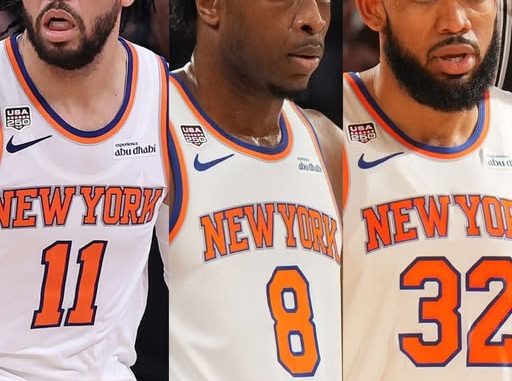
As the New York Knicks stand one victory away from capturing their first NBA championship in more than five decades, the conversation surrounding a potential Finals MVP has become just as compelling as the series itself. With the Knicks holding a commanding 3-1 lead over the San Antonio Spurs heading into Game 5, several players have made strong cases for the honor. Yet if New York finishes the job and lifts the Larry O’Brien Trophy, one name currently appears to stand above the rest.
The Knicks’ remarkable postseason journey has been defined by resilience, balance, and star power. Throughout the Finals, multiple players have delivered pivotal performances, making the MVP race far more competitive than many anticipated when the series began. While championship teams often feature a clear-cut superstar carrying the load, New York’s success has come from contributions across the roster, creating an intriguing debate among analysts, fans, and media members.
At the forefront of that discussion is Jalen Brunson. The Knicks’ floor general has once again demonstrated why he has become the face of the franchise and one of the league’s most dependable postseason performers. Brunson has controlled the tempo of games, delivered clutch scoring in critical moments, and consistently provided the leadership that has transformed New York into a legitimate championship contender.
Throughout the Finals, Brunson has been the player the Knicks turn to whenever they need a basket, a calming presence, or a momentum-shifting play. His ability to create offense under pressure has repeatedly forced the Spurs’ defense into difficult situations. Whether attacking in isolation, orchestrating pick-and-roll action, or knocking down difficult jump shots late in games, Brunson has showcased the complete offensive package that has defined his playoff run.
What strengthens Brunson’s MVP candidacy is not simply the statistics he has produced, but the timing of his contributions. Finals MVP voters historically place enormous value on players who elevate their performances in decisive moments. Brunson has repeatedly answered the call when games have hung in the balance, delivering the kind of signature moments that often sway award voting.
Game 4 may ultimately prove to be the defining moment of his candidacy. With the Knicks facing a determined Spurs team desperate to even the series, New York found itself in a tense battle deep into the fourth quarter. Brunson’s composure, shot creation, and leadership helped the Knicks secure a narrow 107-106 victory that pushed them to the brink of a championship. Those moments matter immensely when Finals MVP ballots are cast.
However, Brunson is not the only Knick deserving serious consideration. Karl-Anthony Towns has delivered some of the most impactful performances of the series. Acquired to help elevate the Knicks into title contention, Towns has provided elite scoring, rebounding, and floor spacing against a talented Spurs frontcourt. His ability to stretch defenses while simultaneously controlling the glass has created matchup problems throughout the Finals.
Towns’ offensive versatility has been particularly valuable. He can punish opponents in the post, knock down perimeter shots, and facilitate offense from multiple spots on the floor. Those skills have made him one of the most difficult players for San Antonio to contain. In several games, his production has rivaled or even exceeded Brunson’s statistical output, leading some observers to argue that he deserves equal consideration for the award.
If Towns delivers a dominant performance in a potential championship-clinching Game 5, the race could tighten considerably. Finals MVP narratives can change quickly, especially when a player produces an unforgettable closeout-game performance. Voters often remember the final impression, and a monster outing from Towns could shift momentum in the discussion.
Another player who deserves recognition is Mikal Bridges. While his statistical numbers may not rival those of Brunson or Towns, Bridges has arguably been New York’s most important two-way contributor. His defensive assignments have routinely involved guarding the Spurs’ most dangerous perimeter threats, and his ability to impact games without dominating the ball has been crucial to the Knicks’ success.
Championship teams frequently rely on players willing to embrace difficult defensive responsibilities, and Bridges has done exactly that. His versatility allows New York to switch defensive coverages seamlessly, while his timely shooting has delivered momentum-changing baskets throughout the series. Though Finals MVP voters traditionally favor high-scoring stars, Bridges’ influence should not be overlooked.
The same can be said for Josh Hart, whose relentless energy has become one of the defining characteristics of the Knicks’ postseason run. Hart’s rebounding, hustle plays, defensive intensity, and willingness to sacrifice for the team have consistently generated extra possessions and momentum swings. Players like Hart rarely win Finals MVP, but championship teams often point to those contributions as being just as important as scoring totals.
Still, when evaluating the award through a historical lens, the strongest case continues to belong to Brunson. Finals MVP winners are typically players who combine elite production with narrative significance. Brunson checks both boxes.
Since arriving in New York, he has transformed the franchise’s trajectory. The Knicks were searching for a leader capable of returning the organization to championship relevance. Brunson has exceeded every expectation. His rise from a highly respected point guard to a legitimate superstar has become one of the NBA’s most compelling stories.
A championship would represent the culmination of that journey. It would also reinforce the perception that Brunson is the engine driving New York’s success. Even with Towns providing tremendous support and the rest of the roster making critical contributions, Brunson remains the player opposing defenses focus on first. He is the player trusted with the ball during crunch time. He is the emotional and strategic leader of the team.
That matters when voters determine who has been most valuable.
The Finals MVP award has historically rewarded players who serve as both statistical leaders and symbolic representatives of championship teams. From Michael Jordan and Tim Duncan to LeBron James and Stephen Curry, the award often goes to the player most closely associated with a team’s identity. For the Knicks, that player is unquestionably Brunson.
Of course, Game 5 still remains to be played, and history has shown that championship-clinching games can dramatically reshape MVP races. A spectacular performance from Towns, Bridges, or another Knicks standout could create legitimate debate. Likewise, if Brunson struggles while a teammate delivers an iconic closeout performance, voters may be forced to reconsider.
But entering Game 5, Brunson appears to hold the inside track.
His leadership, consistency, clutch performances, and overall influence on the series place him at the top of the Finals MVP ladder. He has been the steady force behind New York’s success and the player most responsible for guiding the franchise to the doorstep of basketball immortality.
If the Knicks complete their championship mission in Game 5, the celebration will belong to the entire organization. The players, coaches, and fans who have waited decades for this moment will all share in the achievement. Yet when the time comes to present the Bill Russell NBA Finals MVP Trophy, the strongest candidate at this stage is Jalen Brunson.
Unless Game 5 produces a dramatic shift in the narrative, Brunson’s combination of production, leadership, and defining moments has positioned him as the favorite to receive the honor and cement his place in Knicks history forever.
Be the first to comment