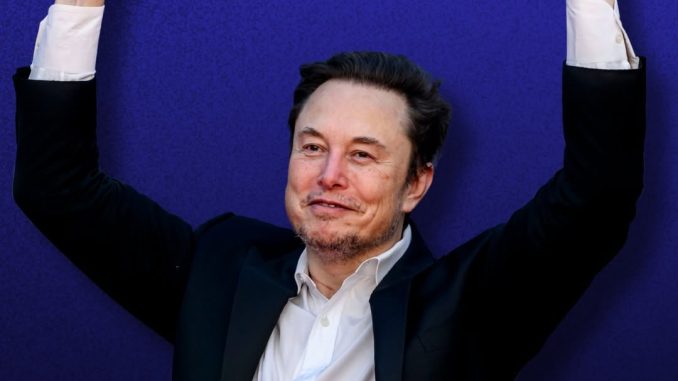
The global business landscape witnessed a historic milestone this week as Elon Musk officially became the world’s first trillionaire, a financial achievement driven largely by the long-anticipated public offering of SpaceX. Following an explosive debut on the public markets, the aerospace giant’s valuation surged beyond even the most optimistic forecasts, propelling Musk’s personal net worth past the unprecedented $1.1 trillion mark and cementing his place in economic history.
For decades, the race to become the world’s first trillionaire was one of the most closely watched storylines in finance and technology. Economists, investors, and market analysts debated whether such a milestone would ever be reached within a single lifetime. Many predicted that a trillion-dollar fortune remained decades away, while others argued that the rapid acceleration of artificial intelligence, space technology, and global connectivity could dramatically alter traditional wealth projections. Those discussions have now become reality.
The catalyst behind the historic moment was SpaceX’s blockbuster initial public offering, an event that instantly became one of the largest and most significant market debuts ever recorded. Investors rushed to secure shares in the company that has transformed commercial spaceflight, satellite communications, and deep-space exploration over the past two decades. The overwhelming demand sent SpaceX’s valuation soaring within hours of its market debut, creating one of the most dramatic wealth increases ever experienced by an individual.
Musk, who already held substantial stakes in several industry-leading companies, saw his fortune rise at a pace rarely witnessed in financial history. While his wealth has fluctuated significantly over the years due to stock market movements, the extraordinary market response to SpaceX elevated his net worth into entirely new territory. The achievement represents more than a personal financial milestone; it marks a turning point in the modern era of entrepreneurship, illustrating the immense value investors now place on innovation-driven enterprises.
SpaceX’s journey to becoming one of the most valuable companies in the world has been anything but straightforward. Founded with the ambitious goal of reducing the cost of space transportation and ultimately enabling human life beyond Earth, the company faced skepticism from many experts during its early years. Multiple rocket failures threatened its survival, and critics questioned whether a privately funded aerospace company could compete with established government agencies and defense contractors.
Yet through persistence, technological breakthroughs, and a willingness to embrace risk, SpaceX gradually reshaped the space industry. The company revolutionized launch economics through reusable rocket technology, dramatically lowering costs and increasing launch frequency. What was once considered an ambitious experiment evolved into a dominant force in global aerospace, serving governments, commercial clients, and scientific organizations around the world.
Perhaps equally important to investors was the company’s success in satellite communications. The rapid expansion of SpaceX’s satellite network created new revenue streams while positioning the company at the center of global connectivity efforts. As demand for internet access continued to grow across underserved regions, SpaceX’s influence expanded far beyond rocket launches and space exploration.
The IPO represented the culmination of years of anticipation. Financial markets had long speculated about the value SpaceX might command if it became publicly traded. Private funding rounds consistently pushed the company’s valuation higher, but many analysts believed the public markets would unlock even greater investor enthusiasm. Those predictions proved accurate as trading activity reflected extraordinary confidence in SpaceX’s future prospects.
Investors appeared eager to buy into a company that has become synonymous with innovation. SpaceX’s achievements include launching astronauts into orbit, delivering cargo to space stations, developing next-generation spacecraft, and pursuing missions aimed at eventually reaching Mars. These accomplishments helped establish the company as one of the defining technological enterprises of the 21st century.
Musk’s ascent to trillionaire status also highlights the growing influence of visionary entrepreneurs in shaping the global economy. Throughout modern history, industrial revolutions have created extraordinary fortunes for those who successfully transformed major industries. From railroads and steel to automobiles and software, each technological era produced leaders who benefited from profound shifts in economic activity. Musk’s rise reflects the latest chapter in that evolution, driven by advances in space technology, electric transportation, artificial intelligence, and communications infrastructure.
The significance of the milestone extends beyond simple wealth rankings. Economists note that the creation of a trillion-dollar personal fortune demonstrates how rapidly value can accumulate in sectors characterized by innovation, scalability, and global reach. Unlike traditional industrial businesses that often required decades of expansion, modern technology companies can achieve enormous market valuations within relatively short periods by serving billions of customers and operating across multiple industries simultaneously.
Supporters of Musk view the achievement as validation of his long-term vision. They point to years of skepticism surrounding many of his ventures and argue that his willingness to pursue ambitious goals ultimately produced transformative results. Projects once dismissed as unrealistic have evolved into influential businesses that impact transportation, energy, communications, and aerospace.
Critics, however, have renewed discussions regarding wealth concentration and economic inequality. The emergence of the world’s first trillionaire inevitably raises questions about the distribution of resources and the growing financial power wielded by a small number of individuals. Analysts from across the political spectrum have debated the broader implications of such unprecedented personal wealth, with some celebrating entrepreneurial success while others expressing concern about the scale of economic concentration.
Despite those debates, there is little disagreement regarding the historical significance of the moment. Financial markets have produced many remarkable success stories, but none have approached the symbolic threshold represented by a trillion-dollar fortune. The milestone carries a psychological impact that extends beyond numerical calculations, illustrating just how dramatically the global economy has evolved in the digital age.
For SpaceX employees, the IPO represents a remarkable chapter in the company’s history. Thousands of engineers, scientists, technicians, and support staff contributed to the organization’s rise from a startup with ambitious goals into one of the world’s most valuable enterprises. Many employees who received stock-based compensation are expected to benefit significantly from the company’s market success, creating substantial wealth across various levels of the organization.
Industry experts believe the company’s public market debut could influence the broader aerospace sector. Increased investor interest in space-related businesses may encourage additional investment across the industry, accelerating research and development efforts. Companies focused on satellite technology, launch services, lunar exploration, and advanced spacecraft systems could all experience renewed attention as investors seek opportunities connected to the expanding space economy.
Government agencies and international partners are also likely to monitor the company’s next steps closely. SpaceX plays a major role in numerous strategic initiatives involving national security, scientific research, and international collaboration. The company’s enhanced financial resources may enable even more ambitious projects in the years ahead, including expanded exploration efforts and advanced infrastructure development.
Market analysts have emphasized that Musk’s net worth remains heavily tied to the value of his corporate holdings rather than liquid cash. Like many ultra-high-net-worth individuals, the majority of his fortune exists in ownership stakes within various companies. As a result, fluctuations in market valuations could significantly impact the exact size of his wealth over time. Nevertheless, crossing the trillion-dollar threshold remains a landmark accomplishment regardless of future market movements.
The IPO’s success also underscores investor confidence in long-term growth opportunities associated with space exploration. Once viewed as a niche sector dependent on government funding, the space industry has increasingly attracted private capital from around the world. Advances in technology, declining launch costs, and expanding commercial applications have transformed space into one of the most dynamic areas of investment.
Many observers compare the current state of the space economy to the early days of the internet revolution. Just as digital connectivity reshaped global commerce and communication, supporters believe space-based technologies could unlock new economic opportunities across multiple sectors. From communications and navigation to manufacturing and resource development, the potential applications continue to expand.
Musk himself has frequently emphasized the importance of long-term thinking and ambitious objectives. Throughout his career, he has advocated for pursuing projects capable of generating transformative societal impact rather than focusing exclusively on short-term financial returns. While opinions differ regarding his leadership style and public persona, few would dispute the scale of his influence across multiple industries.
The trillionaire milestone may also reshape future discussions about entrepreneurship and innovation. Aspiring founders often study the trajectories of successful business leaders, searching for lessons that can be applied to their own ventures. Musk’s journey from startup entrepreneur to the world’s first trillionaire will undoubtedly become a major case study in business schools, investment circles, and leadership programs for years to come.
Financial historians are already placing the achievement within a broader context. Previous generations witnessed the rise of industrial magnates, technology pioneers, and global business icons who redefined economic possibilities. Musk’s ascent represents the latest evolution of that tradition, occurring in an era where technological innovation can generate extraordinary value on a global scale.
Whether viewed as a triumph of entrepreneurship, a symbol of technological progress, or a catalyst for broader debates about wealth and society, the moment stands as one of the most remarkable financial milestones ever recorded. The successful SpaceX IPO did more than create enormous shareholder value; it shattered assumptions about the upper limits of personal wealth and demonstrated the extraordinary impact that transformative businesses can have on global markets.
As investors continue evaluating the long-term implications of SpaceX’s public debut, one fact remains undeniable: history has been made. Elon Musk’s net worth surpassing $1.1 trillion following the landmark IPO establishes a new benchmark in modern finance and signals the arrival of a new era in which the boundaries of wealth, technology, and human ambition continue to expand beyond what many once believed possible.
Be the first to comment