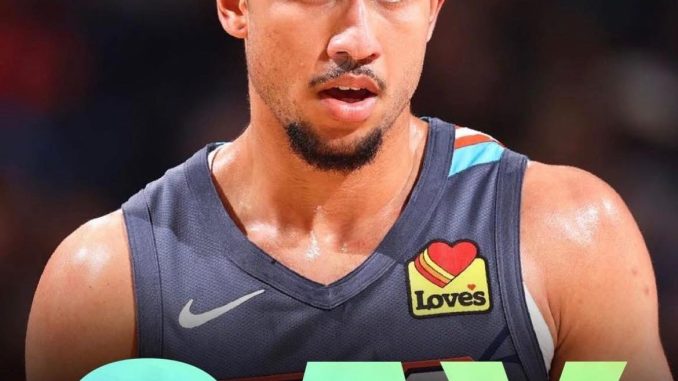
The NBA has long prided itself on being one of the world’s most progressive professional sports leagues, a global brand built on individuality, self-expression, and cultural influence far beyond basketball. Yet for all of its evolution across fashion, music, activism, and player empowerment, one barrier has remained untouched inside the league itself: no active NBA player has ever publicly identified as openly gay while competing full-time on an NBA roster. That reality is why recent online reports and speculation surrounding Oklahoma City Thunder guard entity[“people”,”Jared McCain”,”NBA player”] have ignited widespread conversation across the basketball world.
Multiple social media posts and online discussions in recent months have circulated claims that McCain could become the first openly gay active player in NBA history, though there has been no official public statement from McCain himself confirming those reports. (facebook.com) Even without confirmation, the discussions alone have triggered passionate debate across sports media, fan communities, and social platforms, once again placing basketball at the center of a broader cultural conversation about identity, acceptance, masculinity, and representation in professional sports.
At just 22 years old, McCain has already become one of the NBA’s most recognizable young personalities. A talented scorer with growing popularity among younger fans, the former entity[“organization”,”Duke Blue Devils”,”NCAA basketball team”] standout entered the league with more than just basketball expectations attached to his name. His social media presence, confident personality, painted fingernails, dance videos, and willingness to embrace individuality made him one of the most talked-about rookies in recent memory. While many fans celebrated his authenticity, others criticized him harshly online, exposing the still-complicated relationship between modern sports culture and expressions of masculinity.
That tension became especially visible during McCain’s rookie season with the entity[“sports_team”,”Philadelphia 76ers”,”NBA team”], when viral discussions about his appearance and personality frequently overshadowed his play on the court. Despite averaging strong offensive numbers early in his professional career, conversations around McCain often drifted away from basketball and toward speculation about his personal life. A December 2024 feature from The Guardian highlighted the wave of online hate directed toward the young guard, arguing that the criticism reflected deeper issues involving homophobia and rigid stereotypes still embedded in sports culture. (theguardian.com)
McCain never allowed the outside noise to visibly shake his confidence. Instead, he leaned further into self-expression, continuing to post dance videos, fashion content, and behind-the-scenes glimpses into his personality. In many ways, that approach mirrored a changing generation of athletes who no longer feel obligated to fit into traditional molds created by previous eras.
The modern NBA has increasingly embraced individuality. Tunnel fashion has become part of league culture. Players openly discuss mental health, social justice, and political issues. Stars build multimedia brands around gaming, music, and lifestyle content. Yet sexuality remains one of the final frontiers in men’s professional basketball.
Former NBA center entity[“people”,”Jason Collins”,”Former NBA player”] made history in 2013 when he publicly came out as gay, later becoming the first openly gay player to appear in an NBA game after signing with the entity[“sports_team”,”Brooklyn Nets”,”NBA team”] in 2014. (en.wikipedia.org) Collins’ announcement was groundbreaking, but he was nearing the end of his career at the time and was not viewed as a long-term active player expected to remain in the league for years afterward.
More than a decade later, the NBA still has not seen an openly gay star playing prominently in his prime. That absence has often stood in contrast to the league’s public image as one of the most socially progressive organizations in sports.
If McCain were ever to publicly confirm the reports circulating online, the moment would instantly become one of the most historically significant cultural developments in NBA history. It would not only mark a first for the league but also potentially reshape perceptions about identity and acceptance within men’s professional basketball.
The significance would extend far beyond North America. The NBA is one of the most internationally consumed sports products in the world, reaching millions of viewers across Europe, Africa, Asia, and South America. A young player openly embracing his sexuality while competing at the sport’s highest level could have a ripple effect across global basketball communities, particularly among younger athletes struggling with fear, judgment, or acceptance.
At the same time, the reaction to the reports has demonstrated exactly why such a moment would carry enormous weight.
Supportive messages flooded social media from fans praising the possibility of greater representation in the league. Many younger viewers argued that sports culture is evolving and that athletes should no longer feel pressured to hide who they are in order to succeed professionally. Others pointed to the overwhelming popularity McCain has already developed among Gen Z audiences, suggesting he represents a new generation of athlete less concerned with outdated expectations surrounding masculinity.
But the backlash has also been impossible to ignore.
Online discussions surrounding McCain frequently turned toxic, with many comments targeting his personality, appearance, and mannerisms rather than his basketball performance. Reddit discussions and viral comment sections repeatedly reflected how quickly speculation about sexuality becomes weaponized in sports discourse. (reddit.com) The intensity of those reactions has served as a reminder that despite progress in many areas, men’s professional sports still remain environments where homophobia and stereotypes can thrive.
That reality is not unique to basketball.
Across the four major American men’s sports leagues — the NBA, NFL, MLB, and NHL — openly gay active players have remained exceptionally rare. While retired athletes have publicly come out after their careers ended, very few active male athletes in major North American team sports have openly identified as gay while competing.
The reasons behind that reality are complex.
For decades, professional sports culture has been closely tied to traditional ideas surrounding toughness, aggression, and masculinity. Many athletes have privately spoken about fears involving locker-room acceptance, media attention, endorsement fallout, or becoming defined solely by their sexuality rather than their athletic performance.
Even as public attitudes evolve, athletes considering such a step still face enormous pressure.
That pressure becomes even more magnified in basketball, where individual personalities are often placed under a brighter spotlight than in other sports. NBA stars are not hidden behind helmets or large rosters. Their personal brands are central to league marketing. Every quote, outfit, post, and expression can instantly become headline material.
McCain understands that spotlight as well as any young player in the league.
Before even entering the NBA, he had already developed a massive social media following through TikTok, YouTube, and other platforms. (en.wikipedia.org) Unlike many prospects who carefully protect traditional athlete images, McCain embraced dancing, lifestyle content, and beauty partnerships openly and confidently. That visibility made him beloved by some fans and controversial among others long before any rumors regarding his sexuality emerged.
Ironically, the very qualities that made McCain different may also explain why so many younger fans identify with him.
To many supporters, McCain represents authenticity in an era where athletes increasingly control their own narratives. Younger sports audiences often place greater value on individuality and openness than previous generations, and McCain’s popularity across social media reflects that shift.
Inside the basketball community itself, league officials and many players have repeatedly voiced support for inclusivity over the years. The NBA has hosted Pride initiatives, partnered with LGBTQ organizations, and publicly celebrated diversity campaigns across multiple seasons.
Still, symbolic support and real-world cultural change are not always the same thing.
The conversation surrounding McCain has exposed how much work remains unfinished.
Some analysts believe the first openly gay active NBA player would likely need to possess unusual mental toughness simply because the attention would become overwhelming. Every game, interview, road trip, and social media interaction would carry intensified scrutiny. Critics would dissect performance slumps through a different lens. Opposing fan bases might attempt to weaponize chants or insults. Television debates would inevitably shift from basketball to culture-war arguments.
In many ways, that burden helps explain why no active player has publicly crossed that threshold yet.
But sports history has repeatedly shown that barriers rarely disappear until someone becomes willing to walk through them first.
From racial integration to mental-health advocacy, athletes who challenged norms often faced hostility before eventually being celebrated as pioneers years later. Public opinion in sports frequently changes slower than society itself.
Whether McCain ever confirms the reports or not, the broader discussion may already represent an important cultural moment for the NBA.
The fact that fans are even openly discussing the possibility of an active gay NBA player without it automatically ending a player’s career signals meaningful change compared
Be the first to comment