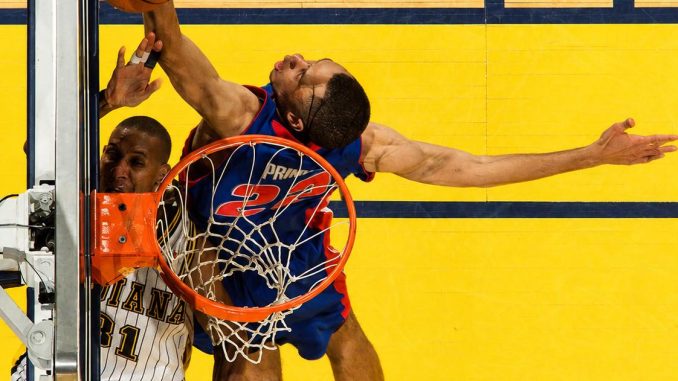
The roar inside The Palace of Auburn Hills still echoes through NBA history. In an era before social media clips flooded every screen and before “chase-down blocks” became part of basketball’s nightly vocabulary, one unforgettable defensive play froze time itself. On this day in 2004, with the season hanging in the balance and the Eastern Conference Finals turning into a brutal war of attrition, Tayshaun Prince sprinted from seemingly nowhere to author one of the greatest defensive moments the playoffs have ever seen.
“From nowhere comes Prince!”
Those legendary words from broadcaster Kevin Harlan became permanently attached to one of the defining plays of the 2000s NBA era after Prince erased Reggie Miller at the rim in the closing seconds of Game 2 between the Detroit Pistons and the Indiana Pacers.
The block was more than a spectacular defensive recovery. It was the embodiment of everything those Pistons teams represented: relentless effort, toughness, discipline, sacrifice, and a refusal to surrender a single possession. In a playoff run defined by defense and grit, Prince’s chase-down rejection became the signature image of Detroit basketball at its peak.
The game itself was a throwback even by 2004 standards. The final score read 72-67, numbers that today resemble halftime totals rather than the result of a conference finals matchup. Every possession felt violent, every dribble contested, every inch of space earned through sheer physical punishment. There were no easy baskets, no transition highlights, and no offensive rhythm. Instead, the game unfolded like a heavyweight fight where every point landed with enormous consequence.
Detroit had entered the series believing it could challenge Indiana’s status as the Eastern Conference’s top seed. The Pacers, coached by Rick Carlisle, had finished the regular season with a league-best 61 wins behind suffocating defense and disciplined execution. Led by the sharpshooting brilliance of Miller and the all-around dominance of Jermaine O’Neal, Indiana was widely viewed as the conference favorite.
But the Pistons were beginning to evolve into something special under head coach Larry Brown. Detroit had already stunned the basketball world months earlier by acquiring Rasheed Wallace at the trade deadline, adding another elite defender and emotional spark to a roster built around toughness. Alongside Prince, Wallace joined a core featuring Ben Wallace, Chauncey Billups, and Richard Hamilton to form one of the most complete defensive units the league had seen in decades.
Game 2 perfectly captured the identity of both teams.
Nothing came easy from the opening tip. Indiana struggled to generate clean looks against Detroit’s physical perimeter defense, while the Pistons found themselves trapped in a half-court wrestling match against the Pacers’ disciplined rotations. Every possession resembled a playoff survival test.
The shooting percentages were almost difficult to believe. Indiana finished the night shooting just 27.5% from the field, a staggering number considering the stakes and talent on the floor. Detroit’s defense swarmed every action. Passing lanes disappeared. Driving angles vanished. Contest after contest forced the Pacers into desperation attempts late in the shot clock.
Yet despite the offensive struggles, the tension only intensified as the clock wound down.
Late in the fourth quarter, Detroit clung to a narrow lead with every possession threatening to alter the series. The Pacers, desperate to steal home-court advantage back after dropping Game 1, needed one final breakthrough. Miller, already one of the most feared clutch performers in NBA history, saw his opportunity.
As the final seconds ticked away, Indiana forced a turnover and suddenly found daylight. Miller leaked out in transition with nothing but open hardwood ahead of him. For a split second, the game appeared destined for a one-possession finish. Miller gathered the ball and prepared for a seemingly uncontested layup that would cut Detroit’s lead to a single point and apply enormous pressure in the closing moments.
Then came Prince.
Starting from behind the play near midcourt, the lanky forward exploded into a full sprint. His long strides devoured the floor as Miller approached the basket. Most players in that moment would have conceded the layup and prepared for the inbound. Prince refused.
Just as Miller extended for the finish, Prince launched from behind and swatted the shot against the backboard with his right hand in one of the cleanest chase-down blocks ever witnessed on a playoff stage.
The arena erupted.
Harlan’s call elevated the moment into immortality.
“Prince blocks it! Prince blocks it! From nowhere comes Prince to block the shot!”
The sequence instantly became part of NBA folklore.
What made the play remarkable was not only the athleticism but the timing and awareness. Prince covered an impossible amount of ground in mere seconds. Miller, one of the smartest veterans in league history, had every reason to believe he had a free path to the basket. Prince’s recovery speed transformed certainty into disbelief.
Even years later, the block remains one of the defining defensive highlights in postseason history because of its context. This was not an early-game hustle play or a meaningless regular-season moment. This was the Eastern Conference Finals. This was crunch time. This was a defensive masterpiece occurring under maximum pressure.
The block also symbolized the changing identity of the NBA during that era. The early 2000s were dominated by defense-first basketball, and few teams represented that philosophy more completely than Detroit. The Pistons were never interested in glamour. They won through execution, communication, rebounding, physicality, and relentless commitment to defending every possession.
Prince, in many ways, became the perfect face of that mentality.
Selected 23rd overall in the 2002 NBA Draft, Prince entered the league without superstar expectations. Coming out of University of Kentucky, he was viewed as a versatile but slender forward whose unusual frame and quiet demeanor caused some evaluators to question his ceiling. What Detroit discovered instead was a uniquely disruptive defender with elite instincts, extraordinary length, and a relentless motor.
At 6-foot-9 with impossibly long arms, Prince became one of the league’s most versatile perimeter stoppers. He could defend guards, wings, and forwards while rarely gambling out of position. His calm personality masked an intense competitive streak that fit perfectly within Detroit’s hard-nosed culture.
The chase-down block against Miller elevated him from respected defender to postseason legend.
Ironically, Miller himself understood greatness better than almost anyone. The Hall of Fame guard had spent his career tormenting defenses with clutch shooting and unforgettable playoff performances. He had silenced Madison Square Garden countless times and built a reputation as one of basketball’s ultimate closers. For Prince to deny Miller in that moment added another layer of significance to the play.
The image of Miller looking stunned beneath the basket while Prince sprinted away in celebration remains burned into NBA memory.
Detroit would go on to win the series in six games before shocking the heavily favored Los Angeles Lakers in the 2004 NBA Finals. That championship run permanently validated the Pistons’ identity and cemented their place among the greatest defensive teams ever assembled.
And throughout that title journey, Prince’s block stood as the emotional centerpiece.
Players and coaches from that era still reference the play when discussing defensive effort and playoff intensity. It has been replayed endlessly across highlight packages, documentaries, and NBA retrospectives because it represents something timeless about basketball: the idea that effort can change history.
Many iconic NBA moments revolve around offense. Game-winning shots dominate conversations. Dunks command attention. Scoring records define legacies. Yet Prince’s block remains unique because it proved that defense could create an equally unforgettable moment.
The play demanded anticipation, conditioning, timing, courage, and absolute commitment. Prince had no guarantee he would reach Miller in time. One mistimed leap could have resulted in a foul and a potential three-point play. Instead, he trusted his instincts and delivered perfection.
For younger generations raised on modern pace-and-space offenses, Game 2 of the 2004 Eastern Conference Finals almost feels like basketball from another planet. The physicality was extreme. The pace was deliberate. Every point required labor. Yet that environment produced one of the sport’s purest demonstrations of competitive will.
The Pistons held Indiana to 67 points not because of luck, but because every player embraced defensive accountability. Ben Wallace controlled the paint. Billups pressured the ball. Hamilton chased shooters endlessly. Rasheed Wallace protected the rim and disrupted passing lanes. Prince erased space on the perimeter and delivered the defining play.
Together, they formed a collective machine that overwhelmed opponents mentally as much as physically.
Prince’s block also foreshadowed the growing appreciation for two-way basketball. In today’s NBA, defensive versatility is celebrated more openly, with wings who can guard multiple positions becoming invaluable. Prince was ahead of his time in many respects. His length, mobility, and intelligence would fit seamlessly into the modern game.
But in 2004, he became famous not for scoring, but for stopping someone else from scoring.
That distinction matters.
Championship basketball has always required stars willing to sacrifice individual glory for collective success. Prince embraced that role completely. While others chased headlines through points and statistics, he built his reputation through stops, rotations, and effort plays that often went unnoticed—except this one could never be ignored.
More than two decades later, the call still resonates whenever the clip resurfaces during playoff season.
“From nowhere comes Prince!”
The line perfectly captured the disbelief of the moment. One second Miller appeared alone with the basket. The next second Prince materialized like a shadow, transforming the game with a single defensive act.
For Detroit fans, the play remains one of the proudest memories in franchise history. It represented the soul of a team that refused to bow to star power or outside expectations. The 2004 Pistons were never supposed to dominate the glamorous Lakers dynasty in the Finals. They were never supposed to overpower the East’s top-seeded Pacers. Yet through discipline and defensive excellence, they conquered both.
Prince’s block became the visual shorthand for that improbable championship mentality.
The NBA has changed dramatically since then. Scores routinely soar past 120 points. Transition offense dominates nightly highlights. Spacing and three-point shooting have transformed strategy across the league. But even in the modern era, Prince’s chase-down block endures because effort never goes out of style.
Every postseason eventually produces moments that define careers and shape basketball history. Some arrive through impossible shots. Others emerge through breathtaking athletic displays.
On that unforgettable night in 2004, one defining moment arrived through defense.
A sprint.
A leap.
A rejection at the rim.
And a legendary call that still sends chills through basketball fans everywhere.
Be the first to comment