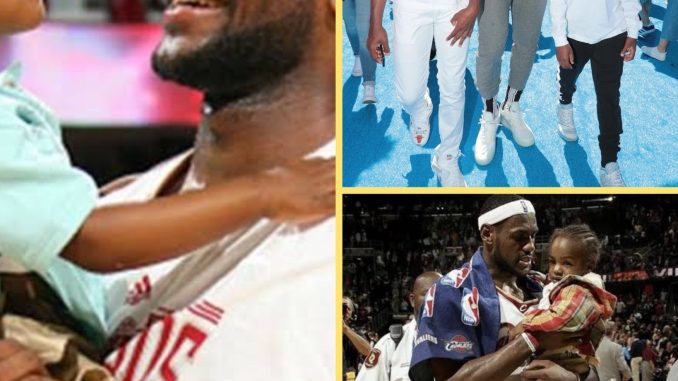
Few stories in modern sports have captured the imagination of basketball fans quite like the journey of LeBron James and his eldest son, Bronny James. What began as a proud father posting clips of his young son dribbling through youth tournaments has evolved into one of the most emotional and unprecedented family narratives the NBA has ever witnessed. For years, the basketball world watched Bronny grow from “Baby Bronny” sitting courtside during championship celebrations into a legitimate professional prospect carrying the weight of one of the most famous last names in sports history.
Now, with Bronny officially chasing his NBA dream and LeBron still competing at the highest level deep into his legendary career, the emotional father-son connection between the two has become bigger than basketball itself. It has become a story about legacy, sacrifice, pressure, family, and the enduring bond between a father and his son under the brightest spotlight imaginable.
Long before Bronny became a household name on scouting reports and social media timelines, fans first saw him as a toddler during LeBron’s early years with the Cleveland Cavaliers. Cameras frequently caught the young boy running around locker rooms, celebrating with confetti falling from championship rafters, or sitting in his father’s lap during postgame interviews. At the time, few could have imagined that the child in those viral moments would eventually grow into a player talented enough to seriously pursue the same professional path as his father.
LeBron, however, always believed.
Throughout his career, the four-time NBA champion repeatedly spoke about his dream of sharing the court with Bronny one day. It was never framed as a publicity stunt or a Hollywood fantasy. To LeBron, it represented the ultimate reward for decades of sacrifice. He had spent most of his adult life under relentless pressure, carrying franchises, battling criticism, and living with expectations few athletes in sports history have ever faced. Yet through it all, one constant source of joy remained watching his children grow.
As Bronny’s basketball abilities developed, so did public fascination. Videos of his AAU games exploded online. Fans analyzed his shooting mechanics, defensive instincts, athleticism, and composure. Every dunk, every highlight, and every mistake instantly became national conversation material. Unlike most teenage prospects, Bronny was never allowed the luxury of anonymity. He entered gyms with cameras already waiting.
That pressure could have crushed many young athletes.
Instead, Bronny handled it with remarkable calm.
Coaches, teammates, and scouts consistently praised his maturity and team-first mentality. Rather than trying to mirror his father’s dominant, physically overwhelming style, Bronny carved out his own identity as a smart guard capable of defending multiple positions, making quick reads, and impacting games without demanding constant attention. Those close to him often noted how hard he worked to avoid shortcuts despite his family’s fame and resources.
LeBron’s parenting style played a major role in that development.
While many superstar athletes become overly controlling with their children’s careers, LeBron appeared determined to give Bronny room to discover himself. Publicly, he celebrated his son’s successes like any proud father would, but he also stressed the importance of accountability and growth. There were moments when he critiqued Bronny’s performances with honesty, always emphasizing basketball IQ, effort, and professionalism over flashy numbers.
Their relationship became one of the most relatable aspects of LeBron’s larger-than-life image. Fans saw not only one of the greatest athletes ever, but also a father nervously watching games from the sidelines, reacting emotionally to his son’s performances, and speaking with genuine pride about family milestones.
The emotional depth of their journey became even more apparent during one of the most frightening moments of Bronny’s life.
When Bronny suffered cardiac arrest during a workout at the University of Southern California in 2023, the basketball world collectively held its breath. News of the incident sent shockwaves across sports, transcending team loyalties and rivalries. Suddenly, the story was no longer about draft projections or basketball potential. It was about the health and future of a young man whose life had been unfolding in public view since childhood.
For LeBron and the James family, it was an unimaginable scare.
Though LeBron has faced immense pressure throughout his career — from NBA Finals elimination games to Olympic gold-medal moments — nothing compared to the emotional weight of seeing his son hospitalized. Friends and insiders later described the experience as deeply sobering for the family. Basketball immediately became secondary.
The support Bronny received during his recovery demonstrated how beloved the James family had become across the sports world. Players, coaches, celebrities, and fans flooded social media with prayers and encouragement. Rivals paused competition to show solidarity. It was one of the rare moments in modern sports where the noise surrounding fame disappeared and humanity took center stage.
Bronny’s eventual recovery and return to basketball only strengthened the emotional significance of his story.
Every step back onto the court felt symbolic. Every game carried deeper meaning. For LeBron, watching his son compete again became less about NBA dreams and more about gratitude. Interviews during that period reflected a noticeably emotional side of LeBron, who repeatedly emphasized how thankful he was simply to see Bronny healthy and smiling again.
Yet even after such a life-altering event, Bronny continued pursuing his basketball aspirations with determination.
That resilience earned widespread admiration around the league.
Executives and scouts evaluating Bronny often acknowledged that his path would never be normal. Fair or not, he would always face comparisons to his father. But many also pointed out that his poise under overwhelming scrutiny revealed uncommon mental strength. Few young athletes have ever entered basketball environments carrying the expectations Bronny inherited.
The idea of LeBron and Bronny potentially sharing an NBA court transformed from distant fantasy into realistic possibility as Bronny’s development continued. Fans began calculating timelines, contract situations, and draft scenarios. Arenas buzzed whenever LeBron referenced the dream publicly.
For LeBron, the possibility clearly carried enormous emotional meaning.
Over the years, he often described fatherhood as his greatest accomplishment. Championships mattered. MVP awards mattered. Records mattered. But his pride when speaking about his children always sounded different. Softer. More personal. More vulnerable.
That emotional connection resonated deeply because fans had essentially watched the James family grow up in real time.
Unlike many global superstars who shield their families from public attention, LeBron frequently shared glimpses of family life. From youth basketball tournaments to graduation celebrations, supporters witnessed the milestones. Bronny’s rise therefore felt strangely personal to millions of fans who had spent nearly two decades following LeBron’s career.
The storyline also challenged traditional ideas about generational greatness in professional sports.
Historically, children of legends often struggle beneath impossible expectations. The burden of living up to iconic parents can derail promising careers before they truly begin. Bronny, however, embraced the challenge with admirable composure. Rather than resisting his father’s influence, he acknowledged the privilege while working to establish his own identity.
LeBron consistently reinforced that message.
He frequently reminded audiences that Bronny did not need to become another version of him to succeed. He praised his son’s instincts, defensive discipline, and feel for the game rather than obsessing over scoring totals or highlight plays. In many ways, LeBron seemed intent on protecting Bronny from the unrealistic comparisons that inevitably follow the son of a basketball icon.
That support became especially important in today’s social-media era, where young athletes face unprecedented scrutiny.
Every Bronny performance instantly generates reactions ranging from glowing praise to harsh criticism. Viral clips spread within minutes. Debates erupt constantly about whether his opportunities stem from talent, fame, or both. Through it all, LeBron has remained publicly supportive, often celebrating Bronny’s growth while encouraging fans to remember that he is still a young player developing his game.
The broader basketball community has increasingly rallied around that perspective as well.
Current and former NBA players understand the pressure attached to carrying a famous surname. Many have openly defended Bronny against unfair criticism, emphasizing the difficulty of growing up under nonstop public evaluation. Coaches who interacted with Bronny frequently describe him as humble, coachable, and intensely competitive — qualities that helped earn respect independent of his father’s reputation.
At the same time, the emotional appeal of the story continues to captivate fans because it reflects universal themes beyond basketball.
Parents everywhere understand the pride of watching children pursue dreams. Children everywhere understand the challenge of stepping out of a parent’s shadow. The James family’s experience may unfold on a global stage, but the emotions attached to it remain deeply relatable.
LeBron’s longevity has made the possibility of sharing the NBA with Bronny even more extraordinary.
In an era where most superstars decline sharply in their mid-30s, LeBron extended his career long enough to realistically overlap with his son’s professional timeline. That alone represents one of the most remarkable feats in sports history. Competing at an elite level across multiple generations of players already cemented his legacy. Potentially sharing the floor with Bronny would elevate the story into something almost mythical.
Around the league, anticipation continues to build.
Executives understand the commercial and emotional impact of such a moment. Television ratings would soar. Jerseys would fly off shelves. Arenas would be packed. Yet beyond the business implications lies something far more powerful: the sight of a father and son achieving a dream together at the highest level of professional basketball.
Moments like that transcend statistics.
They become cultural memories.
For younger fans, Bronny represents the continuation of an era shaped by LeBron’s dominance. For older fans, the story evokes nostalgia, reminding them how long LeBron has remained central to basketball culture. Many still remember watching a teenage LeBron enter the NBA amid impossible expectations in 2003. Now, more than two decades later, they are watching his son begin a journey of his own.
The symbolism is impossible to ignore.
LeBron entered the league as a teenager carrying hopes from his hometown of Akron, Ohio. He grew into one of the most influential athletes in sports history while constantly navigating immense pressure. Through all the championships, controversies, triumphs, and failures, family remained central to his identity. Seeing Bronny follow a similar path brings the story full circle in emotional fashion.
Even opponents acknowledge the uniqueness of the moment.
Players around the NBA frequently speak with admiration about LeBron’s dedication both as an athlete and as a father. Many note how rare it is for someone operating under such enormous professional demands to remain deeply involved in family life. LeBron’s visible support for Bronny has helped humanize one of the most scrutinized athletes of all time.
For Bronny, meanwhile, the journey remains just beginning.
He still faces the challenge every young player encounters: proving he belongs at the highest level. Development will take time. Mistakes will happen. Critics will continue debating every performance. But what has already become clear is that Bronny possesses the mental toughness required to survive basketball’s unforgiving spotlight.
That strength likely comes from years spent observing his father handle pressure few athletes could endure.
LeBron’s career has been defined not only by greatness, but by resilience. He entered the NBA with expectations of becoming a global icon and somehow exceeded them. Bronny witnessed firsthand the discipline, preparation, and emotional control necessary to thrive under constant scrutiny. Those lessons may ultimately become one of the greatest gifts LeBron passes down to his son.
As the basketball world continues monitoring Bronny’s development, the emotional heartbeat of the story remains the bond between father and son.
Whether they eventually share the floor in an NBA game or not, their journey has already left a lasting imprint on sports culture. Fans watched Bronny grow from a smiling child celebrating his father’s championships into a young man chasing a dream of his own. They watched LeBron evolve from teenage phenom into proud father. And through every chapter, the connection between them remained unmistakable.
In an industry often dominated by transactions, controversy, and relentless debate, the story of LeBron and Bronny offers something refreshingly human.
It is a story about legacy, but not just basketball legacy.
It is about a father hoping to see his son succeed.
It is about a son carrying both privilege and pressure with grace.
And above all, it is about family — the kind of emotional foundation that continues to resonate far beyond the hardwood floors of the NBA.
Be the first to comment