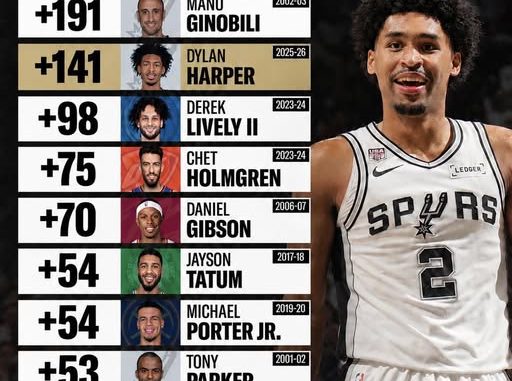
In a season defined by rising young talent and an increasingly crowded pipeline of future NBA stars, few names have generated as much quiet momentum as Dylan Harper. The five-star guard has not needed loud declarations or viral theatrics to announce his arrival. Instead, his game has done the talking—measured, confident, and increasingly impossible to ignore. From the opening stretch of the season, Harper has steadily transformed from a highly touted prospect into a focal point of attention every time he steps on the floor, and the message is now unmistakable: he has officially made his presence felt.
What separates Harper from many of his peers is not just production, but control. At a time when young guards often lean into speed without structure, Harper plays with a deliberate pace that bends defenses rather than rushing them. He operates like a player who understands not only where the game is, but where it is going. For Rutgers Scarlet Knights, that maturity has translated into a stabilizing force in high-pressure possessions, where turnovers typically spike and decision-making usually wavers. Harper, however, has shown an ability to slow the chaos, survey the floor, and consistently make the right read.
That poise has been most evident in half-court settings, where his combination of size, ball-handling, and vision allows him to dictate matchups. Defenders are frequently forced into uncomfortable choices—step up too high, and Harper slips past them with a smooth first step; give him space, and he punishes them with a mid-range pull-up that looks effortless in execution. It is this versatility that has made him one of the most closely monitored young guards in the country. Even when his scoring output fluctuates, his impact rarely does.
NBA scouts have taken notice of that steadiness. In conversations around draft boards, Harper’s name is increasingly being mentioned not as a long-term project, but as a potential foundational piece. Evaluators are particularly intrigued by his frame and the way he uses it. At 6-foot-6 with strong positional instincts, he already possesses the physical tools of an NBA guard who can defend multiple backcourt spots. But what stands out more is how he uses that size offensively—shielding defenders on drives, absorbing contact without losing balance, and finishing through traffic with composure that belies his age.
There is also a growing appreciation for his basketball IQ. Harper does not force highlight plays; instead, he builds possessions. He recognizes defensive rotations before they fully develop, manipulates help defenders with subtle hesitations, and consistently keeps his dribble alive long enough to uncover better options. It is the type of processing speed that tends to separate good prospects from franchise-caliber ones. Coaches at Rutgers have repeatedly emphasized his willingness to learn and adapt, noting that his film study habits are already well beyond what is typical for his stage of development.
Still, what has truly elevated Harper’s profile recently is his ability to take over stretches of games without dominating the ball for extended periods. There are moments when he shifts from facilitator to aggressor almost seamlessly, stringing together possessions where he either scores or creates high-quality looks for teammates. That balance has made him particularly difficult to game plan for. Opponents cannot simply load up on him as a scorer, nor can they ignore him as a playmaker. He occupies both roles with equal comfort.
In transition, Harper is even more dangerous. Once he secures a rebound or intercepts a pass, he immediately pushes the tempo with controlled aggression. Unlike many young guards who rely purely on speed in the open floor, he changes gears with intention, often freezing defenders before accelerating past them. That ability to manipulate space in transition has led to a growing number of “silent highlight” plays—moments that may not always trend on social media but consistently shift momentum in games.
Defensively, Harper continues to show encouraging signs of becoming a two-way presence. While still refining consistency off the ball, his on-ball defense has been notably disruptive. He uses his length to contest passing lanes, recovers well after helping in the paint, and rarely loses containment once he is locked in. For NBA teams projecting his long-term value, this defensive foundation is crucial. Guards who can defend without being hidden in rotations are increasingly rare, and Harper’s trajectory suggests he could develop into exactly that type of asset.
Perhaps the most intriguing aspect of Harper’s emergence is how natural it feels. There is no sense of forced acceleration in his development. Each game seems to add a new layer rather than overhaul his identity. One night it may be improved three-point confidence; another, it may be sharper pick-and-roll reads or more assertive post mismatches against smaller guards. The accumulation of these incremental improvements is what has fueled the broader consensus that he is trending in the right direction at the right time.
Around the Rutgers program, there is a growing understanding that Harper’s presence changes how opponents prepare. Defensive schemes increasingly revolve around limiting his touches, which in turn opens opportunities for teammates who benefit from the attention he draws. Even when he is not the leading scorer, his gravity influences spacing and shot quality across the floor. That type of indirect impact is often what separates standout college players from true NBA prospects.
Comparisons, as always, have begun to surface, though they are treated cautiously within scouting circles. Some see elements of tall, poised lead guards who thrive in pick-and-roll systems, while others point to his composure under pressure as reminiscent of players who ultimately become long-term floor generals in the league. What is consistent across evaluations, however, is the belief that Harper’s game is built for scalability. He does not rely on athleticism alone, nor does he depend on system-specific advantages. His skill set translates.
As the spotlight intensifies, so does the scrutiny. Opposing teams have begun to throw different coverages at him—traps at half court, switches designed to test his patience, and physical defenders aimed at disrupting his rhythm. Yet even in those moments, Harper has largely maintained his composure. He does not appear rushed by pressure defenses; instead, he often uses them as opportunities to create advantages elsewhere on the floor. That calm response to escalating attention is part of why his stock continues to rise.
There is also an emotional steadiness to his game that coaches value. Harper rarely displays visible frustration after mistakes, and he tends to respond to setbacks with immediate corrective action rather than lingering frustration. In a competitive environment where momentum swings can define entire games, that mental resilience is becoming just as important as his physical tools.
As the season progresses, the narrative around Harper is shifting from potential to inevitability. He is no longer being discussed solely as a promising freshman or long-term project, but as a player actively shaping the trajectory of his program and positioning himself firmly within the upper tier of draft conversations. Scouts are not just watching what he does—they are tracking how consistently he does it against increasingly targeted defensive schemes.
For Rutgers, his emergence has redefined expectations. Games that once hinged on collective execution now often tilt based on Harper’s stretches of control. And while the team continues to develop around him, it is clear that he has become the centerpiece of both present competitiveness and future projection.
In the broader landscape of college basketball, where standout freshmen often flash brilliance before fading under pressure, Harper’s consistency stands out. There is a growing sense that what fans are witnessing is not a temporary surge, but the early stages of a player who understands exactly how to impose his will at higher levels of competition.
The season is far from over, and challenges will inevitably intensify. But if the current trajectory holds, Dylan Harper will not simply be remembered for making his presence felt in isolated moments. He is building toward something more lasting—a campaign that signals the arrival of a guard whose impact extends beyond highlights, beyond statistics, and into the deeper framework of winning basketball.
Be the first to comment