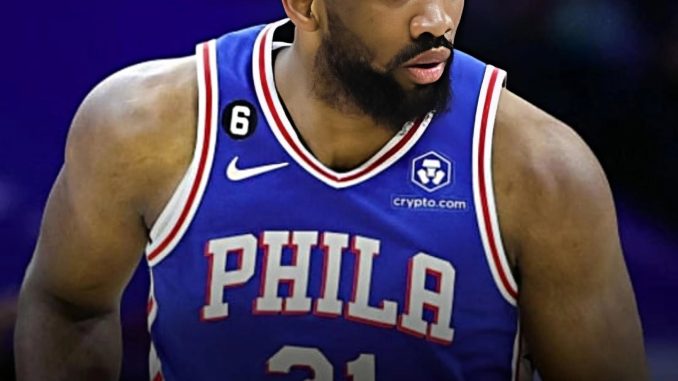
In what is already shaping up to be one of the most explosive early whispers of the NBA trade cycle, the Dallas Mavericks have emerged as a reported suitor in a potential blockbuster pursuit of Philadelphia 76ers superstar Joel Embiid, according to @FortyEightMins. While still firmly in the realm of speculation, the mere mention of a franchise-altering name like Embiid attached to Dallas has sent ripple effects through league circles, front-office discussions, and fan bases that are all too familiar with how quickly “rumors” can evolve into seismic reality in today’s NBA.
For now, there are no formal trade frameworks, no confirmed negotiations, and no publicly acknowledged discussions between the Mavericks and the Philadelphia 76ers. But the idea alone speaks volumes about where Dallas sees itself—and where it may believe it still needs to go. After years of oscillating between contention and retooling, the Mavericks’ reported interest in a player of Embiid’s caliber signals a franchise that is not interested in incremental upgrades. Instead, it suggests a willingness to chase a full-scale transformation at the very top of the roster hierarchy.
At the center of the speculation is Embiid himself, the former MVP and perennial All-NBA force whose dominance on both ends of the floor has made him one of the most impactful big men of his generation. When healthy, Embiid remains a matchup nightmare: a 7-footer with guard-like footwork, a lethal midrange game, elite foul drawing ability, and defensive instincts that anchor entire systems. He is not simply a star; he is a system in himself, one capable of shifting playoff ceilings the moment he steps on the court.
That is precisely why his name continues to surface in trade rumors despite his status as the centerpiece of Philadelphia’s franchise identity. Around the league, executives have long acknowledged the paradox of Embiid’s value: there are few players more dominant, and yet few whose availability is more complicated. His injury history, playoff availability concerns, and long-term workload management all factor into any theoretical trade discussion. And still, when a player is this good, teams at the top of the standings cannot help but imagine what it would look like to build around him—or pair him with another superstar.
For the Mavericks, that “what if” becomes even more intriguing when considering their current competitive timeline. Dallas has positioned itself as a win-now organization, built around a core that has already demonstrated postseason resilience and offensive firepower. Their identity has leaned heavily on perimeter creation, half-court shot-making, and late-game execution. But in the modern Western Conference arms race, where size, versatility, and two-way dominance increasingly define championship formulas, the allure of adding a player like Embiid is obvious.
It is not difficult to see the basketball logic that would make Dallas even entertain such a pursuit. Pairing Embiid with an elite perimeter creator would immediately produce one of the most difficult pick-and-roll combinations in the NBA. Defensively, Embiid would provide rim protection that could fundamentally reshape Dallas’ identity on that end of the floor, allowing guards to pressure more aggressively knowing an elite anchor is patrolling the paint behind them. Offensively, his gravity in the post and short midrange would collapse defenses in ways that open up clean perimeter looks at a volume the Mavericks have often had to manufacture through precision rather than pressure.
Yet, as with any Embiid trade conversation, the questions come as fast as the excitement.
The first and most immediate hurdle is cost. Any deal involving a player of Embiid’s stature would almost certainly require a historic package—multiple rotation players, young talent, and a collection of premium draft assets capable of reshaping a franchise’s future. Dallas, like every contender, must weigh the reality that acquiring a superstar of Embiid’s level could mean stripping down much of the supporting structure that has made them competitive in the first place.
The second is durability. Embiid’s brilliance has never been in question, but his availability has consistently shaped how teams evaluate his long-term value. A franchise trading for him would not only be betting on MVP-level production, but also on a medical and load-management reality that demands careful planning across an 82-game season and a deep playoff run. For a Mavericks team with championship ambitions, the calculus becomes a delicate balance between elevating their ceiling and potentially narrowing their margin for error.
The third, and perhaps most complex factor, is what such a move would mean for the identity of Dallas itself. The Mavericks have spent years building around a perimeter-first philosophy, prioritizing shot creation, spacing, and offensive versatility. Adding Embiid would not simply be an addition—it would be a redefinition. It would require structural adjustments on offense, defensive rotations designed around a dominant interior presence, and a recalibration of how the team closes games.
Still, in the NBA’s modern era, championships are increasingly shaped by bold consolidation rather than slow accumulation. Recent league history is filled with examples of franchises taking massive swings for established superstars in pursuit of immediate contention windows. Dallas, according to this emerging report, may be signaling that it is ready to enter that tier of aggressiveness.
League insiders have also pointed to a broader context that makes rumors like this more plausible. Across the NBA, there is a growing sense that teams are more willing than ever to explore the market for franchise players if internal trajectories do not align perfectly with championship expectations. That environment naturally fuels speculation around players like Embiid, whose combination of dominance and complexity makes him both untouchable in theory and perpetually discussed in practice.
From Philadelphia’s perspective, there is also the question of direction. The 76ers remain committed on paper to competing in the Eastern Conference, but the pressure of postseason expectations has lingered for years. Any legitimate inquiry from a team like Dallas would force difficult internal conversations about long-term sustainability versus short-term contention. Even entertaining such a scenario would require a return package so significant that it would likely reshape the 76ers’ roster structure for years to come.
For now, however, there is no indication that talks have progressed beyond exploratory interest. Sources have not confirmed any formal framework, and Dallas has not publicly signaled any intent to pivot away from its current roster core. But in the NBA, where even the earliest whispers can escalate into full-scale negotiations within days, the importance of “interest” should never be underestimated.
Fans in Dallas will remember that franchise-altering moves are not foreign to the organization’s history. The Mavericks have never been shy about chasing star power when the opportunity aligns with their competitive window. What makes this rumor particularly striking is the scale of the player involved. Joel Embiid is not a complementary star or secondary piece. He is a franchise centerpiece, an MVP-level anchor whose presence immediately changes the identity of any team fortunate enough to acquire him.
Around the league, the reaction to the report has been predictably split. Some executives view it as routine offseason noise, the type of speculative chatter that surrounds elite players every year. Others see it as part of a larger pattern—an indication that contenders are preparing for an increasingly aggressive market where even the most established stars are not immune to trade speculation.
What remains clear is that the idea of Embiid in Dallas, even at the rumor stage, forces the imagination into overdrive. It raises questions about lineup construction, playoff ceilings, and the shifting balance of power in a Western Conference that already demands maximum firepower to survive. It also underscores the reality that in today’s NBA, no star is ever truly removed from the conversation.
Whether this report develops into something tangible or fades into the background of offseason noise will depend on factors that are still unfolding behind closed doors. But for now, the mere suggestion that the Dallas Mavericks are among the teams interested in Joel Embiid is enough to reshape the early narrative of the trade season.
And in a league defined by sudden shifts and unexpected alliances, sometimes the first whisper is all it takes to change everything.
Be the first to comment