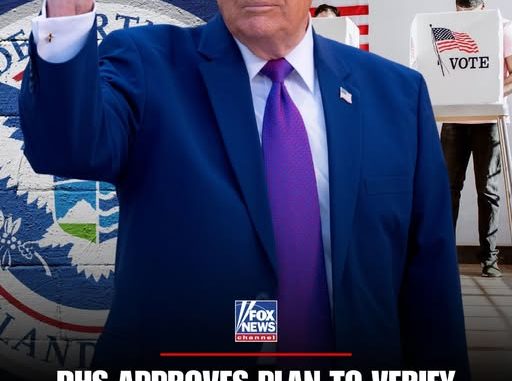
The Department of Homeland Security has moved to greenlight a sweeping new voter verification program that expands citizenship checks and increases federal oversight of mail-in ballot processes, marking one of the most significant federal interventions into election administration in recent years. The initiative, framed by officials as a modernization and security upgrade for U.S. election infrastructure, arrives amid renewed political debate over election integrity and intensifying support from allies of President Donald J. Trump, who has long made voting system security a central pillar of his political messaging.
According to the announcement tied to the rollout, the program is designed to strengthen verification protocols at multiple stages of voter registration and ballot handling. At its core, it seeks to create a more uniform federal framework for confirming citizenship status during registration processes, while also introducing enhanced auditing mechanisms for absentee and mail-in ballots. Officials within the Department of Homeland Security argue the system is intended to reduce administrative inconsistencies across states, many of which currently operate under varying standards for voter identification and ballot verification.
The move immediately injected new energy into a debate that has remained one of the most polarizing in American politics. Supporters of the initiative, including several prominent figures aligned with Trump’s election integrity platform, argue that the program represents a necessary step toward restoring public confidence in electoral outcomes. They claim that inconsistencies in voter roll maintenance and mail-in ballot procedures have contributed to skepticism about fairness and transparency, and that federal involvement is now required to ensure uniform standards.
Critics, however, have raised concerns about the potential for expanded federal oversight to encroach on state authority, which has historically governed election administration in the United States. Voting rights advocates warn that increased citizenship verification requirements could inadvertently create barriers for eligible voters, particularly among naturalized citizens and communities that have historically faced documentation challenges. They also caution that heightened scrutiny of mail-in ballots could slow down processing times and introduce logistical complications during peak election cycles.
Within political circles, the timing of the announcement has become a central talking point. The expansion of the voter verification program arrives at a moment when election integrity remains a defining issue for Republican leaders and a continuing source of contention across the broader political spectrum. Allies of Trump have pointed to the initiative as a long-awaited institutional response to concerns that have been raised since previous election cycles, arguing that federal agencies are now aligning more closely with demands for stronger verification systems.
For Trump’s supporters, the program is being interpreted as validation of a long-standing argument that election infrastructure requires tighter safeguards. They point to the integration of citizenship verification as a key policy shift that could reshape how voter rolls are maintained and updated. In their view, the DHS framework represents a structural overhaul that could reduce discrepancies and improve confidence in close electoral outcomes, particularly in battleground states where margins often determine control of key offices.
Inside the Department of Homeland Security, officials have emphasized that the program is not intended to restrict participation but rather to standardize verification processes across jurisdictions. They describe the initiative as a technological and administrative upgrade, incorporating more advanced data matching systems designed to cross-reference citizenship records with voter registration databases. The agency has also highlighted plans for enhanced coordination with state election boards to ensure compliance and minimize disruptions during implementation.
Still, the expansion of federal involvement in voter verification has reignited longstanding legal and constitutional questions. Election law experts note that while the federal government does have a role in setting broad standards for federal elections, the administration of voting systems has traditionally been left to states under the Constitution. The introduction of a more centralized verification mechanism is expected to face legal scrutiny, particularly if states challenge the scope of federal authority in implementing such requirements.
At the same time, election officials in several states are reportedly preparing for the operational implications of the program. Updating voter registration systems, integrating new verification tools, and aligning mail-in ballot procedures with federal guidelines could require significant logistical adjustments. Some officials have expressed concern about funding, training, and the timeline for implementation, especially if the program is rolled out ahead of major election cycles.
The political ramifications are already beginning to take shape. Republican leaders have largely welcomed the announcement, viewing it as a step toward addressing what they describe as vulnerabilities in the current electoral system. Democrats, meanwhile, are expected to scrutinize the program closely, particularly its impact on voter access and the potential for uneven implementation across states with differing administrative capacities.
Beyond the immediate political response, the program raises broader questions about the future of election administration in the United States. The expansion of citizenship verification and mail-in ballot oversight signals a shift toward greater federal involvement in processes that have traditionally been decentralized. Whether this shift becomes a long-term restructuring of election infrastructure or faces legal and political pushback that limits its scope remains to be seen.
Observers note that the debate surrounding the initiative is likely to intensify as implementation details become clearer. Key questions remain about how citizenship data will be verified, how errors in voter rolls will be corrected, and what safeguards will be in place to ensure eligible voters are not improperly removed or delayed. The handling of mail-in ballots, already a contentious issue in recent election cycles, is expected to remain a focal point of scrutiny as the program advances.
In Washington, the announcement has also underscored the continuing influence of election integrity politics on federal policy direction. The alignment between the DHS initiative and Trump’s longstanding messaging on voting security reflects a broader trend in which electoral administration has become a central policy battleground. Supporters of the program argue that this alignment demonstrates responsiveness to public concerns, while opponents view it as a politicization of federal agencies.
As the rollout moves forward, attention will likely turn to how the program is implemented on the ground and whether it achieves its stated goals without creating new administrative challenges. Election officials, legal experts, and political stakeholders across the spectrum are expected to monitor its impact closely, particularly as states begin adapting their systems to meet new federal requirements.
For now, the DHS decision marks a significant escalation in the national conversation over how elections are managed and secured in the United States. It places voter verification and mail-in ballot oversight at the center of policy debate heading into future election cycles, ensuring that questions of access, security, and federal authority will remain firmly in the political spotlight.
Be the first to comment