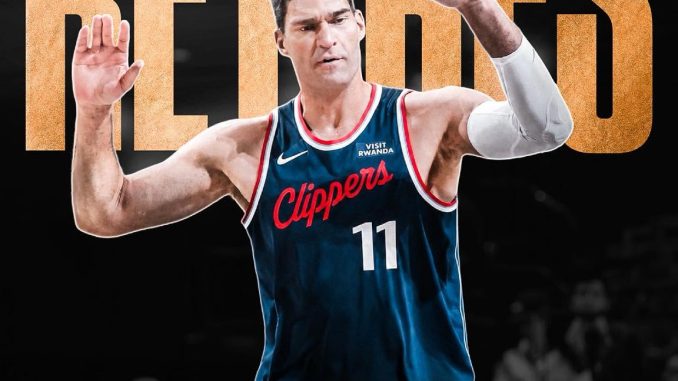
The NBA’s defensive landscape lost one of its most distinctive architects on Tuesday as Brook Lopez officially brought the curtain down on an 18-season professional career, a journey that reshaped how modern big men protect the rim, space the floor, and extend their basketball value well beyond traditional roles. In a league that has rapidly evolved through pace, spacing, and perimeter dominance, Lopez stood as a rare constant—an old-school center who adapted so thoroughly to the modern game that he became indispensable in both eras.
For Brook Lopez, retirement closes a chapter defined not only by longevity but by transformation. From a dominant post scorer in his early years to a floor-spacing, rim-protecting anchor in his prime championship run, Lopez carved out a career that refused to fit neatly into any single archetype. When he entered the league in 2008, few would have predicted that he would eventually retire as one of the most influential stretch-big pioneers of his generation and a central piece of a championship blueprint in Milwaukee.
Lopez’s journey began in New Jersey with the then-New Jersey Nets, where he quickly established himself as one of the most polished young centers in the league. A product of Stanford’s basketball program, Lopez entered the NBA with a soft touch around the rim, advanced footwork, and an unusually refined scoring feel for a traditional big man. He was not merely a role player learning the ropes—he was a foundational piece from day one, averaging strong scoring numbers early in his career and becoming the franchise’s offensive focal point during a transitional era for the organization.
As the Nets relocated to Brooklyn, Lopez remained the steady heartbeat of the franchise. He became the team’s all-time leading scorer during his tenure, a testament to both his consistency and durability in an era that saw significant roster turnover around him. Yet, for all his offensive production, his early career was often defined by one perceived limitation: range. Lopez operated primarily in the post and mid-range areas, thriving as a back-to-the-basket scorer in a league that was just beginning to pivot heavily toward three-point shooting.
That perception would eventually become the foundation of his reinvention.
The turning point in Lopez’s career came after his stint with the Los Angeles Lakers in 2017–18. While that single season in Los Angeles was statistically modest, it marked the beginning of a philosophical shift in how he approached the game. Released into free agency, Lopez made a decision that would redefine his legacy: he embraced the three-point revolution rather than resisting it. In Milwaukee, that transformation would reach its full expression.
Signing with the Bucks in 2018 proved to be one of the most impactful acquisitions in franchise history. What made Lopez invaluable was not just his shooting expansion to the perimeter, but the way he anchored the defense behind an aggressive, switching perimeter unit. His ability to sit in drop coverage, protect the paint, and still stretch opposing centers to the three-point line made him a tactical dream for Milwaukee’s defensive system. He was no longer just a scorer or a traditional rim protector—he became the structural spine of an elite defense.
In Milwaukee, Lopez flourished alongside Giannis Antetokounmpo, forming a frontcourt pairing that blended chaos and containment. Giannis attacked downhill with relentless force, while Lopez served as the final line of resistance, erasing drives and deterring attacks at the rim. The synergy between the two became the foundation of one of the NBA’s most feared defensive units.
That defensive dominance reached its peak during the 2021 season, when the Bucks captured their first championship in 50 years. Lopez played a critical role throughout the playoff run, particularly in matchups that demanded interior protection and disciplined defensive positioning. While the spotlight often gravitated toward the team’s offensive explosions and Giannis’s Finals MVP performance, Lopez’s presence quietly dictated how opponents attacked Milwaukee. Every drive into the paint carried the looming presence of a 7-footer with elite timing and positioning.
The championship run cemented Lopez’s reputation as more than just a system player. He was a stabilizer, a communicator, and a veteran anchor who understood how to bend without breaking under playoff pressure. For Milwaukee, his value extended beyond box score contributions. He was the safety net that allowed the rest of the defense to play aggressively on the perimeter.
Over the course of his career, Lopez also established himself as one of the most prolific shot blockers of his generation. Finishing among the league’s all-time leaders in blocks, he combined timing, positioning, and discipline rather than relying purely on athletic explosiveness. His defensive identity was built on anticipation—meeting drivers at the apex, contesting without fouling, and consistently forcing opponents into difficult finishes.
By the time he reached the later stages of his career, Lopez had completed one of the most unusual evolutions in modern basketball. Few players transition from low-post scorer to high-volume three-point shooting center while simultaneously maintaining elite rim protection. Even fewer do so while remaining a consistent starter on championship-contending teams deep into their 30s. Lopez managed all of it with remarkable stability.
What made his transformation even more striking was how seamlessly he adapted to changing NBA expectations. In one era, he would have been considered a traditional back-to-the-basket center. In another, he became a prototype for the modern “stretch five”—a big man who spaces the floor offensively while anchoring the paint defensively. Coaches across the league studied his usage as teams increasingly searched for centers who could survive playoff matchups without being targeted on switches or pick-and-roll actions.
Beyond the numbers and tactical impact, Lopez’s career was also defined by durability and professionalism. Over 18 seasons, he maintained a reputation as a reliable presence, both on and off the court. Teammates consistently pointed to his steady demeanor and willingness to embrace whatever role was needed for team success. Whether scoring in isolation during his early years or setting screens and spacing the floor later in his career, Lopez rarely deviated from team-first execution.
His legacy also carries a unique familial dimension. Alongside his twin brother Robin Lopez, Brook helped form one of the most recognizable sibling stories in modern NBA history. While Robin carved out his own successful career as a defensive-minded center, Brook often stood out as the more offensively versatile and system-defining presence. Together, they symbolized two different interpretations of the modern big man, both effective in their own right.
As news of his retirement spread, the basketball world reflected not just on what Lopez achieved, but on what he represented. He was a bridge between eras—between the traditional post-up center and the modern floor-spacing rim protector. His career arc mirrored the NBA’s own evolution over the past two decades, making him one of the most quietly influential big men of his time.
For the Milwaukee Bucks, Lopez’s departure marks the end of an era that included a championship breakthrough and sustained defensive excellence. For the league as a whole, it signals the exit of a player whose adaptability helped define how centers are evaluated in the modern game.
Eighteen seasons later, Lopez walks away not just as a champion, a shot-blocking force, or a reinvention story, but as a blueprint. His career will be studied by coaches and young big men trying to understand how to survive—and thrive—in a league that rarely stands still. And in that sense, Brook Lopez didn’t just play through NBA history. He helped reshape it.
Be the first to comment